
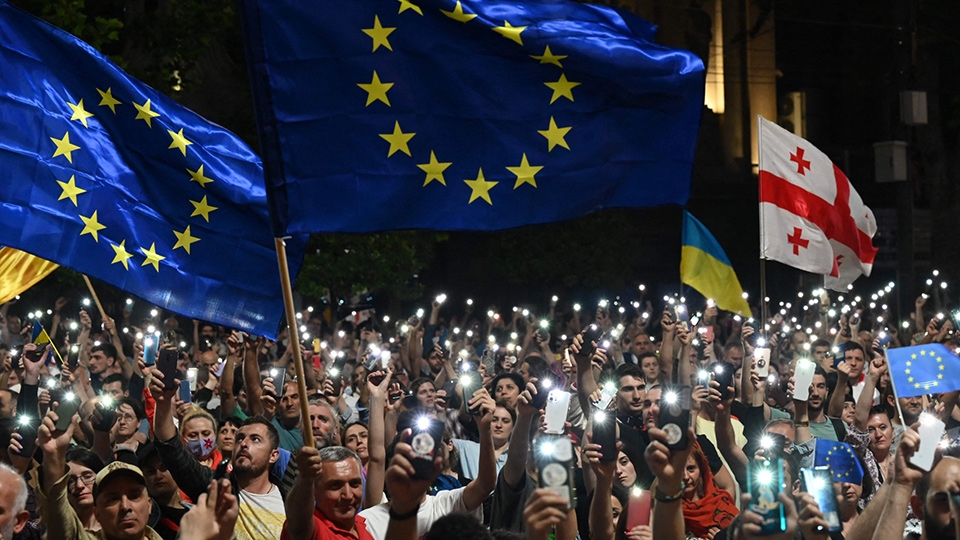

Since November 28, widespread pro-European protests have beleaguered Georgia after the government’s move to suspend negotiations for the country’s European Union (EU) accession until 2028.
Previously, Georgian Prime Minister Irakli Kobakhidze had declared his government’s intention to freeze EU accession talks until 2028. Meanwhile, Tbilisi will still fulfil its existing obligations as per the Association Agenda with the EU, but will do so on as an equal partner in its interactions with Brussels, Kobakhidze added, according to a report by Russia Today (RT).
“We are a self-respecting nation with a great history… it is absolutely unacceptable for us to consider integration into the European Union as a favor that the European Union should give us,” Kobakhidze stated, decrying Brussels for trying to use Georgia’s accession talks to “blackmail” the country and interfere in its politics.
The socially conservative Georgian Dream party recently adopted a pro-family law explicitly banning state recognition of “marriage” for same-sex couples, same-sex child adoption by homosexuals as well as gender transition treatment.
“We will continue our march towards the European Union, but we will not allow anyone to leave us in a state of constant blackmail and manipulation, which is… offensive to our country and society,” Kobakhidze elaborated.
Given Brussels’ dismal track record of bullying dissenting EU member states like Hungary into submission to its pro-war, anti-life,and anti-family agendas, it is no surprise that the government, currently led by the nationalist Georgian Dream party, voiced the aforementioned sentiments.
After all, the socially conservative Georgian Dream party hitherto tabled a bill “on family values and the protection of minors” and recently adopted a pro-family law explicitly banning state recognition of “marriage” for same-sex couples, same-sex child adoption by homosexuals as well as gender transition treatment. On top of that, the government has declared May 17 as a day of “family sanctity and respect for parents”and a public holiday to counter the pro-LGBTQ+ celebration of the “International Day against Homophobia, Transphobia, and Biphobia”. Little wonder Brussels elites consider the Georgian Dream party as a thorn in the flesh!
Therefore, when the Georgian Dream party emerged victorious in Georgia’s recent parlimentary election (with 53% of the vote), pro-EU voices both in Georgia and abroad acted like sore losers, accusing the Georgian Dream party of rigging the election with a “Russian special operation”.
For one, Georgia’s leftist pro-EU president, Salome Zourabichvili, who, like many of her bosses in Brussels, supports LGBTQ+ ideologies, slammed the conservative government as “illegitimate”, adding that the October election outcome was a “total falsification, a total stealing of your votes”.
Using rhetoric taken from the EU standard playbook (rhetoric that is so blasé that it could write itself), Zourabichvili brought the liberal West’s favorite scapegoat, Russia, into the picture. After all, according to the logic of the Brussels brahmins, whoever dissents from them is necessarily an evil Russian stooge.
Using rhetoric taken from the EU standard playbook (rhetoric that is so blasé that it could write itself), Zourabichvili brought the liberal West’s favorite scapegoat, Russia, into the picture. After all, according to the logic of the Brussels brahmins, whoever dissents from them is necessarily an evil Russian stooge.
“Recognizing these elections is the same as accepting Russia’s entry here and Georgia’s subordination to Russia,” Zourabichvili declared, in statements cited by RT.
Yet Zourabichvili could not back her allegations of election falsification with substantial proof at all. When questioned by the Prosecution Service of Georgia, Zourabichvili refused to supply evidence to back her claims.
“I don’t intend to go to the prosecutor,” Zourabichvili said.
“It’s not up to the president to provide the proof,” she argued.
“In any standard investigation, it’s the investigative body’s duty to gather proof, not the other way around. I’ve never seen an investigative authority ask a president for election-related evidence,” she added, in comments quoted by RT.
Rather than encouraging national unity, Zourabichvili even urged Georgian schools to support pro-EU protests on her X account.
“After universities, it is the turn of schools to express their solidarity with the protests, all over Georgia,” Zourabichvili penned.
In turn, the Patriarchate of the Georgian Orthodox Church condemned Zourabichvili, for her call on schools to support the protests, in light of the violent methods used by some protestors.
“Madam Salome, I hope that, after schools, you will not call on kindergartens to participate in protests,” the head of the Georgian Patriarchate’s press service, Archpriest Andria Dzhagmaidze, declared.
Any statements “aimed at inciting the involvement of schoolchildren and, in general, minors, especially [such statements] made by the country’s president, are extremely disturbing,” the Patriarchate stated, in remarks quoted by RT.
“Madam Salome, I hope that, after schools, you will not call on kindergartens to participate in protests,” the head of the Georgian Patriarchate’s press service, Archpriest Andria Dzhagmaidze, declared on Facebook.
Likewise, Western governments could not provide tangible proof to support the accusations from pro-EU voices in Georgia. Besides, a recount by the Central Election Commission of ballots from five precincts in each electoral district reinforced the initial election results, dampening accusations of election fraud. Additionally, Georgia’s Constitutional Court refused lawsuit demands from Zourabichvili and pro-Western opposition parties that called for an annulment of the recent election.
“The Constitutional Court of Georgia did not accept the lawsuits of the president and political parties regarding the recognition of the October 26 elections as unconstitutional,” the country’s top court decreed.
Undaunted, pro-EU voices have demanded new elections with international supervision. “The only negotiations we will hold with the government will be about conducting new elections with the assistance of international observers,” proclaimed MP Giorgi Vashadze. What is more, in a blatant attempt at meddling in Georgia’s domestic politics, the new foreign policy chief of the EU, Kaja Kallas, hailed the protests as legitimate and warned of “consequences” if the government tried to suppress them.
“Unlike Ukraine in 2013, Georgia is an independent state with strong institutions and, most importantly, experienced and wise people. The Maidan scenario cannot be realized in Georgia. Georgia is a sovereign state and will not allow this,” Kobakhidze said.
“It is clear that using violence against peaceful protesters is not acceptable, and the Georgian government should respect the will of the Georgian people,” Kallas stated, in spite of some protesters evidently acting in violent ways.
Moreover, demonstrations attained a heightened frenzy over the past week, with pro-EU protesters throwing Molotov cocktails at riot police, setting off fireworks, and confronting the authorities. Talk about total mayhem!
In response, Kobakhidze has decried the pro-EU protests as an “attack on the constitutional order in the country”, blaming the liberal West for trying to stage a coup just like the US-backed Maidan revolution in Ukraine in 2014. However, Kobakhidze declared that an outcome similar to the Maidan revolution “cannot be realized in Georgia.”
“Unlike Ukraine in 2013, Georgia is an independent state with strong institutions and, most importantly, experienced and wise people. The Maidan scenario cannot be realized in Georgia. Georgia is a sovereign state and will not allow this,” Kobakhidze said.
As per the premier, EU politicians and their agendas have given rise to the present violent chaos in Georgia.
“The main responsibility for yesterday’s violent rally lies with the relevant European politicians and bureaucrats, with local agents, the fifth column, which is represented by four opposition parties,” Kobakhidze articulated, based on a report by RT.
Similarly, Kremlin spokesman Dmitry Peskov asserted that the ongoing protests in Georgia have “all the signs of an attempt to carry out an ‘orange revolution’”, elaborating that “the most direct parallel that can be drawn is the events of the Maidan in Ukraine,” alluding to the Western-backed 2014 coup in Kyiv that deposed Ukraine’s democratically-elected president.
For several years, the United States, often followed by its European allies, has taken the liberty of intervening in the electoral processes of various countries under the pretext of ensuring “democracy.” However, this posture of self-proclaimed guardians of democracy becomes inconsistent if it only applies to elections that serve their interests.
Also, Sputnik News reported Bidzina Ivanishvili, the founder and honorary chairman of the ruling Georgian Dream party, as saying that a high-ranking Western official had suggested that Georgia declare war against Russia before switching to guerrilla warfare with the West’s support.
Sputnik News further quoted Russian Foreign Minister Sergey Lavrov as saying that there were no reasons to doubt Georgian politicians’ claims that the West was pressuring Tbilisi into a war with Russia.
“I see no reason not to believe them. They cite dialogues with Western countries that directly instructed them to take military action against Russia. I have no reason not to trust them,” Lavrov stated.
To boot, the executive secretary of the ruling Georgian Dream party, Mamuka Mdinaradze, has stated that up to a third of those identified at recent demonstrations in Tbilisi have turned out to be foreign nationals.
Mdinaradze claimed that “30% of the people who were identified at the protests in Tbilisi are citizens of other countries.”
“What’s going on? Someone has to explain this strangeness. Why are these foreign citizens so upset after our decision?” the politician asked, highlighting that there were people from the US, the UK and the Netherlands among the detained demonstrators.
Strikingly, Swedish climate activist Greta Thunberg joined the protests in Georgia.
“This is an outrageous and authoritarian development… I have great respect for the people who again and again fill the streets and use the right to demonstrate to express their dissatisfaction with the current situation, despite the oppression,” Thunberg stated, in allusion to current developments in Georgia.
Commenting on the protests in an op-ed for RT, Egountchi Behanzin, founding president of the international African Black Defense League, spokesperson for the Pan-African Brothers, political analyst, and pan-African activist, had this to say:
“This situation once again raises the crucial issue of foreign powers intervening in the internal affairs of sovereign nations. For several years, the United States, often followed by its European allies, has taken the liberty of intervening in the electoral processes of various countries under the pretext of ensuring “democracy.” However, this posture of self-proclaimed guardians of democracy becomes inconsistent if it only applies to elections that serve their interests. In Georgia, the people voted and chose to place their trust in Georgian Dream, a local party which seeks to build pragmatic relations with Russia and managed to gather broad popular support. The Georgian Dream party secured 54% of the votes. International observers present noted that the electoral process adhered to democratic standards, despite unfounded accusations made by some external actors. So why, in this context, do Washington and Brussels suddenly feel the need to question the results? It seems that this is less about fraud or malfunctions and more about disappointment over the defeat of their pro-Western Georgian political allies. In short, for some Western powers, when they do not win an election, they adopt a strategy aimed at delegitimizing the results through unfounded doubts and calls for investigations.”