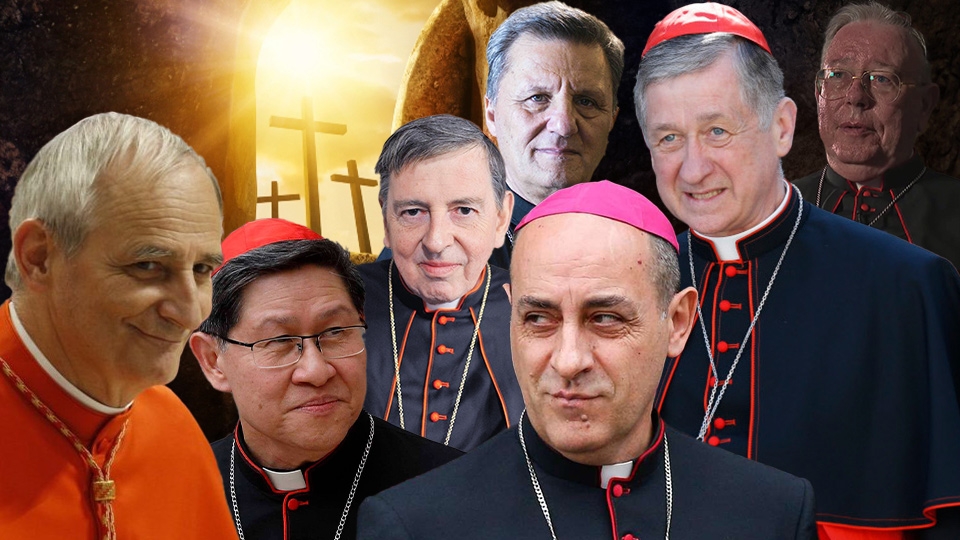

The majority of these heterodox Cardinals may openly profess certain truths of the Faith, but they routinely deny the logical consequences of those truths. So we have Cardinals such as “Tucho” Fernández, Cupich, McElroy, Tagle, Koch, Zuppi, Grech, and Hollerich (among many others) tell us that there is no need for non-Catholics to convert, and even less need for Catholics to follow Our Lord’s commandments.
During Holy Week and Eastertide the Church offers us countless reminders of God’s desire that all souls should believe and practice the Catholic Faith. From the establishment of the priesthood on Holy Thursday to Jesus’s promise to the Good Thief on Good Friday, the Church gives us so many lessons about Jesus’s hatred of sin and His mercy towards repentant sinners. Then, among so many other splendors of the Easter Vigil, the Church has us renew our Baptismal promises:
“Therefore, dearly beloved brethren, the Lenten observance now completed, let us renew the promises of baptism by which formerly we renounced Satan and his works, and the world likewise, the enemy of God; and by which we promised to serve God faithfully in the holy Catholic Church . . .”
Our Lord’s triumph at Easter is our victory as well, so long as we remain faithful to the graces that He has won for us and provides through His Church.
On Easter Monday, we hear the voice of St. Peter, our first pope, proclaiming why all souls should follow Our Lord through His Church:
“In those days, Peter, standing in the midst of the people, said: Men brethren, you know the word which hath been published through all Judea: for it began from Galilee, after the baptism which John preached, Jesus of Nazareth: how God anointed Him with the Holy Ghost, and with power, Who went about doing good, and healing all that were oppressed by the devil, for God was with Him. And we are witnesses of all things that He did in the land of the Jews and in Jerusalem, Whom they killed, hanging Him upon a tree. Him God raised up the third day, and gave Him to be made manifest; Not to all the people, but to witnesses preordained by God, even to us, who did eat and drink with Him after He arose again from the dead; And He commanded us to preach to the people, and to testify that it is He who was appointed by God, to be judge of the living and of the dead. To Him all the prophets give testimony, that by His name all receive remission of sins, who believe in Him.” (Acts 10:37-43)
For those who believe these things, it is obvious that we must cooperate with God’s grace to faithfully follow what Jesus taught — in practice, this means we must be good Catholics.
By the time many of us heard these words of St. Peter on Easter Monday, we had already learned that Francis had died earlier in the day. Thus, in a few weeks, a successor to St. Peter will be selected by the College of Cardinals, many members of which no longer appear to believe the words of St. Peter.
The majority of these heterodox Cardinals may openly profess certain truths of the Faith, but they routinely deny the logical consequences of those truths. So we have Cardinals such as “Tucho” Fernández, Cupich, McElroy, Tagle, Koch, Zuppi, Grech, and Hollerich (among many others) tell us that there is no need for non-Catholics to convert, and even less need for Catholics to follow Our Lord’s commandments. Somehow — through malice or insanity — they have gotten comfortable with upholding some truths of the Catholic Faith while thoroughly rejecting the necessary consequences of those truths.
Led by Satan, the enemies of the Mystical Body of Christ employed certain weapons during Vatican II, which continue to have a devastating effect today.
There are, of course, many contributing factors to this disastrous situation in which Cardinals no longer understand the Catholic Faith, including the Modernism that wrecked minds prior to the Council and continues to do so today. At root, though, the various contributing factors generally involve sophistry. Modernism, for example, is not an end in itself but rather an anti-intellectual weapon wielded by the Church’s enemies to dislodge Catholics from the truths we have re-learned during Lent and Easter.
Led by Satan, these enemies of the Mystical Body of Christ employed certain weapons during Vatican II, which continue to have a devastating effect today. One of the best explanations of these weapons comes from Professor Oscar Cullmann, a Protestant observer at the Council who worked closely with Yves Congar and Augustin Bea:
“[I]t could not be the goal of the Council to change as such something in the wording of the early dogmas. Strictly speaking, the obvious knowledge of this fact should show the limit which is set for every Catholic reform, in contrast to Protestant reforms. . . Now, however, the significant thing at this Council is exactly that it has succeeded to renew Catholicism, as has hardly ever been the case in its long history; it has even succeeded in moderating the rigidity of the dogmas without altering the smallest things in wording. This has become possible in two ways. On the one hand, an opposite thesis, so to say, in which the will for renewal comes to expression has been placed alongside the unaltered text of the old dogma. On the other hand, a shifting inside of the kernel of the established Catholic teaching which is established by the dogma is undertaken due to the principle of renewal in such a way that an order of preference is set forth among the truths which are expressed in the dogmas, and greater meaning is assigned to one than to another.” (Cullmann, Vatican Council II: The New Direction, p. 68)
This passage is worth studying in detail because it truly reveals some of the most insidious tactics of the Council’s anti-Catholic architects, such as Bea. Tragically, the conservative Council Fathers actually contributed to the first tactic to some extent by accepting liberal ideas in the Council documents so long as they were moderated by an accompanying orthodox statement. As we know from painful experience, the anti-Catholic architects of the Council were ultimately responsible for interpreting and implementing the Council, and they invariably emphasized the heterodox statements while ignoring the orthodox counterpoints promoted by faithful Council Fathers like Archbishop Marcel Lefebvre.
While Bea’s reinterpretation of Mystici Corporis did not appear anywhere in Vatican II’s documents, the fruits of the thought process were indispensable both for the advancement of various ecumenical ideas found throughout the Council’s documents.
For an illustration of the second tactic, we can look to the way in which Cardinal Bea attempted to “solve” the problem caused by paragraph 22 of Pope Pius XII’s 1943 encyclical on the Mystical Body of Christ, Mystici Corporis Christi, which reads as follows:
“Actually only those are to be included as members of the Church who have been baptized and profess the true faith, and who have not been so unfortunate as to separate themselves from the unity of the Body, or been excluded by legitimate authority for grave faults committed. ‘For in one spirit’ says the Apostle, ‘were we all baptized into one Body, whether Jews or Gentiles, whether bond or free.’ As therefore in the true Christian community there is only one Body, one Spirit, one Lord, and one Baptism, so there can be only one faith. And therefore, if a man refuse to hear the Church, let him be considered – so the Lord commands – as a heathen and a publican. It follows that those who are divided in faith or government cannot be living in the unity of such a Body, nor can they be living the life of its one Divine Spirit.”
This clearly stands in the way of the false ecumenism that animated Vatican II and the revolution that continues today. As Fr. Stjepan Schmidt recounted in his biography of Bea, Augustin Bea: The Cardinal of Unity, Bea specifically wanted to change the assertion that limited Church-membership to Catholics:
“An important point on which Bea hoped the Council would provide clarification was that of the church-membership of Christians separated from us. . . We shall first try to give an idea of the problem facing the cardinal in this field, and how he set about solving it. . . .The problem sprang from a solemn passage in the encyclical Mystici Corporis of Pius XII, which stated: ‘Only those are to be accounted really members of the church who have been regenerated in the waters of baptism and profess the true faith, and have not cut themselves off from the structure of the body by their own unhappy act or been severed therefrom for very grave crimes, by the legitimate authority.’” (p. 402)
As discussed in a previous article, Bea attempted to solve the problem both by avoiding the concept of “membership” in the Church as well as by reinterpreting Pius XII’s “problematic statement” as follows:
“[T]he encyclical Mystici Corporis denies that heretics and schismatics belong to the mystical body, which is the church, only in the full sense in which Catholics are said to belong to it. That is, it denies full sharing in the life which Christ communicates to His church . . . but the encyclical does not by any means rule out all forms of membership of the church or deny all influence of the grace of Christ.” (p. 403)
This is masterful sophistry that surely must have been inspired in some way by the Father of Lies. Bea worked within the problematic text of Mystici Corporis by manipulating the significance of ideas found throughout Pius XII’s encyclical, consistent with the tactic described above by Oscar Cullmann: “a shifting inside of the kernel of the established Catholic teaching which is established by the dogma is undertaken due to the principle of renewal in such a way that an order of preference is set forth among the truths which are expressed in the dogmas, and greater meaning is assigned to one than to another.”
As with the story of the emperor with no clothes, though, we are not stuck with this diabolical absurdity unless we choose to be.
While Bea’s reinterpretation of Mystici Corporis did not appear anywhere in Vatican II’s documents, the fruits of the thought process were indispensable both for the advancement of various ecumenical ideas found throughout the Council’s documents as well as for most manifestations of false ecumenism that we have seen for the past sixty years.
Thus we find so many Catholic prelates who might concede that Pius XII’s Mystici Corporis remains true and yet . . . there is no real need to be Catholic, much less to be a faithful Catholic. They can hear how the Church teaches us throughout Lent and Easter that we must die to sin and draw ever closer to Our Savior, and they still proceed as though nobody really needs to believe any of it. Few people other than Archbishop Marcel Lefebvre pointed out that this is absurd, so the nonsense has become accepted. This not only repels souls from the Faith established by Our Lord but also destroys minds because it can only be believed through a negation of the principle of non-contradiction.
As with the story of the emperor with no clothes, though, we are not stuck with this diabolical absurdity unless we choose to be. Any Catholic can insist that the truth remains the truth, with all of its logical implications intact; indeed, those of us with the use of reason are called to do this. This does not necessarily mean that we will convince the Cardinals to elect a truly Catholic pope, but it is a long overdue step in the restoration, which God will surely reward. Immaculate Heart of Mary, pray for us!