
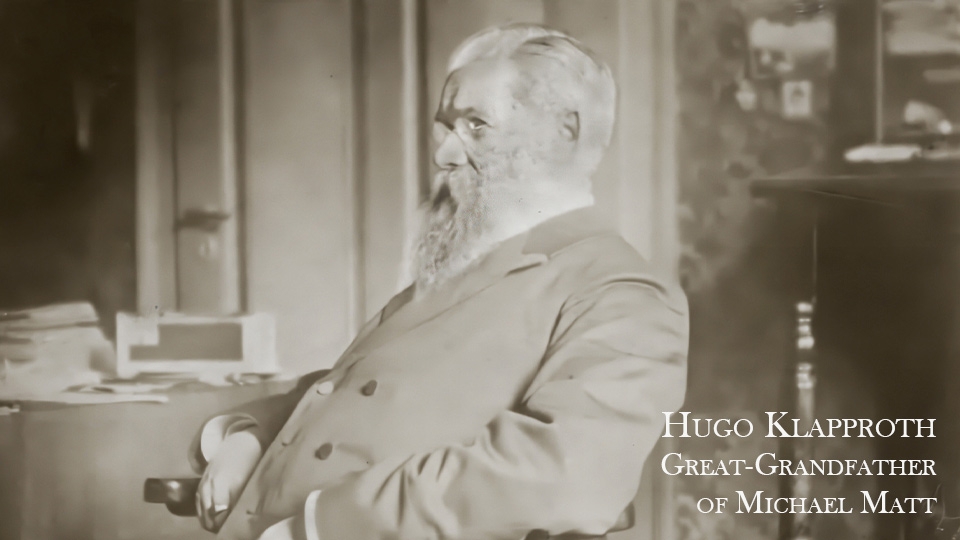

From the very first lines of Hugo Klapproth’s volume, Letters to a Protestant Friend,[i] I knew I was reading a book written by a gentleman. Indeed, a Catholic gentleman. For me, this means a great deal in our dark times, where even the most basic rules of conduct and elegant manners have been forgotten. This is why reading such a book is, above all else, a display of elegance and delicacy, something quite rare in our days.
Of course, this is to be expected from a 19th-century author. It was simply the air of the era they breathed, just as we, nowadays, breathe the toxic air of post-modernity, where we are constantly told that everything is permitted (blasphemy and sacrilege included). But just as I often enjoy watching recordings and pictures that are a hundred years old, where the decency of dress and the clear distinction of genders/sexes is the norm rather than the exception, I equally delight in such a reading, imbued with the fragrance of times better than our own. Hugo’s book is like an old wine that has become more tasteful and aromatic with time.
To the elegance of his expression, Hugo adds, with a care full of Christian charity, the testimonies of a friendship he strives to keep alive, despite the fact that, in a certain sense, he has separated from the Protestant members of his German community through his conversion to Catholicism. For example, from the very first lines, we read his words full of devotion to his unnamed friend:
“I can assure you that I would have remained true to our friendship even if you had forgotten it.” (p.1)
Especially now, in the period of great confusion we are going through, we need this true Christian spirit of solidarity and friendship. We truly need to unite the clans. How many times have we seen the spirit of division and discord attacking not only Catholicism in general but even the members of those communities that wish to remain faithful to the sacred Tradition? Unfortunately, we must acknowledge that often, from the very comments and replies accompanying our discussions and articles, it is not a spirit like that of Hugo Klapproth that emerges, but rather one filled with irritation, irony, sarcasm, and other such characteristics incompatible with Christian morality. Often, exchanges degenerate into direct attacks, like those of angry fighters striking in the dark. By reading Hugo’s letters, I am convinced that we will be imbued with a different spirit, a truly Christian one, of civilized confrontation driven by the love of Truth.
The conversion of any person is not within our power. Not even the holy apostles, who sometimes achieved the conversion of thousands through the power of their preaching, were the ones effecting these conversions: it was God and His graces who converted.
Aware of the uproar caused by his entry into the Catholic Church, he does everything in his power to emphasize the deepest motivation for such a choice: the love of truth. This is the driving force behind all his letters. A German gentleman, he defends, on the one hand, the honor of the venerable and distinguished Christian apostolic Tradition. On the other hand, he strives to present as clearly as possible the Truth of our Lord Jesus Christ’s faith, in which he firmly believes. And he does this not for a moment with the feeling of superiority that comes from looking down on his opponents. On the contrary, everything shows us that both the love of truth and solidarity with his companions are the profound reasons for his letters. In essence, Hugo Klapproth is, in relation to the members of his Protestant community, in the same situation as the apostle Paul in the midst of the Jewish people. Even if rejected, attacked, and criticized, he never ceases to hope, to respond, to explain. In short, he does not close the door; he does not burn the bridge that connects him to his former co-religionists. Even if he himself can be attacked at any time, he knows very well that he can defend himself with results that only God will decide.
As I mentioned in my first article dedicated to Hugo’s letters, we find in the pages of this book a surprising manual of Christian apologetics. Of course, one focused especially on combating the errors and heresies of the Reformation, but still a work whose dominant profile is apologetic. Reading it allowed me to identify several “lessons” from which I, myself, have learned a great deal, and from which, I am convinced, anyone who reads them carefully can learn. The first of these concerns what he himself emphatically calls “a Catholic thoroughly Principle.” Let’s see what it’s about.
Repeatedly, the introductions to his letters seem hesitant, full of a certain concern. Sometimes he explains this reluctant attitude as follows:
“I do not feel that is my task to preach to someone who is unwilling to listen” (p. 2).
Clearly, Hugo does not wish to force open closed doors. At first glance, this might seem like a reserved attitude toward his former Protestant co-religionists, from whom he expects a strongly critical stance. But it’s not just that. In his third letter, he will reveal, as clearly as possible, the principle that guides him. The introduction of this principle will be made, to the great delight of all lovers of literature and poetry, through a verse from one of the most esteemed Romantic poets, quoted by Hugo:
“Life is only error; and knowledge is death” (p. 6).
This verse is part of a poem, not very long, titled Cassandra and composed by Friedrich Schiller (1759-1805). Another English translation of the verse from Schiller, perhaps somewhat clearer, is the following:
“Human lives are only error
And with knowledge, death prevails.”[ii]
The introduction through such a subtle verse is astonishing. As a worthy compatriot of some of the most important writers of the Romantic era, Hugo Klapproth stands out, quoting them with the refinement of a connoisseur. Then, in a manner that once again reminds us of Saint Paul the Apostle, who, in the Athenian Areopagus, began his discourse before the statue of the ‘unknown god’ by quoting two Greek poets, Epimenides and Aratus, to prepare for the exposition of the Gospel, Hugo adds the following commentary:
“There is something true in that statement insofar as it is better to err due to no fault of one’s own than to know the truth without following up on its serious call. Consequently, in accordance with a thoroughly Catholic principle, I have generally taken it as a rule not to enter into religious controversies unnecessarily with those who believe differently. But you ask, and to your questions answers should be given” (p. 6).
This is why prudence and patience in conversation, accompanied by the elegance of a true gentleman and, also, by deeply ingrained humility, can help us more than anything else in becoming true Christians, witnesses to a love that alone can pull us out of the terrible crisis in which we are all engulfed.
The explanation offered by the wise Hugo stems from something more than just his gentlemanly upbringing: it reflects the charity of a true Christian toward those in error. For conveying the Truth revealed by God carries a tremendous responsibility. Those who hear it and reject it are in terrible danger. This is the reason, as explained by Saint John Chrysostom, among others, that the Savior Christ spoke in parables: so that those who, upon hearing the Truth, might trample it underfoot by rejecting it, would not be punished for their ‘deafness.’ Therefore, it was better for them not to understand it upon hearing it, so they would not reject and scorn it. Based on this same principle, Saint Alphonsus Maria de Liguori, Doctor and Bishop of the Catholic Church, taught the priests under his care not to proclaim certain moral teachings in front of those who, living depraved lives, would have gone from being merely ‘material’ sinners to becoming enemies of God and ‘formal’ sinners, thereby increasing their own guilt. Thus, Hugo Klapproth’s attitude is that of a Catholic gentleman: not only polite and considerate with his interlocutors, but also prudent and deeply concerned for their spiritual well-being. Let’s be clear: this does not mean cowardice or guilty silence, but rather patience to discern the signs of Providence that indicate when to act and speak. As Pope Leo XIII said, the Christian who bears witness to the Truth of faith is like a surgeon: he is allowed to delay the stroke of the scalpel to carefully assess the optimal conditions, but in the end, he must perform it, aiming to save the one who is ill.
To all this, I can add one more thing: the conversion of any person is not within our power. Not even the holy apostles, who sometimes achieved the conversion of thousands through the power of their preaching, were the ones effecting these conversions: it was God and His graces who converted. The apostles, like any believer working toward the conversion of others, were merely unworthy instruments through which God accomplished the great work of saving souls. To engage in such a difficult task, one must have the certainty that God desires it. Imprudence and impatience can be fatal mistakes in the work of evangelization. Therefore, what we can learn from Hugo is to be patient with those who are ‘hardened’ and, at the same time, to wait for signs from Divine Providence before taking action. Of course, we can always act through the most powerful means: prayer, fasting, almsgiving, mortifications, the holy liturgies, and so on. However, direct action toward someone like the recipients of Hugo Klapproth’s letters must be done with great care, so as not to provoke sterile, pointless disputes and conflicts. The good physician is the one who heals, not the one who worsens the patient’s condition.
I would especially emphasize the importance of this lesson for the Catholic environment of those who love Holy Tradition. I am convinced that one of the most important objectives in the difficult situation we find ourselves in is to unite the clans. But this cannot be done with traditionalists who are engaged in an endless series of polemics. This is why prudence and patience in conversation, accompanied by the elegance of a true gentleman and, also, by deeply ingrained humility, can help us more than anything else in becoming true Christians, witnesses to a love that alone can pull us out of the terrible crisis in which we are all engulfed.
Sancta Maria Auxilium Christianorum, ora pro nobis!
[i] The English translation of the volume was published by The Remnant Press in 2022, 127 years after the original German edition appeared.
[ii] You can read the entire poem on the Schiller Institute’s official website: https://archive.schillerinstitute.com/transl/schiller_poem/cassandra.html [Accessed: 08 August 2024].
