
Many of us would have applauded a statement from Pope Leo to the effect that neither Cupich nor Durbin are actually Catholic, coupled with a firm defense of Catholic teaching as being the truth given to us by God.
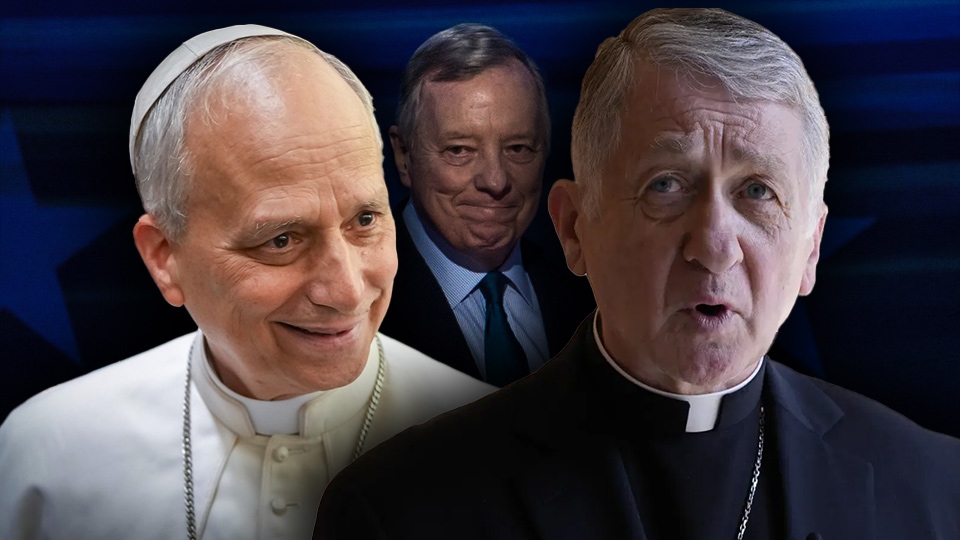
Serious Catholics around the world have justifiably criticized Blase Cupich’s attempt to provide a Catholic award to the pro-abortion Senator Richard Durbin, as well as Pope Leo XIV’s defense of Cupich’s effort:
“I’m not terribly familiar with the particular case. I think that it is very important to look at the overall work that the senator has done during, if I’m not mistaken, 40 years of service in the United States Senate. I understand the difficulty and the tensions, but I think, as I myself have spoken in the past, it’s important to look at many issues that are related to what is the teaching of the church. Someone who says I am against abortion but says I am in favor of the death penalty is not really pro-life. Someone who says I am against abortion, but I am in agreement with the inhuman treatment of immigrants in the United States, I don’t know if that’s pro-life. They are very complex issues, I don’t know if anyone has all the truth on them.”
Catholics have a right to look to the popes as a truth-tellers, but in moments like this the pope sounds like a public relations agent defending the indefensible. Perhaps worst of all, the final words in this quote positively deny any claim to possessing the truth about pro-life issues: “They are very complex issues, I don’t know if anyone has all the truth on them.”
This is yet another confirmation of what Michael Matt said shortly after the world learned that Cardinal Robert Prevost had been elected to the papacy — the revolution continues. The implications should be clear: the disorder that has plagued the Church since Vatican II persists, and those who love the Faith must contend with the disorder in various ways, just as they have for the past sixty years. The only “breaking news” from Rome that could truly change that reality would be if the pope were to renounce the Vatican II revolution, and we have now gone roughly 22,000 days without that happening.
If we want the papacy to return to what it should be, it seems that we must confront the fact that Vatican II itself — not merely the problematic interpretations of it — bears responsibility for this situation in which Rome no longer speaks clearly about the Faith.
Still, episodes like this can serve a useful purpose if we decide to look at them in the proper light. How, in particular, would we have wanted Leo XIV to respond to the situation? Many of us would have applauded a statement to the effect that neither Cupich nor Durbin are actually Catholic, coupled with a firm defense of Catholic teaching as being the truth given to us by God. We want the pope to defend the entire Catholic Faith with the same conviction and fervor with which the pre-Vatican II popes defended the Catholic Faith. Why would we want something less?
However, if we want the papacy to return to what it should be, it seems that we must confront the fact that Vatican II itself — not merely the problematic interpretations of it — bears responsibility for this situation in which Rome no longer speaks clearly about the Faith. To recall what it would mean for Rome to speak clearly about the Faith, and about the errors opposed to it, we can consider the words of Pope Pius XI’s 1928 encyclical on religious unity, Mortalium Animos:
“But, all the same, although many non-Catholics may be found who loudly preach fraternal communion in Christ Jesus, yet you will find none at all to whom it ever occurs to submit to and obey the Vicar of Jesus Christ either in His capacity as a teacher or as a governor. Meanwhile they affirm that they would willingly treat with the Church of Rome, but on equal terms, that is as equals with an equal: but even if they could so act, it does not seem open to doubt that any pact into which they might enter would not compel them to turn from those opinions which are still the reason why they err and stray from the one fold of Christ. This being so, it is clear that the Apostolic See cannot on any terms take part in their assemblies, nor is it anyway lawful for Catholics either to support or to work for such enterprises; for if they do so they will be giving countenance to a false Christianity, quite alien to the one Church of Christ. Shall We suffer, what would indeed be iniquitous, the truth, and a truth divinely revealed, to be made a subject for compromise? For here there is question of defending revealed truth.”
Pope Pius XI clearly defended Catholic teaching: non-Catholics are on the wrong path and we cannot take part in their assemblies or support their work. To say or do otherwise, he asserts, would be to compromise divinely revealed truth.
So when Leo XIV says that nobody has all the answers about pro-life matters, he is speaking like a loyal son of the ongoing Vatican II revolution.
If Pius XI was wrong, then the entire Catholic religion is not what the popes prior to Vatican II thought it was, and we can quite reasonably conclude it is a fraud. However, if Pope Pius XI and the other pre-Vatican II popes were correct then we must condemn ecumenical madness that was enshrined in Rome with Vatican II. For those who may not be familiar with how the Council’s documents contributed to the ecumenical madness, we can merely consider the following passages:
- Pro-Islam: “The Church regards with esteem also the Moslems. They adore the one God, living and subsisting in Himself; merciful and all-powerful, the Creator of heaven and earth,(5) who has spoken to men; they take pains to submit wholeheartedly to even His inscrutable decrees, just as Abraham, with whom the faith of Islam takes pleasure in linking itself, submitted to God. Though they do not acknowledge Jesus as God, they revere Him as a prophet. They also honor Mary, His virgin Mother; at times they even call on her with devotion. In addition, they await the day of judgment when God will render their deserts to all those who have been raised up from the dead. Finally, they value the moral life and worship God especially through prayer, almsgiving and fasting.” (Declaration on the Relation of the Church to Non-Christian Religions, Nostra Aetate)
- Pro-Hinduism: “Religions, however, that are bound up with an advanced culture have struggled to answer the same questions by means of more refined concepts and a more developed language. Thus in Hinduism, men contemplate the divine mystery and express it through an inexhaustible abundance of myths and through searching philosophical inquiry. They seek freedom from the anguish of our human condition either through ascetical practices or profound meditation or a flight to God with love and trust.” (Nostra Aetate)
- Pro-Buddhism: “Again, Buddhism, in its various forms, realizes the radical insufficiency of this changeable world; it teaches a way by which men, in a devout and confident spirit, may be able either to acquire the state of perfect liberation, or attain, by their own efforts or through higher help, supreme illumination. Likewise, other religions found everywhere try to counter the restlessness of the human heart, each in its own manner, by proposing “ways,” comprising teachings, rules of life, and sacred rites. The Catholic Church rejects nothing that is true and holy in these religions. She regards with sincere reverence those ways of conduct and of life, those precepts and teachings which, though differing in many aspects from the ones she holds and sets forth, nonetheless often reflect a ray of that Truth which enlightens all men.” (Nostra Aetate)
- Pro-Protestantism: “The brethren divided from us also use many liturgical actions of the Christian religion. These most certainly can truly engender a life of grace in ways that vary according to the condition of each Church or Community. These liturgical actions must be regarded as capable of giving access to the community of salvation. It follows that the separated Churches and Communities as such, though we believe them to be deficient in some respects, have been by no means deprived of significance and importance in the mystery of salvation. For the Spirit of Christ has not refrained from using them as means of salvation which derive their efficacy from the very fullness of grace and truth entrusted to the Church.” (Decree on Ecumenism, Unitatis Redintegratio)
Catholics have accepted, and defended, these positions for so long that few of us can detect anything wrong with them. Why, though, would we take issue with Leo XIV making excuses for Cupich and Durbin if we are comfortable with Vatican II praising Islam, Hinduism, Buddhism, and Protestantism? Is the theory that those false religions are properly pro-life? Or perhaps the theory is that Cupich’s award, and Leo’s interview response, are somehow more authoritative than the Vatican II documents?
We can pray that Leo XIV will eventually cooperate with God’s grace to oppose the Vatican II revolution, but his failure to do so should not shake our Faith in the least. We know from Our Lord that the gates of hell will not prevail against the Church, and He would have had little reason to tell us that if there would not be times in which we might be inclined to doubt it.
The reality is that for several decades some serious Catholics have defended Vatican II’s documents with ostensibly noble motivations but without adequate consideration of the issues at stake. It is not sufficient to claim that one can look at the documents in just the right light — a dim light, with blindfolds is best — to avoid seeing statements that compromise the Faith. All such defenses of the Council have contributed significantly to a practical rejection not only of what the pre-Vatican II popes said (such as in Mortalium Animos) but also of how they thought and spoke about Catholic truth. So when Leo XIV says that nobody has all the answers about pro-life matters, he is speaking like a loyal son of the ongoing Vatican II revolution.
This perspective need not be particularly distressing, for it primarily confirms the need for Catholics to insist on the unadulterated Catholic Faith that has been under attack for over sixty years. God permits this crisis to continue for our good and surely part of that involves an opportunity for us to realize that the pre-Vatican II popes were correct. With Francis, it was relatively easy to attribute his anti-Catholic behavior to a real distaste for the Faith; but with Leo XIV, we see a man who appears to genuinely want to be a good Catholic. The problem is that he has presumably had little reason to question the tenets of the Vatican II revolution. If we accept that revolution, then we really have little logical basis for opposing Leo XIV’s defense of Cupich and Durbin.
We can pray that Leo XIV will eventually cooperate with God’s grace to oppose the Vatican II revolution, but his failure to do so should not shake our Faith in the least. We know from Our Lord that the gates of hell will not prevail against the Church, and He would have had little reason to tell us that if there would not be times in which we might be inclined to doubt it. Moreover, the unadulterated Catholic Faith is under attack because it alone stands in the way of Satan’s aims, and we know that God wins in the end. As such, our patient and charitable fight against the anti-Catholic Vatican II revolution is the way in which God calls us to become saints and serve the Mystical Body of Christ, no matter what Leo XIV might say. Immaculate Heart of Mary, pray for us!