
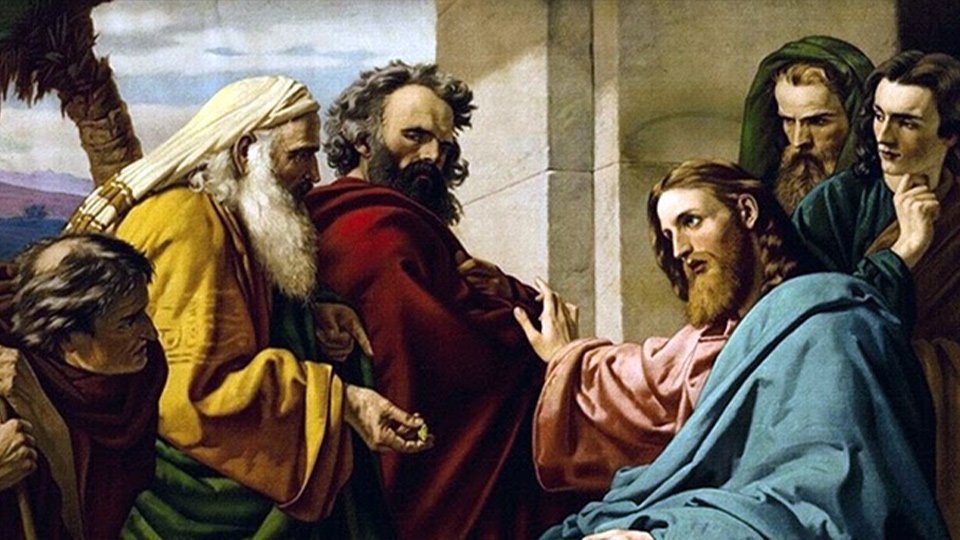

Immediately following His sublime assertion of unity with the Father, Christ utters words that, at first glance, seem to soften—or even contradict—His previous claim. But Christ is not retracting; He is revealing the blindness of His accusers and appealing, with divine cunning, to their own legal traditions to delay their murderous intent.
In the tenth chapter of the Gospel according to Saint John, a drama unfolds in the Temple portico during the Feast of the Dedication. The Jews encircle Jesus and pose the question that echoes through the ages: “If thou be the Christ, tell us plainly” (John 10:24). To this, Jesus answers in no uncertain terms—yes, a most emphatic yes. Not only is He the Christ, the Anointed One of Israel, but more, He is one with the Father, the very YHWH of Israel made flesh, who speaks and acts with divine authority, and who dares to say: “I and the Father are one” (John 10:30). This bold declaration is not metaphorical, nor is it vague. It is immediate, arresting, and divine. The response of His listeners is not confusion or inquiry—but fury. They take up stones to kill Him, not for blasphemous allusion, but for a clear and direct claim that “being a man, thou makest thyself God” (John 10:33).
Yet immediately following this sublime assertion of unity with the Father, Christ utters words that, at first glance, seem to soften—or even contradict—His previous claim. “Is it not written in your law: I said you are gods?” (John 10:34). He refers here to Psalm 81 (82), verse 6, wherein God addresses the judges of Israel, calling them “gods” because they bore His word and administered His justice. “If he called them gods, to whom the word of God was spoken, and the scripture cannot be broken,” Jesus continues, “do you say of him whom the Father hath sanctified and sent into the world: Thou blasphemest, because I said, I am the Son of God?” (John 10:35–36). On the surface, this might appear to dilute His divine claim. But Christ is not retracting; He is revealing the blindness of His accusers and appealing, with divine cunning, to their own legal traditions to delay their murderous intent. His hour had not yet come, and thus He employs a kind of juridical argument—not to escape the truth of His identity, but to expose the irrationality of their rage. He reasons with them according to their own Scriptures, not to deny His divinity, but to defer their violence. He then anchors His claim not merely in words, but in works: “If I do not the works of my Father, believe me not. But if I do, though you will not believe me, believe the works: that you may know and believe that the Father is in me, and I in the Father” (John 10:37–38). The rhetorical maneuver is not a contradiction, but a mercy—a momentary veil over the burning light of His divinity, lest it incite their fury before the appointed time. The truth remains intact: He and the Father are one. But the fullness of that truth will be unveiled not by argument alone, but by the cross and the resurrection.
The Jews were not seeking a simple affirmation when they posed their question. They were invoking a deeply-rooted promise: the expectation of the one prophesied by Moses, the one anointed by God to restore Israel.
To perceive the depth of this revelation, one must gaze backward into the ancient words of the Law and the Psalms, listen to the still voice of the prophets, and observe the apostolic ripple in the early Church—those bishops chosen not by whim or human wisdom, but by divine guidance, to ensure the enduring presence of the One Shepherd who still leads His flock through His Mystical Body, the Catholic Church.
The Jews were not seeking a simple affirmation when they posed their question. They were invoking a deeply-rooted promise: the expectation of the one prophesied by Moses, the one anointed by God to restore Israel. “The Lord thy God will raise up to thee a prophet of thy nation and of thy brethren like unto me: him thou shalt hear” (Deuteronomy 18:15). The gravity of this promise lay in its mystery. For Moses, as the Lawgiver, the one who conversed with God upon the mountain, who received the covenant, and who stood as mediator between a sinful people and a holy God, was utterly singular. To be “like unto” him suggested not only prophetic utterance, but mediation, leadership, and divine proximity.
In ancient Israel, this expectation of a prophet like Moses was understood with serious weight. It was not interpreted to mean a mere repetition of Elijah’s miracles or Jeremiah’s lamentations. Moses had spoken with God face to face. He had stood in the breach, endured divine wrath, interceded for mercy, and brought forth the covenant sealed in blood. No ordinary prophet could embody such functions. The One who would fulfill this promise must be uniquely anointed, uniquely holy—He must be more than a messenger. He must Himself be God’s own speech made flesh. And so, when Jesus of Nazareth speaks in John 10 not merely of mission or teaching, but declares “I and the Father are one,” He is not speaking as a teacher of wisdom but as the very Wisdom of God incarnate. He does not claim proximity to God—He claims identity with God.
He does not claim proximity to God—He claims identity with God. To understand how shocking this is, we turn to the ancient Psalmody which filled the ears and hearts of devout Jews.
To understand how shocking this is, we turn to the ancient Psalmody which filled the ears and hearts of devout Jews. Psalm 94, rendered in the Douay-Rheims numbering, provides a key: “Come let us adore and fall down: and weep before the Lord that made us. For he is the Lord our God: and we are the people of his pasture and the sheep of his hand” (Psalm 94:6–7). The image is tender, but it is also powerful. The hand of God holds His people. This is not abstract poetry. It is deep theology. The hand is the place of power, authority, and divine protection. That hand belongs to the Lord—YHWH. Yet in John 10, Jesus proclaims, “My sheep hear my voice: and I know them, and they follow me. And I give them life everlasting: and they shall not perish for ever, and no man shall pluck them out of my hand. That which my Father hath given me is greater than all: and no one can snatch them out of the hand of my Father” (John 10:27–29). The imagery is deliberate. Jesus is aligning His own hand with the hand of the Father. More than that, He identifies the sheep as already belonging to Him, and places Himself in the divine seat of power, promising eternal life—something only God can give. The conclusion is not left to inference. “I and the Father are one” (John 10:30).
We are not dealing with metaphors here. This is a direct identification with the God of Israel. But Christ is not teaching a flattened monotheism; He is revealing a mystery that had remained hidden in shadows. The unity He proclaims with the Father is a unity of nature, not person. For He does not say, “I am the Father,” but rather, “I and the Father.” There is distinction, and yet inseparable communion. This is the threshold of Trinitarian theology. Already, we see the emergence of the eternal Sonship, and with it, the harmony of wills within the Godhead. That Christ is God, and yet not the Father, is a confession not of contradiction but of deeper unity—a unity so rich and eternal that it surpasses all creaturely comparison.
This divine identity is not new, though it is now fully revealed. In the ancient song of Moses, found in Deuteronomy 32, God Himself is portrayed as shepherd and savior of Israel. “He set him upon high land: that he might eat the fruits of the fields… The Lord alone was his leader: and there was no strange god with him” (Deuteronomy 32:13, 12). God alone guides, feeds, and protects His people. The metaphor of shepherd is thus divinely charged. When Christ says in John 10:11, “I am the good shepherd,” He is not simply expressing pastoral concern. He is claiming the very identity of the Shepherd of Israel, the One who led them through the wilderness, who fed them with manna, and who bore them in His arms. He is the Shepherd who holds the sheep in His hand—just as Psalm 94 had declared. But now, that hand is visible, touchable, pierced.
From this foundation, the revelation of the Trinity begins to shine with full clarity. Jesus makes it known that the Father sends, that the Son is sent, and that another is yet to come. He speaks of the Holy Ghost, the Paraclete, the Spirit of Truth.
And it is a hand not only of comfort and provision, but of divine justice. For in that same song of Moses, a warning thunders forth—one which ought to have shaken the very men who stood before Christ with stones in their hands. Speaking of those “void of counsel” and lacking understanding, God says, “They are a nation without counsel, and without wisdom… vengeance is mine, and I will repay. In due time their foot shall slide: the day of destruction is at hand, and the time makes haste to come” (Deuteronomy 32:28, 35). The hand of God which gathers His sheep is the same hand that strikes down the proud and unrepentant. “I will lift up my hand to heaven, and I will say: I live for ever. If I shall whet my sword as lightning, and my hand take hold on judgment: I will render vengeance to my enemies, and repay them that hate me” (Deuteronomy 32:40–41). The Christ who stood in the Temple that day was not merely speaking words of unity and peace. He was identifying Himself as the one whose hand not only protects His flock, but also executes righteous judgment. The words He spoke were mercy for the humble—but to the hard-hearted, they were fire.
From this foundation, the revelation of the Trinity begins to shine with full clarity. Jesus makes it known that the Father sends, that the Son is sent, and that another is yet to come. He speaks of the Holy Ghost, the Paraclete, the Spirit of Truth. “But the Paraclete, the Holy Ghost, whom the Father will send in my name, he will teach you all things” (John 14:26). And again, “But when the Paraclete cometh, whom I will send you from the Father, the Spirit of truth, who proceedeth from the Father, he shall give testimony of me” (John 15:26). This is not a fragmented God. This is One God in three divine Persons, eternally united in essence and distinction, and now fully revealed by the mouth of the Son. The divine unity Christ proclaims with the Father is extended through the sending of the Spirit, who proceeds from the Father, through the Son, and into the very heart of the Church. The Trinity is not a theory—it is the divine life poured into the Church.
But Christ’s presence among His people did not end with the Ascension. He continues to shepherd His Church not only invisibly, but sacramentally and hierarchically. Before the fire of Pentecost descends, Peter rises and declares that the void left by Judas must be filled. “His bishopric let another take” (Acts 1:20). The word used—episkopēn—is not vague. It is the office of oversight, the bishopric. And the Apostles, without hesitation or dispute, proceed to elect a successor. This is before tongues of fire and rushing wind. The Church’s hierarchical order is not an invention of later centuries—it is the immediate response of the Apostles themselves. They understood that the Church, to be Christ’s visible body, must be governed not merely by memory or enthusiasm, but by men chosen and anointed for apostolic succession.
The Jews asked a question they could scarcely imagine would be answered in such a way. The Man they questioned was the very Lord of the Covenant, the Voice from the burning bush, the Shepherd of Israel. In Him, the Law is fulfilled, the Psalms are embodied, the Church is founded, and the Trinity is revealed.
Saint Paul continues this work. When he lays hands upon Timothy, he does not merely pass along advice. He transmits authority. And he warns Timothy to do the same with great care: “Impose not hands lightly upon any man, neither be partaker of other men’s sins” (1 Timothy 5:22). This is sacred office, not ceremonial formality. And it is not limited to one generation. “For this cause I left thee in Crete: that thou shouldest set in order the things that are wanting, and shouldest ordain priests in every city, as I also appointed thee” (Titus 1:5). Here, again, is the voice of the Good Shepherd, continuing through the bishops whom He appoints through His Apostles. The flock is not left to wander. The hand of Christ still holds the sheep—now through the hands of those ordained in His name.
Thus, the Church stands not as a human project but as a divine institution. It is no mere gathering of like-minded believers. It is the sacramental extension of the Incarnation, the Mystical Body of Christ. And it is protected by the Holy Ghost. This is why Saint Paul can write with absolute clarity: “That thou mayest know how thou oughtest to behave in the house of God, which is the church of the living God, the pillar and ground of the truth” (1 Timothy 3:15). The Church—not Scripture alone, not individual interpretation, but the visible Church—is the pillar and ground of the Truth because it is the dwelling place of God. Christ speaks in her, acts through her sacraments, and governs through her bishops. She cannot err in her solemn teachings, for she is guided by the Spirit of Truth whom the Son sent from the Father.
All of this flows from that moment in Solomon’s porch, when the Jews asked a question they could scarcely imagine would be answered in such a way. The man they questioned was the very Lord of the Covenant, the Voice from the burning bush, the Shepherd of Israel. He was the Prophet foretold by Moses, but He was also the Word through whom Moses had spoken. His hand was the hand of the Father, and His voice was the voice that called light from darkness. In Him, the Law is fulfilled, the Psalms are embodied, the Church is founded, and the Trinity is revealed.
Let us listen, then, and not harden our hearts. “Today if you shall hear his voice, harden not your hearts” (Psalm 94:8). The Shepherd speaks still. The sheep are in His hand. And that hand will not let go.
