
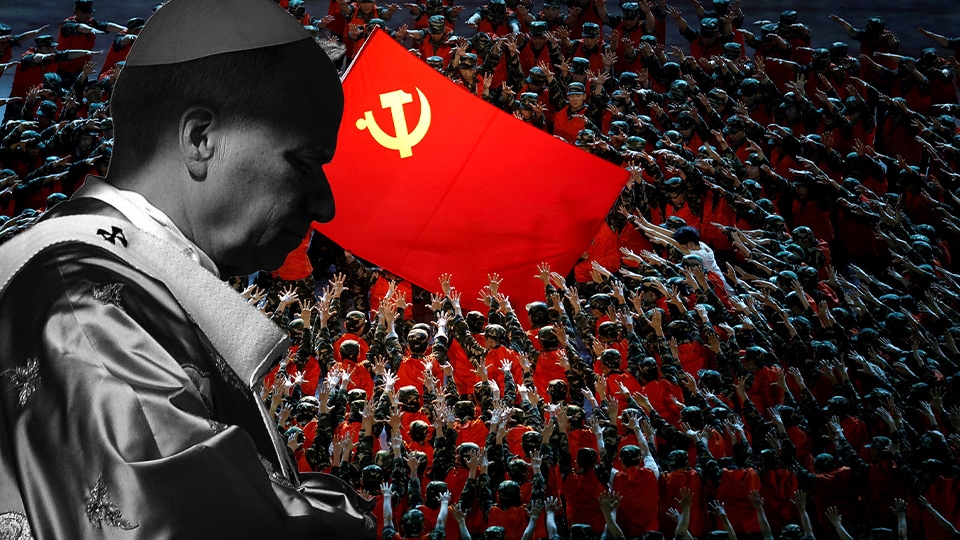

On September 15, the Department for Religious Affairs in Beijing issued a new “Code of Conduct for Religious Clergy on the Internet,” addressed to priests and ministers of various faiths present in Xi Jinping’s post-Maoist China. The document, composed of eighteen articles, aims to impose strict control over both the methods of online preaching and — above all — the content published by religious representatives.
The code applies to priests and ministers of the five religions officially recognized in China — Buddhism, Taoism, Islam, Catholicism, and Protestantism — and extends to religious figures residing in Hong Kong, Macao, and Taiwan, as well as to foreign clergy operating online within the country, even when using foreign web platforms.
Preaching and religious formation are permitted exclusively through digital channels legally established by licensed Chinese religious organizations. Among these is the Chinese Patriotic Catholic Association — the so-called “official Church” — which operates under the direct supervision of the Communist Party’s Office for Religious Affairs.
Whenever a member of the clergy registers or uses a public online account, they are required to present a certificate to internet service providers confirming their affiliation with officially recognized religious institutions. In case of violations, the Department for Religious Affairs mandates a correction within a specified timeframe; failure to comply results in sanctions under current regulations, including suspension or closure of the account. Furthermore, depending on the content published, authorities may initiate additional investigations, potentially leading to far more serious consequences.
The new code claims to aim at “maintaining order in the religious sphere” and preventing the spread of “illegal religious content”. However, behind these ambiguous formulations lie objectives typical of a totalitarian regime: the pervasive control of thought, speech, and faith.
These new regulations are part of Beijing’s broader and ongoing campaign to control religious practices and reshape faith according to the dictates of the Chinese Communist Party. The guiding principle is explicit: clergy must believe in and practice the core values of socialism and conform to the policy of religious sinicization. All religious denominations in the country are expected to adapt to the socialist Chinese society, contributing to the appearance of religious, social, and ethnic harmony. In reality, this process serves only to tighten state control over every aspect of public life — religion included — with the aim of suppressing competing ideologies and consolidating the regime’s authority over people’s minds and lives.
The restrictions aim to prevent “collusion with foreign forces” and participation in “foreign religious infiltration activities”. Behind this phrasing lies Beijing’s deep mistrust of any external influence, particularly that of Islamic nations, Christian missionary organizations, and above all, the Vatican — considered one of the most insidious religious actors. The suspicion stems not only from the obedience Catholic priests owe to a foreign authority, the Pope, but also from the Church’s social doctrine, which is rooted in private property and the principle of subsidiarity — both fundamentally incompatible with socialist ideology.
Catholicism cannot be reduced to an ethical or political system: it is the proclamation of God made man in Christ Jesus, the one true king over all things, who redeemed us from sin, death, and the devil through His sacrificial Passion and Death, and who dispenses His grace through the Sacraments of the one Church. Maoism, by contrast, views the human being as a cog in the collective machine and denies any reference to a natural order higher than the State. The family, private property, and the freedom to worship the true God — pillars of Catholic social doctrine — are inevitably perceived by the regime as ideological threats to be eradicated. This opposition allows no compromise: between the Church and communism lies an anthropological and theological contradiction, even before a political one.
This very obsession reveals the regime’s Achilles’ heel: its fear of inner freedom. Communism knows it cannot penetrate the conscience of the young and fears that faith, even when transmitted clandestinely, may become an indelible source of resistance.
One of the explicit goals of the new code of conduct is to prevent — or, if possible, entirely eliminate — minors’ exposure to religious content online. This very obsession reveals the regime’s Achilles’ heel: its fear of inner freedom. Communism knows it cannot penetrate the conscience of the young and fears that faith, even when transmitted clandestinely, may become an indelible source of resistance. The anxiety to block the generational transmission of belief exposes the system’s fragility — a system that requires total control to survive and collapses the moment a community acknowledges the existence of a different authority.
For years, China has been intensifying efforts to halt the transmission of faith to younger generations. Christianity, in particular, has been experiencing uncontrolled growth, causing deep concern within the Party. The so-called “Christian fever” is viewed as a latent threat to the regime’s stability and as a potential cause — or contributing factor — to its collapse in the medium to long term.
In the face of yet another shameful attack on the religious freedom of Catholics by the Chinese communist regime, what is the Vatican’s response? So far, there have been no clear or unequivocal statements. Beijing’s repressive strategy, however, does not concern only Chinese Catholics. A silent Vatican, willing to accept opaque compromises in order to preserve a diplomatic channel, ends up offering moral cover to other regimes hostile to Christianity. The absence of a clear denunciation weakens the Church’s prophetic voice and jeopardizes the credibility of its universal mission: if Rome remains silent before Chinese communism, how can it speak with authority against persecutions in Africa, the Middle East, or even in the West itself?
In the face of yet another shameful attack on the religious freedom of Catholics by the Chinese communist regime, what is the Vatican’s response? So far, there have been no clear or unequivocal statements.
On the contrary, the existence of Secret Agreements granting Beijing full freedom in the appointment of bishops, combined with the recent statements of Pope Leo XIV in the newly published book-interview — León XIV: Ciudadano del mundo, misionero del siglo XXI — reinforce the impression that the Holy See not only remains silent, but even acquiesces.
When asked about his stance on relations with China, Pope Leo stated that he does not yet have a defined position and that, at least “in the short term”, he intends to continue along the “line followed by the Holy See in recent years”. Leo XIV affirms that he has “no claim to be wiser or more experienced” than Francis and his predecessors. The approach adopted by Pope Francis and Cardinal Parolin is commonly referred to as Ostpolitik, in reference to the diplomatic strategy pursued by John Paul II in dealing with the USSR.
This diplomatic policy is based on a logic of delay (a concept especially dear to Prevost), patient dialogue, bilateral agreements, and gradual recognition. It reflects a diplomatic realism that accepts compromises in order to ensure a Catholic presence in the country. This strategy entails a necessary media silence: the Holy See avoids public statements on persecution or violations of religious freedom, fearing they might jeopardize the fragile dialogue with Chinese authorities. At the heart of this approach lies a primarily “pastoral” mission, considered a priority even at the cost of institutional ambiguity, in the belief that the survival of the local Church outweighs formal consistency or open denunciation.
Francis’s approach presents serious critical issues: the opacity of the agreements with Beijing, the lack of support for persecuted Catholics, and institutional ambiguity undermine the Church’s credibility — in China and across the world.
Pope Francis’s Ostpolitik toward China shares with John Paul II’s approach to the Soviet Union the intent to keep diplomatic channels open with regimes hostile to religious freedom, but differs in tone and posture: Wojtyła, in fact, did not shy away from publicly denouncing persecution and offering moral support to oppressed believers. Well known is the moral — and even financial — support that John Paul II extended to resistance movements such as Solidarność in Poland.
Benedict XVI took a different stance: although he sought dialogue, he would never have accepted compromises on the appointment of bishops or on doctrine. In his Letter to Chinese Catholics (2007), Ratzinger reaffirmed the necessity of communion with Peter and the need to overcome the division between the official and underground Church. According to him, diplomacy could never come at the expense of the witness and coherence of the Catholic faith.
Francis’s approach presents serious critical issues: the opacity of the agreements with Beijing, the lack of support for persecuted Catholics, and institutional ambiguity undermine the Church’s credibility — in China and across the world — fostering confusion between evangelical fidelity and diplomatic submission, and handing unilateral power to the regime. Documents such as the one published on September 15 fully confirm what we are saying.
There is hope that Pope Leo XIV, drawing on his experience over the years in dealing with the Chinese people, the government, and various religious and lay leaders, may initiate a shift that gives the Vatican greater leverage in advocating for persecuted Catholics in China, including priests and bishops.
There is hope that Pope Leo XIV, drawing on his experience over the years in dealing with the Chinese people, the government, and various religious and lay leaders, may initiate a shift that gives the Vatican greater leverage in advocating for persecuted Catholics in China, including priests and bishops. “After two months,” Leo stated in the book-interview, “I have already begun to engage in multi-level discussions on this issue”.
The Chinese martyrs of the 20th century bear witness that faith cannot be extinguished, not even by the fiercest persecution. If the Church remains silent out of calculation, it risks obscuring its universal mission and confusing fidelity to Christ with submission to power. But communism, like every anti-human ideology, is destined to pass away: Christ alone is destined to reign for all eternity, despite the hatred and envy of the Devil and his followers.