
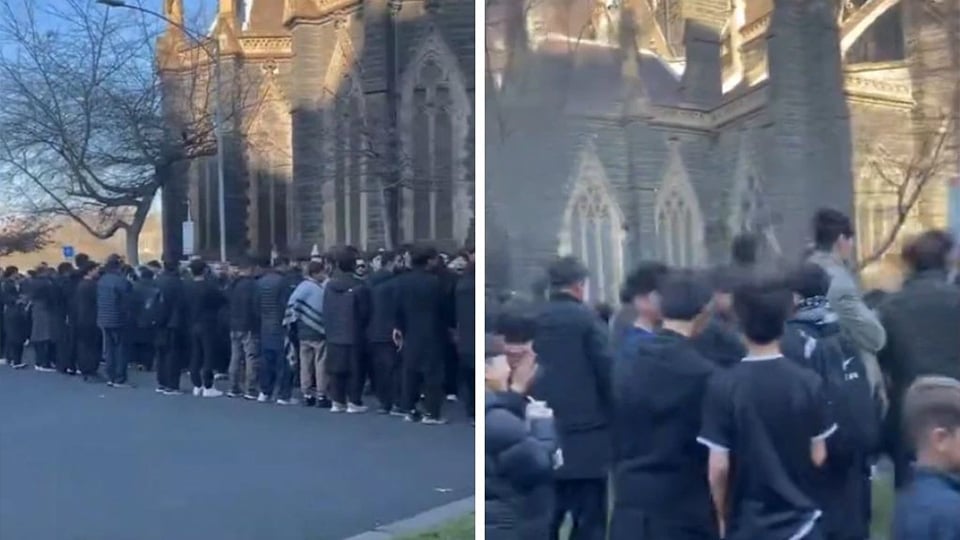

Video circulating online showing hundreds of Moslem men surrounding St. Patrick’s Cathedral in Melbourne has alarmed many Christians. What appeared to be a clear case of intimidation based on the ages-old animosity between Moslems and Christians was, in fact, not the primary purpose of the gathering, and the painting of the incident in this way has angered both Moslems and sympathetic Christians alike.
A sign from Melbourne’ Ashura procession expressing a message of peace.
Yet while signs on display at the event expressed messages of peace and unity, the overall impression was sinister. It is a scene that is becoming more and more familiar, thanks to social media, as shocked citizens share similar images from their own cities around the world, and raises questions about demographics, immigration policy and religious expression.
Ashura
The procession was part of the observance of a day of mourning known as Ashura, and is an annual event among Shia Moslems around the world. Ashura commemorates the death of Imam Hussein, the grandson of Mohammed, who was slain in the Battle of Karbala in the 7th century. His death was due to his resistance to what he saw as the moral corruption of the leaders of his day. As well as commemorating Imam Hussein, the contemporary festival is often seen as a wider protest against oppression.
During the procession, the attendees, known as ‘mourners’ sing songs of lamentation while making gestures called matam: acts of self-flagellation such as beating the breast or face with one hand. Video footage from similar processions that have taken place in other parts of the world frequently show the men bare-chested, and even occasionally drawing blood.
Mourners making gestures of matam.
Although the procession has taken place following the same route through Melbourne’s inner-city for over ten years, this seems to have been the first time it has stopped at the Cathedral instead of processing past it. By standing still and turning their attention towards the building, the attendees gave the appearance of attempting to threaten or demoralise Melbourne’s Catholics.
Screengrab from The Noticer Facebook page
Bad optics
The mainstream media ignored the incident, leaving independent commentators to draw their own conclusion about the display. Although a prudent statement from the Shia community could have been issued to attempt to quell the concerns of Christians and other freedom-lovers, this was not made.
Instead, Victoria’s Premier took to social media to make one of the most tone-deaf messages possible: promoting the free housing her government is providing for Moslem immigrants. Premier Allen’s social media post about her project drew so many negative responses that the comments were closed after a short time.
The insult contained in her message was exacerbated by Melbourne’s housing crisis: house prices across the board in Australia are so high that ownership is out of reach for many families. Rental costs have also increased exponentially in recent years, due largely to the huge influx of immigrants. Melbourne, particularly, as a capital city, is suffering greatly from this crisis.
Archbishop Comensoli hides his pectoral cross at the ecumenical meeting.
Anti-semitism but not Christophobia
The poor optics continued as religious leaders, including the Archbishop of Melbourne, seemed oblivious to the disturbing incident, preferring instead to focus on the persecution being waged against Melbourne’s Jewish community. Only days after his own Cathedral was targeted by the host of Moslems, Archbishop Peter Comensoli organised an ecumenical photo-op at the synagogue a few doors away to promote initiatives aimed at curbing anti-semitism. This is not to say that Melbourne’s Jews aren’t under threat – the synagogue was recently firebombed – only to indicate that for a bishop, his own flock must be the priority.
Archbishop Comensoli, a Modernist known for his pro-LGBTI, syncretic flavour of Catholicism, organised his event to promote “solidarity and hope”, saying that “in the face of such darkness, we are reminded of the strength of faith, the resilience of community and the power of unity. Please know that you are not alone.”
Yet are not his own people being left alone to deal with an incident that was puzzling, if not blatantly frightening?
At the same ecumenical meeting, a representative of a Shia Muslim organisation addressed the leaders, also expressing her sympathy for Melbourne’s Jewish community. She said that “An attack on a place of worship is an attack on the shared values of peace, safety and sacredness that unite all faiths” and that her community offers “unwavering support for your right to gather, pray and live without fear.”
Yet her words rang hollow in the context of the daunting show of force made by her own community towards Catholics only days earlier. Or is “unwavering support” reserved for the Jewish community alone?
Shia Moslems gather in prayer prior to the Ashura procession.
The new religious expression
Questions about non-Christian and anti-Christian religious observance are not going away in a hurry. Around 40% of Australia’s half-million annual immigrants are non-Christians, and in Melbourne, immigrants comprise more than half of the city’s population.
Alternative media commentator, Rukshan Fernandez, made a salient point regarding the Islamic parade. He said, “What should concern Australia is not these displays but the fact that in many western countries, the decline in Christian religious observance has led, in some instances, to centuries-old churches being converted into mosques or temples. This points to a broader issue that those who emphasise the Christian foundations of Australia often ignore: the decline in public religious observance and church communities in the real world, particularly among younger generations.”
He is not wrong, but to be fair, Rukshan may not be aware of the flourishing traditional parishes scattered around Australia and the world. He may also not have been aware of the Corpus Christi procession which left from the same Cathedral last June:
Organised by the Archdiocese of Melbourne, it drew thousands of Catholics to the heart of Melbourne. While questions could be asked about the formation being received by the mainstream Catholics who attend processions like these, there is no doubt that it is an encouraging sign in this city which has been the scene of so much anti-Christian activity.
It is to be hoped that such well-attended public displays of Catholic devotion multiply in the coming months and years throughout Melbourne and that Shia Moslems do not repeat their intimidatory tactics. One can only think of the moving and memorable closing scene from Robert Benson’s book, The Lord of the World and consider that devotion to the Blessed Sacrament, the “source and summit of Christian life” is the key to our Church’s future. It is also vital for the souls of multitudes of Moslems, Jews, atheists and Freemasons, whether they acknowledge it or not. We pray for their conversion to the Catholic faith.
NOTE: Unless otherwise stated, images are taken from the Pakistani Students Association of Australia (PSAA) Facebook page
