
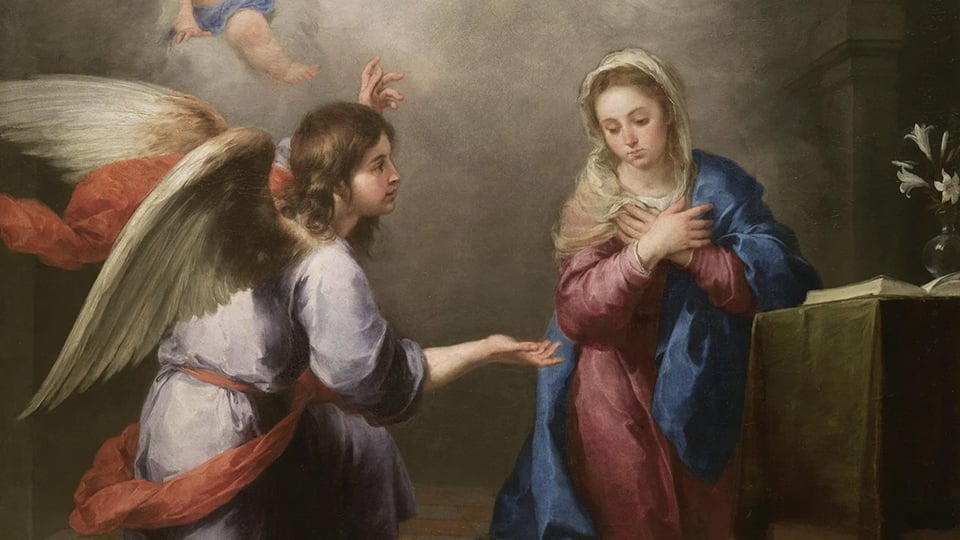

The Annunciation is the episode in salvation history when the angel Gabriel announces to the Virgin Mary that she has been favoured to bear the Son of God the Most High. It is the reverberating opening shot to the climax of the war between the children of Eve and the children of the serpent foretold in the book of Genesis. An unconventional painting of the Annunciation now fifteen years old, however, reveals the fate of that pivotal moment in the contemporary life of the Church, with its stark implications for Catholics.
We know of the Annunciation primarily from the Gospel according to Luke. Second-century Church Father Irenaeus of Lyon in Against Heresies (Book III, Chapter 14) affirms that through Luke “we have become acquainted with important parts of the Gospel, for instance … the coming of the angel to Mary”. This angel bears news putting any other with pretensions to greatness in the shade: that Mary by the power of God will conceive a child to be given the throne of his ancestor King David, whence he would reign over the house of Jacob forever in a kingdom without end (Luke 1:32–33; 1:35). The child’s coming would be the fullest fruition of words from the sixth century before Christ, of God himself shepherding his neglected sheep (Ezek 34:15).
The Annunciation by Fra Angelico, c.1425–1428. Tempera and gold on panel. Prado Museum, Madrid. Originally for an altarpiece in the Convent of San Domenico, Fiesole. Wikimedia Commons, CC BY-SA 4.0.
We know from the New Testament and Irenaeus that Luke was a close associate of Paul. Most commonsensically, it would have been Mary who first recounted to someone else, likely Luke himself, her encounter with Gabriel which made its way into his gospel. Thus, we have or infer already at least three ancient iterations of the Annunciation after the original episode, with Luke’s being the most salient record of Gabriel’s visit.
The Annunciation’s tremendous significance for man’s salvation is further evident in its countless artistic depictions continuing till the present. These, too, reiterate the encounter. Although not sacred scripture, art is nonetheless a key Catholic means of recalling the Annunciation. Jesus says, “Whoever has seen me has seen the Father” (John 14:9). Jesus is God tangible in the flesh, “the image of the invisible God” (Col 1:15). Material, visual depictions of the articles of Catholic faith, otherwise known as art, themselves participate in this logic of the divine becoming incarnated in the material realm.
The Annunciation by Fra Angelico, 1438–1445. Fresco atop a stairwell, San Marco Museum, Florence. Photo by Vincenzo Fontana via Getty Images.
Living from c.1400 to 1455, the early Italian Renaissance painter Fra Angelico made multiple, varying versions of the Annunciation based on the leitmotif of Gabriel facing a seated Mary. He was for years a resident monk of the Dominican Convent of San Marco in Florence, today a museum housing many of his murals, including two quite different Annunciations.
The better known sits atop a stairwell, visible to those climbing the contiguous steps. The scene portrayed looks as if it takes place in a genuine loggia (a room with one or more open sides, including a side open to a garden) at the top of the stairs. Its Ionic columns receding to the rear left of the loggia and arcades resemble actual features on the convent’s ground floor, giving then-resident monks a sense of the encounter between divine messenger and divine mother as being real and ever present among them. Both figures are scaled slightly larger than the enclosing architecture. Were they to stand fully upright they would near its ceiling. The implication, therefore, is of characters occupying physical space. Typically of the Renaissance, we see the rebirth of the realistic human (or anthropomorphic) figure and its place in artistic imaging and imagination. It was a time well suited for announcing the Incarnation.
Angelico’s Annunciation shows Gabriel’s and Mary’s arms in the gesture of servanthood. In contrast, many individual Christians today preoccupy themselves with trying to jam God into their customised versions of church and faith involving selective obedience and worldly morality.
The stylobate (the base supporting the columns) bears two inscriptions underscoring the scene as being an aid to devotion. The lower is Virginis intacte cum veneris ante figuram pretereundo cave ne sileatur ave (“When you come before the figure of the ever-Virgin, take care not to pass by without saying ‘Hail!’ ”); the upper Salve Mater pietatis et totius trinitatis nobile Triclinium (“Hail Mother of Piety and noble couch of the Trinity”). To visitors previously unacquainted with this painting it becomes clear upon reaching the landing where the mural is, that the scene is a clever painterly illusion conveying a spiritual reality. Even the painting’s frame is an element of the painted image itself, its lower horizontal executed to suggest that viewers may step into the image itself and so partake of its experience.
Both painting and artist loom large within the canon of Western art. Fra Angelico was beatified by Pope John Paul II in 1982. In 1984, for “the perfect integrity of his life and the almost divine beauty of the images he painted, to a superlative extent those of the Blessed Virgin Mary”, he was declared patron saint of artists.
In 2009, just four years after John Paul’s pontificate, a new artistic vision of the Annunciation inspired by Angelico’s stairwell painting was produced. It is troubling in its darker, harsher teal green and jaundiced ochre, and its more brooding, subdued quality no longer holding the optimistic lightness and devotional sweetness of its parent image.
The Annunciation by Yue Minjun, 2009. Acrylic on canvas. Image courtesy of the artist, Tang Contemporary Art and Ocula.
If the painting itself is obscure, its creator is assuredly not. Yue Minjun is arguably the most domestically loved and internationally renowned contemporary Chinese artist. Not long before painting his Annunciation he attained the peak of his country’s contemporary art market. His works are exhibited and retailing at galleries worldwide, with the price for one auctioned item nearing $7 million. He is best known for his trademark painted and sculpted men who are clones of one another, often clad only in underwear while laughing concertedly at nothing in particular, or at background settings ranging from symbols of communist propaganda and traditional Chinese culture, through mundane and everyday scenes, to global pop culture and appropriations of iconic Western artworks including Catholic masterpieces. So inane and raucous are his characters that one gets an impression of an artist in full-blown mockery of everything.
A-maze-ing Laughter by Yue Minjun, 2009. Bronze. Vancouver. Photo by JudaM from Pixabay.
The much more complex truth is hinted at by how uniformly red or tense the laughing men look from the exertion. What almost certainly resembles Yue’s downright mockery of Piero della Francesca’s Baptism of Christ, or Caravaggio’s Entombment of Christ, may be something quite opposite. Christianity is politically suspect in communist China, and attempts by an artist of Yue’s prominence to depict it empathetically could invite official repression. No communist, however, can fault images of people laughing through Christ’s baptism and entombment. Yet, Yue’s painted men laughing through these events are not making fun of them. They engage instead in Chinese ku xiao or bitter laughter — the kind invoked during suffering to downplay its appearance for propriety’s sake. Chinese culture traditionally frowns upon obvious shows of positive and negative emotion. Material prosperity in recent times has significantly loosened up such strictures surrounding emotion, which nevertheless pushes up against the still widespread mores limiting its display. The forced laughter in Yue’s “parodies” of Catholicism is not only the collision of these opposing tendencies, but the coded portrayal of Christians grinning and bearing hardship.
Given Yue’s typically loud use of laughing men to make sobering points, the silence of his Annunciation is striking.
The original visual basis for Yue’s painting — the Angelico Annunciation — is instantly recognisable by many familiar with Renaissance art. Yue’s unexpected removal of the protagonists Gabriel and Mary has potential to trigger a sense of immense loss, perhaps even in the most irreligious among them. The removal renders a celebrated image of human history’s most important good news into little more than a cute pastiche, a hollow decorative shell of a missing main event. But, considering Mr. Yue’s ability and standing as an artist, that is precisely his opening gambit. The retention of the title The Annunciation by his work so clearly lacking the core of the original Annunciation of Gabriel to Mary, alluded to only by the remaining architectural and horticultural setting, speaks volumes.
When Mary is removed from a Christian’s faith, what happens over time is the draining of the Annunciation and all that depends on it. Witness, therefore, the void in Yue’s composition, evoking the words of Archbishop Fulton Sheen in 1947, that an “ape of the Church … will have all the notes and characteristics of the Church, but in reverse and emptied of its divine content.”
Those aware of the crisis of spirituality, morality and leadership besetting a Catholic Church battling the inroads of secularism can read Yue’s work as saying that the Annunciation and all it ushered in and stands for, while once openly manifested, is now greatly muted and risks total eclipse. Its moment seems to be over, the dawning day of the Angelico has turned to gathering gloom.
When we refer to the Annunciation, we imply Mary’s acceptance of the divine commission to motherhood of God the Son. There would be no Annunciation to speak of, no Incarnation, indeed no Christianity had it been unaccompanied by Our Lady’s fiat: “Here am I, the servant of the Lord; let it be with me according to your word” (Luke 1:38). Notwithstanding, many Christians both in and outside the Catholic Church refuse to acknowledge her as a model of perfect, sinless obedience, the Virgin whom God’s own messenger calls “full of grace” (Luke 1:28). In doing so, they pull the ground out from beneath the legs of faith. For what is the implication of the Annunciation, but in choosing the will of God and thereby announcing that Christ has come by how we live to serve him. Angelico’s Annunciation shows Gabriel’s and Mary’s arms in the gesture of servanthood. In contrast, many individual Christians today preoccupy themselves with trying to jam God into their customised versions of church and faith involving selective obedience and worldly morality. Tragically, they are abetted by misguided elements in the institutional Catholic Church pursuing religious dilution and indifferentism frankly opposed to Christ as the way, the truth and the life (John 14:6).
Thus, when Mary is removed from a Christian’s faith, what happens over time is the draining of the Annunciation and all that depends on it. Witness, therefore, the void in Yue’s composition, evoking the words of Archbishop Fulton Sheen in 1947, that an “ape of the Church … will have all the notes and characteristics of the Church, but in reverse and emptied of its divine content”, being “a mystical body of the anti-Christ that will in all externals resemble the mystical body of Christ.”
The externals are surely present in Yue’s Annunciation. Even those less savvy might identify its one pointed Gothic arch with the architectural trappings of Christianity. The hortus conclusus or walled garden symbolising the Virgin’s presence in Renaissance art is reduced to an empty symbol, with the pictorial voiding of Gabriel and the actual Mary indicating the emptying away of not just the divine, but also humanity in the pews. The evacuation of the Virgin Mother from the religious scene forced by the unbelief in her relevance is also an evacuation of the Church (whom she represents as she is the recipient of the Incarnation). These evacuations are confirmed by the disappearance of the stylobate inscriptions honouring her. Hence, if Angelico’s Annunciation makes present the divine and invites others into divine life, Yue’s signals the retreat of and from divine life. In this age of reversal, monasteries once vibrant with vocations are considered fortunate to persist as superb museums like San Marco, studded with the jewels of Europe’s former Christian civilisation. Many visit for the art while simultaneously rejecting the God who inspired it.
Interior of the Oude Kerk, Delft by Emanuel de Witte, probably 1650. Oil on wood. The interior is whitewashed, with heraldic emblems and civic banners replacing Catholic paintings and sculpture destroyed in the Reformation. Boys scribble on one column, a dog urinates against another. Image from the Metropolitan Museum of Art.
Yue’s Annunciation is reminiscent of certain paintings from the post-Reformation seventeenth century, when artists depicted whitewashed churches rid of Catholic statues, paintings and stained glass windows containing images of saints and angels, as well as altars and shrines. Not all Reformation-era Protestants reviled these items. However, the general Protestant practice of subtracting from the Catholic faith was already being applied, and this foreshadowed the wholesale emptying out of Christianity across much of the West today which The Annunciation suggests.
Why should one work by a maker of secular art operating outside the Catholic tradition but appropriating its symbols matter to Catholics? Its artist hails from a society where interest in Christianity is not officially encouraged. The religion, although growing domestically, is still largely a novelty and not yet the deeply-rooted shaper of China’s upwardly mobile and dynamic society. Despite that, it has not escaped his canny observation. Even without necessarily having a Westerner’s or Christian’s precise, pained and personal understanding of the ruins of Christendom, Yue, in one fell, understated and underestimated swoop of a painting has intuited the spirit of the age in which the Church now lives.
The silent and empty “Annunciation” Yue Minjun depicts is not itself a silent and empty work. Nor is he some bit player learning the ropes of Western image-making through facile copying. He is a major force in contemporary culture who has skilfully ridden the waves of China’s measured opening to the world. His Annunciation very amenably speaks to the fact of the Catholic Church having too long dumbed down her message. It tells us the word has gotten out that the Church has lost her way and her unique voice in the contemporary world. She might be the maker of civilisations affording all the artistic and architectural treasures worthy of the world’s greatest museums. But, the Church herself was never made to be either a museum of dying faith, or a museum piece. It is time she unmute the Annunciation, now.
________________
Rachel Lucy Choo is a commentator on Catholic affairs. She spent years as a museum guide of Western and Chinese art and is indebted to Michelle Heng for her insights into Chinese language and culture. This article was written in conjunction with the Feast of the Annunciation.
