
The major issue seems to be that Cardinal Koch perceives the Traditional form of the Mass as a significant obstacle to ecumenical dialogue and Christian unity. This perspective is highly problematic. Regarding the topic of the Papacy, Cardinal Koch seeks to lay the groundwork for reforming the Papacy as an institution, whereby the Pope would effectively function as the bishop who presides, arbitrates, and represents all the teaching bishops of the Church.
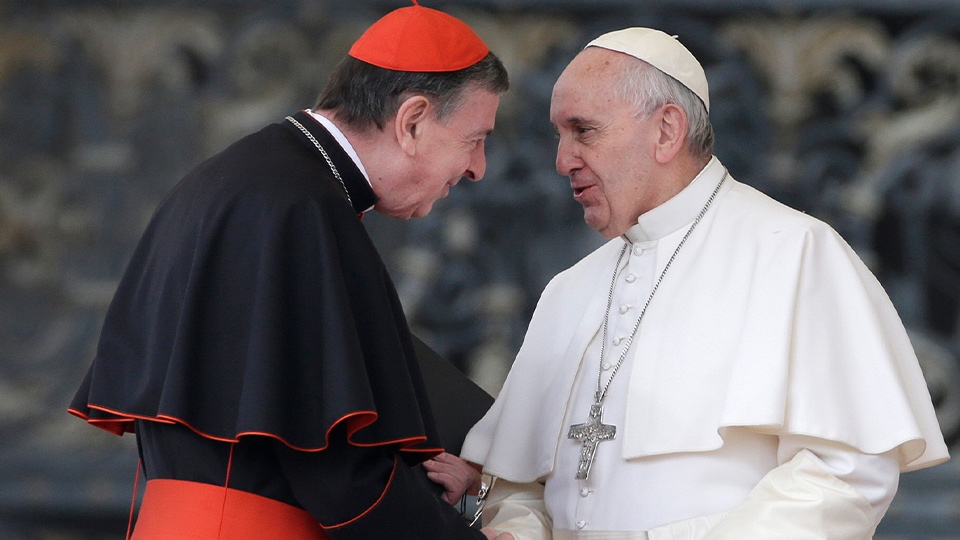
After publishing my article in The Remnant, where I provided a broad analysis of the most prominent papabili for the upcoming Conclave, some readers expressed concerns about my decision to place Cardinal Kurt Koch in the more left-leaning wing of the spectrum, among the most modernist figures.
My choice was primarily driven by two factors: the stance he has taken on two issues that lie at the very heart of not only Catholic religion but also the centuries-long struggle waged by revolutionaries against the Institution of Jesus Christ. These two issues are the Liturgy and the Papacy.
The Reform of Liturgy
Cardinal Kurt Koch has expressed support for yet another liturgical reform of a “synthetic” nature, which could be described as Hegelian in its approach. This reform aims to merge the two currently existing forms of the Roman Rite: the so-called “ordinary form” (novus ordo missae) and the so-called “extraordinary form” (vetus ordo missae), using the (arguably debatable) terminology adopted by Benedict XVI in his motu proprio Summorum Pontificum (2007).
This proposed liturgical reform carries significant implications, as it is grounded in the assumption that the two liturgical forms are related in a historicist manner. In this view, the ordinary form is seen as the development and refinement of the extraordinary form, and even as an intermediate stage toward a future liturgical form that will ultimately be the only one permitted. This “future form” is envisioned to integrate the supposed positive elements of both theological structures of the Mass.
In 2019, Cardinal Koch criticized the proposal to create an Amazon rite of the Mass, asserting that “rites are not created at a desk, but through organic growth.” However, this concept of “organic growth” raises certain concerns, as liturgy is not something that grows. Growth implies reaching maturity and perfection, but the liturgy, at its core, already attained maturity during the apostolic age and finds its doctrinal and devotional strength in the structure of the Roman Rite. This strength makes the Roman Rite in its vetus ordo form “scalable,” meaning it is suited to all the cultures humanity can produce, since rational human nature is the same in every place and in every time. Saint Paul, not coincidentally, describes worship as obsequium rationabile (cf. Romans 12, 1).
Kurt Koch has been deeply invested in ecumenism from the earliest years of his formation. The major issue seems to be that Cardinal Koch perceives the Traditional form of the Mass as a significant obstacle to ecumenical dialogue and Christian unity. This perspective is highly problematic.
Koch has also stated in this regard that “the DNA of the Church is unchangeable, as it is given in Revelation”; yet, does this correct assertion not contradict his earlier remarks on the “organic growth” of the liturgy?
The major issue seems to be that Cardinal Koch perceives the Traditional form of the Mass as a significant obstacle to ecumenical dialogue and Christian unity. This perspective is highly problematic. While it must be acknowledged that Cardinal Koch is correct in observing that the post-conciliar liturgical reform may not have fully corresponded to the intentions of the Council Fathers and that some fundamental decisions of the Constitution on Sacred Liturgy may have been omitted or possibly deliberately exceeded the Council’s recommendations, this accurate observation does not necessarily lead to the need for a Hegelian synthesis between the old and new rites—especially if the new rite is suspected to result from interpretations that may betray even the spirit of the Second Vatican Council.
The liturgical reform, which is certainly necessary and urgent, should indeed aim toward a single form within a single Rite. The coexistence of two forms within one Rite already indicates a deficiency or a state of conflict, and on this point, Cardinal Koch is absolutely right. However, such a reform should be carried out in a way that (1) addresses the deficiencies, (2) resolves the ambiguities, and (3) eliminates the distortions, including those introduced later, that are present in what is considered the “ordinary” form today.
It is important to clarify that these theological deficiencies, ambiguities and distortions present in the novus ordo Mass do not in any way undermine its sacramental validity, for it relies solely on four key aspects: the valid ordination of the minister, the minister’s proper intention to celebrate according to the Church’s will, the valid matter, and the valid form of the sacrament.
The Reform of the Papacy
Regarding the topic of the Papacy, Cardinal Kurt Koch, in his role as Prefect of the Dicastery for Promoting Christian Unity, is a signatory of the study document (non-magisterial) The Bishop of Rome: Primacy and Synodality in Ecumenical Dialogues and Responses to the Encyclical Ut Unum Sint.
This document seeks to lay the groundwork for reforming the Papacy as institution, and aligns with a theological school of thought that, while erroneous, has been dominant in the post-conciliar age.
According to this perspective, the Pope would no longer be viewed as the sole individual possessing the primacy of jurisdiction—that is, ordinary, full, supreme, absolute, and immediate power over the universal Church. Instead, he would be seen as the Bishop of Rome who, as a “bishop among bishops,” holds a primarily honorary primacy. This would consist of the ability to express the magisterium of the episcopal college, which would be understood as the true, collective (not individual) repository of infallibility.
The reasons behind this proposed reform of the Papacy are explicitly and primarily ecumenical, aiming to facilitate a supposed reunification of all Christian denominations — whether Eastern or Reformed schismatics — into a single Church, maybe one of a confederal nature.
In this model, the Pope would effectively function as the bishop who presides, arbitrates, and represents all the teaching bishops of the Church.
The reasons behind this proposed reform of the Papacy are explicitly and primarily ecumenical, aiming to facilitate a supposed reunification of all Christian denominations — whether Eastern or Reformed schismatics — into a single Church, maybe one of a confederal nature. Yet, what worth would such Christian unity hold if it came at the expense of truth and justice? “The understanding and exercise of the ministry of the Bishop of Rome entered a new phase with the Second Vatican Council,” we read on page 106 of the Document. “Since then, the ecumenical dimension has been an essential aspect of this ministry.”
This proposal for Papal reform represents yet another Hegelian synthesis, or merely a compromise, between the Catholic view (monarchical: Papa primus super pares), the Eastern view (aristocratic: Papa primus inter pares), and the Protestant view (democratic: Papa par inter pares). In doing so, however, the traditional conception of the Papacy would be undermined, both theologically and canonically. Such a shift would be deeply troubling, as the Papacy is of divine right (de jure divino) and is, by its very nature, immutable and irreformable. The consequences of altering this foundational principle would therefore be disastrous.
Traditional, conservative, or modernist?
Swiss-born and 75 years old (born in 1950), Kurt Koch has been deeply invested in ecumenism from the earliest years of his formation. Ordained in Bern in 1982, he explored themes related to interreligious dialogue, particularly engaging with Protestant theological thought. In fact, in 1987, the subject of his doctoral dissertation was the work of Wolfhart Pannenberg [1928–2014], a German theologian of evangelical denomination.
Pannenberg advocated for a radical reform of the evangelical churches in the most democratic sense possible. He also borrowed the Hegelian notion of history as a gradual manifestation of the Spirit (Zeitgeist) through various human institutions, reinterpreting human history as a “progressive revelation of God.” Consequently, Revelation, according to Pannenberg, is not yet complete, as Catholicism traditionally asserts, but ongoing — its completion would only occur at the end of the world.
In essence, the Christian God becomes flattened onto Hegel’s concept of Spirit, which is, however, a Gnostic-Masonic notion elaborated by the Prussian philosopher Georg Hegel [1770–1831], a 22nd-degree Mason in the Scottish Rite Ancient and Accepted.
Hegel secularized, “popularized,” and disseminated this Masonic philosophy at an academic level. (I analyzed this crucial aspect of modern philosophical history in a chapter of my book La Tiara e la Loggia, Verona: Fede & Cultura, 2023, currently available only in Italian.)
It is important to emphasize that I am not asserting Koch believes Christian revelation remains incomplete. Rather, I am saying that conclusions arising from these Hegelian-inspired premises might not lead to the most fortunate outcomes.
Returning to the doctoral thesis of the young Koch, Pannenberg’s theology of history becomes “paradigmatic for ecumenical theology.” Simply put, Koch suggests that the world, understood as the universe—the totality of all that exists—would reveal the presence and action of God in the same way as the sacraments, as a sign and vehicle of grace.
Unlike the God of the Bible, Hegel’s Spirit coincides with the universe (pantheism); it is not immutable, impassible, or eternal, but rather subject to temporality. When the attributes of Hegel’s Spirit are applied to the Christian God, the latter becomes a completely different deity. In this way, Pannenberg’s theology aligns with a broader contemporary theological movement known as process theology. This school of thought posits that God evolves along with the world, is influenced by it, and in turn, influences worldly processes, experiences emotions, and changes His will based on circumstances.
Pannenberg’s theology, therefore, shares significant affinities with modernist and neo-modernist theology, which infiltrated and spread within Catholic thought throughout the 19th and 20th centuries. This trajectory ultimately culminates in pantheism, as highlighted by Pope St. Pius X [1835–1914] in his masterful encyclical Pascendi Dominici Gregis (1907), where he thoroughly explains what modernism is and how to effectively refute it.
Returning to the doctoral thesis of the young Koch, Pannenberg’s theology of history becomes “paradigmatic for ecumenical theology.” According to Koch, the tension between secular philosophy and Christian theology could be resolved, and even transformed into a solid relationship, if the sacramental transparency of the reality of the world were taken seriously and philosophical theology were understood in this sense as sacramental theology.
Simply put, Koch suggests that the world, understood as the universe—the totality of all that exists—would reveal the presence and action of God in the same way as the sacraments, as a sign and vehicle of grace.
In this idea, there are evident parallels (note: not coincidences) with the thought of the neo-modernist Jesuit Pierre Teilhard de Chardin, a self-admitted pantheist, who viewed the world as a sacrament, and a place of evolution and growth toward divine perfection. However, in his work, Koch demonstrates a precise and unique intention: since God progresses with the world and humanity, Christian unity becomes desirable and achievable, not in the sense of converting all non-Catholics to Catholicism, but rather as a journeying together in the understanding that truth does not fully belong to any one Christian denomination. Instead, it is, so to speak, distributed among all denominations, perhaps with greater intensity in Catholicism.
In other words, the Church must become synodal, not only among Catholics but also with other Christians.
“How certain is Koch of his principles – Vatican journalists Diane Montagna and Edward Pentin ask on The College of Cardinals Report – if he is able to so readily reverse them to align with the pope of the day?”
Indeed, Koch has also stated that “unity can only be found in faith, and therefore we must seek unity not only among today’s churches but also with the Church of the past and especially with its apostolic origins.”
This statement is insidious and only partially true: while the idea that unity is found in faith (that is, in truth) is undoubtedly correct, the second part is problematic. It seems to reinforce the idea that Catholic doctrine is not entirely aligned with apostolic doctrine, nor does it represent a coherent development of it, but rather a departure from it.
This can be seen in Koch’s view that ecumenism should address both historical changes (diachronic ecumenism) and present-day differences (synchronic ecumenism), highlighting a potential gap between the original teachings of the apostles and today’s Catholic doctrine. Such a perspective inevitably raises serious questions about the relationship between Catholic Tradition and its conformity to apostolic doctrine, and thus, to Jesus Christ Himself.
Ordained a bishop by Pope John Paul II himself in 1995, Koch served as president of the Swiss Bishops’ Conference from 2007 to 2009. In 2010, Benedict XVI called him to Rome, appointing him president of the Pontifical Council for Promoting Christian Unity and creating him a cardinal. Since 2010, he has continuously held this role, with the distinction that, from 2022, following Pope Francis’ curial reform via the apostolic constitution Praedicate Evangelium, the Pontifical Council became a Dicastery, and Koch transitioned from president to prefect.
For a time, as reported by The College of Cardinals Report, Koch showed clear openness to making priestly celibacy optional and introducing female ordination. These positions appear to have been abandoned following his curial appointments during Benedict XVI’s reign.
“How certain is Koch of his principles – Vatican journalists Diane Montagna and Edward Pentin ask on the aforementioned online portal, reflecting the cardinal’s critics – if he is able to so readily reverse them to align with the pope of the day?”
Regarding his stance on female ordination, Koch stated after Pope John Paul II’s publication of Ordinatio Sacerdotalis (1994) that the issue was closed “for now, awaiting a new Council” — similarly to remarks made in different circumstances by Cardinal Schönborn.
As Saint Paul taught, scandals, schisms, and factions are inevitable and even “necessary” (cf. 1Corinthians 11, 19), so that what is authentic and aligned with divine truth may shine forth. We must not forget that divisions among Christians are, in reality, a human error of perspective.
Ultimately, it seems that, from the very beginning of his formation, Cardinal Kurt Koch’s primary concern—so much so that it has consumed nearly all of his theological and pastoral efforts—has been the issue of Christian unity. He perceives the divisions among denominations as one of the greatest evils the Church must confront and resolve. However, this perspective risks overestimating the value of visible unity in comparison to the Church’s primary mission, which is the eternal salvation of the souls, the preservation and proclamation of right faith and right morals. Without truth, unity is false and even dangerous.
As Saint Paul taught, scandals, schisms, and factions are inevitable and even “necessary” (cf. 1Corinthians 11, 19), so that what is authentic and aligned with divine truth may shine forth. We must not forget that divisions among Christians are, in reality, a human error of perspective. The Church, though marked by human conflicts and divisions from a historical and sociological standpoint, remains mystically indivisible. For this reason, we proclaim belief in unity as an essential mark of the Church, every Sunday during the recitation of the Creed.
The Catholic church is like Our Lord’s “coat without seam, woven from the top throughout”, upon which worldly powers, rising and falling on the stage of history, vainly attempt to “cast lots” (cf. John 19, 23-24). Stat Crux dum volvitur orbis. The Cross stands firm while the world turns.