
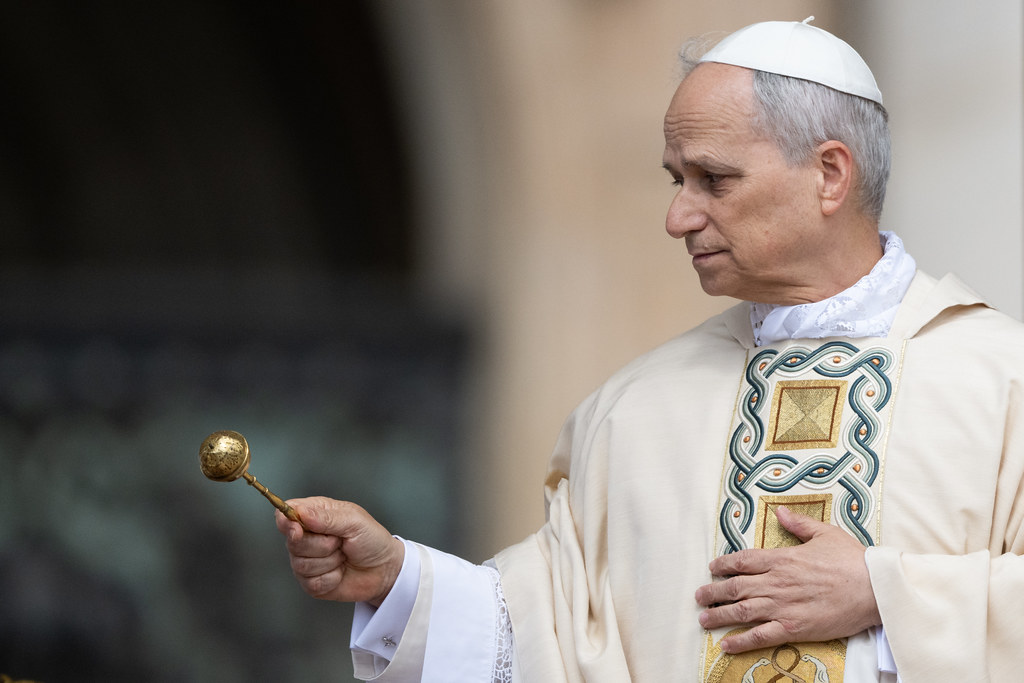

According to the Holy See Press Office, on November 15, 2025, Pope Leo gave an audience with Bishop Fernando Arêas Rifan, titular of Cedamusa and apostolic administrator of the personal apostolic administration of Saint John Vianney. Bishop Rifan’s pastoral ministry in Campos, Brazil is exclusively dedicated to Latin Mass, making him unique in the Catholic world today in that he is the only bishop whose entire pastoral ministry is centered on the Traditional Latin Mass.
In a subsequent statement, Bishop Rifan said that he used the occasion of the papal audience to express his fealty to the pope and to explain how his Tridentine community functions within the larger Church: “We asked him to continue supporting us, giving us strength, and we showed him that we preserve the liturgy in its ancient form, but in full communion with the Church. He was very pleased. Our meeting was very good – our conversation and all the support we received from him. Let us continue with God’s grace. Let us always pray for the Holy Father, Pope Leo XIV.”
So, Bishop Rifan has been a busy guy in Brazil; he never gave up the public fight for the Traditional Latin Mass and all things Catholic. And now he had the chance to meet with Pope Leo and to again push the case for the Latin Mass.
In light of Pope Leo’s September Crux interview, in which the Pope said he’d “not had the chance to really sit down with a group of people who are advocating for the Tridentine rite” but intended to do so very soon, this particular audience has attracted the attention of not a few Vatican watchers, especially those interested in the question of Leo and the Latin Mass.
Now, who is Bishop Rifan? He is the successor of Antônio de Castro Mayer, the Brazilian bishop who served as Bishop of Campos from 1949 to 1981 – and the only bishop in the Church in 1988 who had the courage to stand with Archbishop Lefebvre (and was “excommunicated” for his trouble).
Some years later, the first post-1988 successor of Antônio de Castro Mayer regularized the diocese with the Vatican under the condition that it remain exclusively Traditional Latin Mass. Now, I’m including this bit of history for the sake of full disclosure, so it won’t be necessary for anyone to accuse me of hiding the controversy that certainly ensued after Campos decided to regularize. I lived through it, and there were good men on both sides of the divide. But that’s not the point of this post.
So, here’s the question: do you think His Excellency Bishop Rifan was wrong to accept a papal audience with Pope Leo? Serious question.
My point here is to turn Bishop Rifan’s papal audience into a teaching moment for us all. So, here’s the question: do you think His Excellency Bishop Rifan was wrong to accept a papal audience with Pope Leo? Serious question. Or would you have preferred it if Bishop Rifan had told Pope Leo to pound sand, given the reports coming out of Rome lately about blessing ice cubes, sending missionary artifacts back to Indigenous Canadians, and other Francisteinian aberrations.
In other words, when we have a pope who is no traditionalist and may even be diabolically disoriented, what do we do? What should Bishop Rifan have done? Remember, this is the same Bishop Rifan who partnered with President Jair Bolsonaro six years ago when he signed the Act of Consecration of Brazil to the Immaculate Heart of Mary at the Planalto Palace.
That was then. This week, Brazil unveiled a monumental 54-metre statue of Our Lady of Fatima in Crato, surpassing Rio de Janeiro’s iconic Christ the Redeemer. The towering statue, as tall as an 18-storey building, now stands as the tallest Our Lady of Fatima monument in the world.
So, Bishop Rifan has been a busy guy in Brazil; he never gave up the public fight for the Traditional Latin Mass and all things Catholic. And now he had the chance to meet with Pope Leo and to again push the case for the Latin Mass.
Bottom line: Do we attempt to influence the pope, or not? We can’t look to someone else to help us answer this question. We have to ask ourselves what we want to see happening moving forward. Do you want faithful Catholics of influence to try to impact this pontificate, or do you want them to give up on it and allow the Jimmy Martin’s of the world full and unfettered access to the pope?
What should he have done? And what would you have done? If we’d been in his situation, would we have denounced the pope and cut off all contact with him? Or would we have taken his disorientation into account and do as Bishop Rifan did – try to exercise whatever influence we do have to potentially move the pope away from his disorientation and closer to the light of truth?
Bottom line: Do we attempt to influence the pope, or not? We can’t look to someone else to help us answer this question. We have to ask ourselves what we want to see happening moving forward. Do you want faithful Catholics of influence to try to impact this pontificate, or do you want them to give up on it and allow the Jimmy Martin’s of the world full and unfettered access to the pope? Do we want to fight for this, or do we just forfeit?
This is where the rubber meets the road. What do YOU want to do? What do you want the tradition-minded cardinals and bishops to do? What do you want the Catholic press to do? What do you want me to do?
How we answer this question is important because it determines our strategic outlook moving forward, who we support, how we pray, and even that for which we pray. We have to decide – do we sit this one out, or do we engage?
