
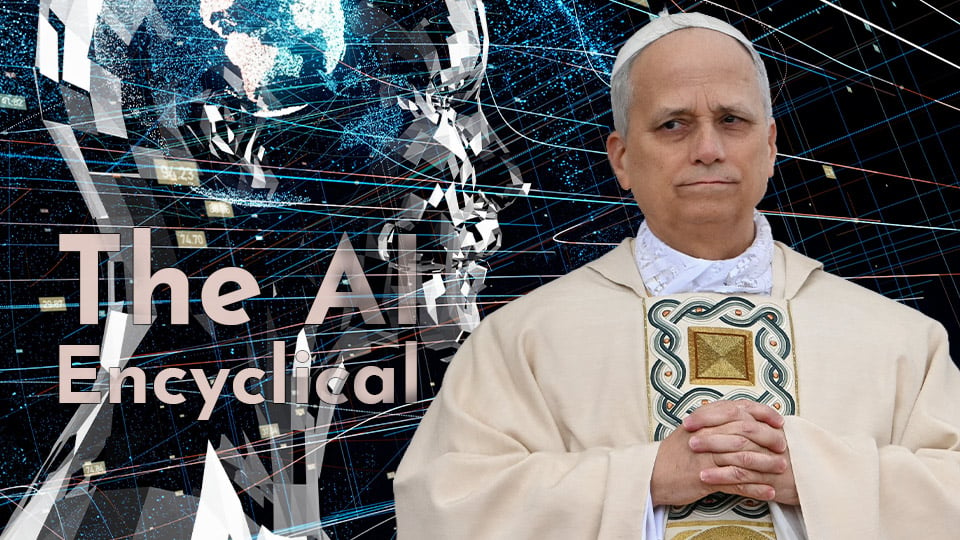

Leo XIV began his first encyclical, Magnifica Humanitas — on the safeguarding of the human person in the age of artificial intelligence (AI) — by drawing our attention to the Old Testament story of the Tower of Babel:
“Humanity, created by God in all its grandeur, is today facing a pivotal choice: either to construct a new Tower of Babel or to build the city in which God and humanity dwell together.”
Because the image of the Tower of Babel is crucial to understanding what Leo XIV has offered the Church and world with this encyclical, it is worthwhile to recall the nine verses of the Book of Genesis that tell the story:
“And the earth was of one tongue, and of the same speech. And when they removed from the east, they found a plain in the land of Sennaar, and dwelt in it. And each one said to his neighbour: Come, let us make brick, and bake them with fire. And they had brick instead of stones, and slime instead of mortar. And they said: Come, let us make a city and a tower, the top whereof may reach to heaven: and let us make our name famous before we be scattered abroad into all lands. And the Lord came down to see the city and the tower, which the children of Adam were building. And he said: Behold, it is one people, and all have one tongue: and they have begun to do this, neither will they leave off from their designs, till they accomplish them in deed. Come ye, therefore, let us go down, and there confound their tongue, that they may not understand one another’s speech. And so the Lord scattered them from that place into all lands, and they ceased to build the city. And therefore the name thereof was called Babel, because there the language of the whole earth was confounded: and from thence the Lord scattered them abroad upon the face of all countries.” (Genesis 11: 1-9)
The sin of the builders is highlighted by the words attributed to them: “Come, let us make a city and a tower, the top whereof may reach to heaven: and let us make our name famous before we be scattered abroad into all lands.” They wanted to build a tower to reach heaven, and imagined that this feat would make their names famous throughout the world. Their sin was one of pride, with the special offense of challenging God.
Leo XIV’s AI encyclical transforms the Tower of Babel into a defense of pluralism and synodality.
As we can see from Leo XIV’s description of the story of the Tower of Babel below, he highlights part of the obvious lesson — the perils of challenging God’s domain — but also suggests a few less common lessons to be drawn from the story:
“The story of Babel appears in the Book of Genesis, at the origins of humanity, immediately after the genealogies of Noah’s sons. After settling in a plain in the land of Shinar, the people decided to build a city and a tower “with its top in the heavens” (Gen 11:4). Fearing being scattered across the earth, they sought to guarantee stability and power for themselves, and above all to ‘make a name’ for themselves. It was an impressive feat: a single language, a single technology, a single direction. However, the project concealed a profound danger. It was a project conceived without reference to God, supported by a uniformity that eliminated diversity and that chose homogenization over communion. When a city is built on pride and the claim to self-sufficiency, communication breaks down, languages are confused and people no longer understand each other. The result is not unity, but dispersion. Babel thus reveals the limits of any effort that, however grandiose, arises from self-affirmation, sacrifices human dignity for efficiency and aspires to reach heaven without God’s blessing.”
At the risk of being corrected by Old Testament scholars, it seems fairly likely that most reliable interpretations of the story of the Tower of Babel have not suggested that its central message relates to the need for diversity and an affirmation of human dignity. Nonetheless, Leo used this unique understanding of the lessons from the story of the Tower of Babel as the foundation of his entire encyclical on AI.
Knowing that Leo XIV seeks to avoid these underappreciated sins of the architects of the Tower of Babel, it naturally follows that he wants us to build based on blueprints and methods that fully account for diversity and pluralism:
“We must, then, avoid the ‘Babel syndrome,’ namely the idolatry of profit that sacrifices the weak, a uniformity that neutralizes differences, and the pretense that a single language — even a digital one — can translate everything, including the mystery of the person, into data and performance. . . . Rebuilding today means recognizing that, precisely from the plurality of voices and visions which, even though they sometimes remind us of the confusion caused by the diversity of spoken languages, a bright possibility emerges. Indeed, this is the possibility of building together, of transforming diversity into a resource and of making listening and dialogue the common ground upon which to cultivate justice and fraternity. Within this shared task, Christians discover their unique role of guiding actions toward God so that, in his light, pluralism does not dissipate into disorder, but instead, through the practice of synodality, it becomes the space in which humanity rediscovers its solid foundations and its final end. In the Book of Revelation, John sees the New Jerusalem “coming down out of heaven from God” (Rev 21:2) as a gift for all humanity.”
So the way to guide our actions toward God is to transform diversity into a resource through synodality. With synodality, pluralism “becomes the space in which humanity rediscovers its solid foundations and its final end.” These are the new synodal lessons of the story of the Tower of Babel.
In the Synodal Church, diversity becomes the path to communion — even when that diversity includes doctrinal contradictions.
What, though, does Leo XIV mean by the pluralism and diversity that synodality can foster? As we know from what we have seen from the Synod on Synodality thus far, pluralism and diversity encompass doctrinal and moral differences that were hitherto impermissible in the Church (and, in reality, still are). In the Synodal Church, all are seeking truth, and it is wrong to suggest that God has entrusted His truth to the Church alone. Accordingly, Leo XIV emphasized that the Church does not have a monopoly on the truth and that we need to join our voices with those of other religions to address today’s challenges:
“Understanding that the truth is a gift to be shared, not a possession to be monopolized, frees the Church from the temptation of seeking forms of presence based on power. In order to rediscover the evangelical approach of a gentle proclamation of truth that is not imposed, Saint John Paul II invited us to examine honestly the times when acquiescence was given to ‘intolerance and even the use of violence in the service of truth.’ In this same vein, I too have reaffirmed that the Church ‘does not claim to possess a monopoly on truth,’ because truth is not a territory to be defended, but a good to be shared. . . . This attitude of openness to truth, which is at the same time both one and diverse, profoundly expresses the catholicity of the Church, for she embraces the entire human family yet is also immersed in the concrete situations of peoples and cultures. . . . In light of what has been said so far, the Church’s Social Doctrine can be seen more authentically. It is not a handbook of principles and norms to be applied, but a process of shared discernment. . . . Therefore, when the dignity of our brothers and sisters is violated, when politics fails to address the tragedies of humanity, when the economy turns against the person or science oversteps the limits of its competence, the Church — together with other Christian denominations and believers of other religions — must make her voice heard, not in order to dominate, but to promote communion.”
Catholics in past centuries certainly agreed with Leo’s sense that truth is a “good to be shared,” which is precisely why we have so many saints who dedicated their lives to spreading the true Catholic Faith. However, as Leo writes in his encyclical, the social doctrine of the Church now calls us to live by John Paul II’s “spirit of Assisi,” opening our minds to the spiritual traditions of non-Catholic religions:
“In rejecting the mindset of violence, interreligious dialogue plays a decisive role, because at the heart of the great spiritual paths lies a message of peace. Whereas those who use the name of God to legitimize terrorism, violence, or war betray his true nature, for to fight in the name of religion means attacking religion itself. The ‘spirit of Assisi,’ evoked by Saint John Paul II and carried forward by Pope Francis — for example, through his dialogue with the Grand Imam of Al-Azhar — shows that believers can draw upon the most authentic sources of their particular spiritual traditions, where there is no room for ‘sanctified hatred.’”
To his credit, Leo clearly discussed the evolution of Catholic social doctrine — from Leo XIII and Pius XII to Vatican II and John Paul II to Francis — but we ought to reflect on what it is that Leo XIII said about this in his 1891 encyclical, Rerum Novarum (to which Leo refers to over a dozen times in his encyclical). Here are passages from Leo XIII’s encyclical which clearly oppose the spirit of religious pluralism in Leo XIV’s new encyclical:
- “But We affirm without hesitation that all the striving of men will be vain if they leave out the Church. It is the Church that insists, on the authority of the Gospel, upon those teachings whereby the conflict can be brought to an end, or rendered, at least, far less bitter . . . .”
- “What advantage can it be to a working man to obtain by means of a society material well-being, if he endangers his soul for lack of spiritual food? ‘What doth it profit a man, if he gain the whole world and suffer the loss of his soul?’ This, as our Lord teaches, is the mark or character that distinguishes the Christian from the heathen. ‘After all these things do the heathen seek . . . Seek ye first the Kingdom of God and His justice: and all these things shall be added unto you.’ . . . Let the working man be urged and led to the worship of God, to the earnest practice of religion, and, among other things, to the keeping holy of Sundays and holy days. Let him learn to reverence and love holy Church, the common Mother of us all; and hence to obey the precepts of the Church, and to frequent the sacraments, since they are the means ordained by God for obtaining forgiveness of sin and for leading a holy life.”
- “But the Church, not content with pointing out the remedy, also applies it. For the Church does her utmost to teach and to train men, and to educate them and by the intermediary of her bishops and clergy diffuses her salutary teachings far and wide. She strives to influence the mind and the heart so that all may willingly yield themselves to be formed and guided by the commandments of God. It is precisely in this fundamental and momentous matter, on which everything depends, that the Church possesses a power peculiarly her own. The instruments which she employs are given to her by Jesus Christ Himself for the very purpose of reaching the hearts of men, and drive their efficiency from God. They alone can reach the innermost heart and conscience, and bring men to act from a motive of duty, to control their passions and appetites, to love God and their fellow men with a love that is outstanding and of the highest degree, and to break down courageously every barrier which blocks the way to virtue.”
It is evident from these passages that Leo XIII believed that the Church’s perspective on social doctrine was vital because God has appointed the Church as the sole instrument of dispensing the divinely revealed religious and moral truth that should guide all men. Of course, men can arrive at certain natural truths through the exercise of reason, without divine revelation; but Leo XIII understood that only the Catholic Church is guided by God to disseminate His truth.
Leo XIII taught that the Church uniquely possesses divine truth. Leo XIV argues that truth must be shared across religions.
Again, Leo XIV discussed the “evolution” of Catholic teaching in his encyclical, and so he presumably understood that his encyclical conflicts with Rerum Novarum on this point. What, though, does this evolution look like in light of the story of the Tower of Babel? Leo XIV’s notion that the story tells us about the necessity of pluralism and diversity would suggest that Leo XIII’s words about the unique value of Catholicism were misguided. However, if we simply read the story of the Tower of Babel like serious people have for thousands of years, it should be clear that evolving away from the truth that God has given us — to solve social problems without His truth — mimics the sin of the prideful architects. Who is right?
For a common-sense check on this, we can consider the words of Fr. John A. Perricone from his January 16, 2024 article on the Synod:
“The Synodal Way considers truth an intrusion. These Synodal trailblazers have successfully erected a new Tower of Babel. Their breezy debasement of language, and the words which are its glue, is ultimately a defiant mockery of the Word.”
That makes much more sense and comports with the tragic reality that we have all seen since Francis started building the Synodal Church. So synodality imitates the sins of those who tried to build the Tower of Babel. For this reason, Leo XIV’s first encyclical — as well-intentioned and sincere as it seems — builds upon a fundamentally flawed foundation. Other than that, the new encyclical is probably worthy to be included in the list of top-100,000 pieces that have been written about AI this year. If he had written it from a Catholic perspective, it might have been the best, but that would have required a humble submission to God’s unadulterated truth that eschews the pluralism that has reigned in Rome since Vatican II. Immaculate Heart of Mary, pray for us!