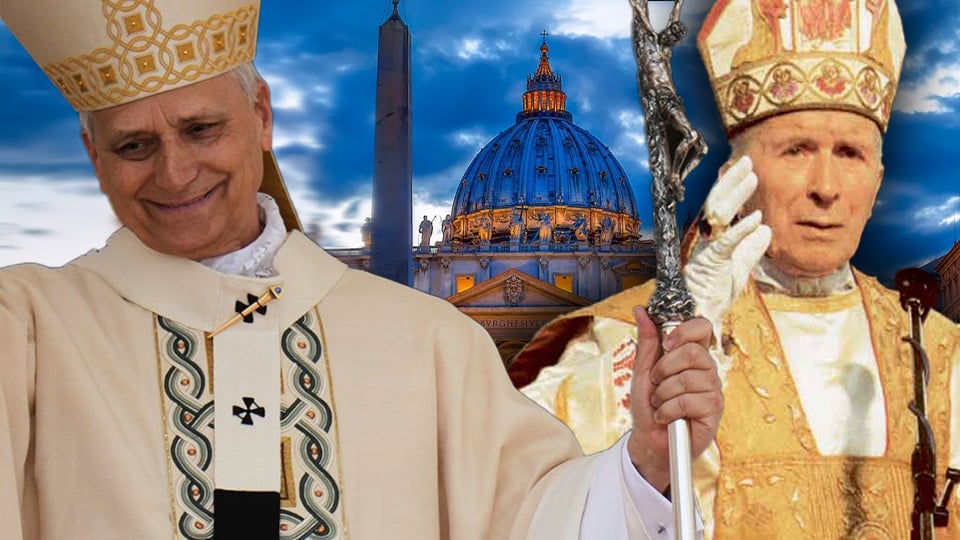

Of the 245 paragraphs of Leo XIV’s encyclical “on the safeguarding of the human person in the age of artificial intelligence (AI),” Magnifica Humanitas, four of them (86 through 89) relate to an “examination of conscience for the Church”:
“In conclusion, I would like to touch on a point that is particularly close to my heart. Social Doctrine is not merely a message addressed to society; it is also an examination of conscience for the Church — a home and school of communion that is always called to ensure that the principles outlined in this chapter are applied, especially within its own structures.” (86)
Although the “examination of conscience” described in the encyclical relates primarily to matters of social doctrine, we can apply the same principles outlined by Leo to matters related more specifically to how the Church treats Catholics. As such, the analysis that follows applies the examination of conscience from Magnifica Humanitas to the situation of the Society of Saint Pius X (SSPX).
If synodality means listening to marginalized consciences, then Rome cannot exclude the SSPX without contradicting its own principles.
To begin with, it is worthwhile to recall the words of Pius XII from his 1943 encyclical on the Mystical Body of Christ, Mystici Corporis Christi, regarding the limited way in which we can attribute fault to the Catholic Church:
“And if at times there appears in the Church something that indicates the weakness of our human nature, it should not be attributed to her juridical constitution, but rather to that regrettable inclination to evil found in each individual, which her Divine Founder permits even at times in the most exalted members of His Mystical Body, for the purpose of testing the virtue of the Shepherds no less than of the flocks, and that all may increase the merit of their Christian faith. For, as We said above, Christ did not wish to exclude sinners from His Church; hence if some of her members are suffering from spiritual maladies, that is no reason why we should lessen our love for the Church, but rather a reason why we should increase our devotion to her members. Certainly the loving Mother is spotless in the Sacraments by which she gives birth to and nourishes her children; in the faith which she has always preserved inviolate; in her sacred laws imposed on all; in the evangelical counsels which she recommends; in those heavenly gifts and extraordinary grace through which with inexhaustible fecundity, she generates hosts of martyrs, virgins, and confessors. But it cannot be laid to her charge if some members fall, weak or wounded. In their name she prays to God daily: ‘Forgive us our trespasses;’ and with the brave heart of a mother she applies herself at once to the work of nursing them back to spiritual health.”
As we can see, the Church is spotless in the Sacraments, faith, sacred laws, and other aids to our salvation. However, it is still the case that the Church is composed of sinners who can act against what the Church actually teaches.
In evaluating Leo’s examination of conscience for the Church, we can assume for the sake of argument that it comports with the understanding Pius XII set forth. To the extent that it does not, the encyclical’s author(s) would be at fault — but this would not therefore become a “fault of the Church.” With this understanding in mind, we can simply use the measure provided by Leo’s new encyclical to measure the current situation with the SSPX and Rome.
Synodal Approach for the Common Good
Paragraph 86 of Magnifica Humanitas reads as follows:
“In conclusion, I would like to touch on a point that is particularly close to my heart. Social Doctrine is not merely a message addressed to society; it is also an examination of conscience for the Church — a home and school of communion that is always called to ensure that the principles outlined in this chapter are applied, especially within its own structures. In the ecclesial context, the common good takes the form of a synodal approach for mission at the service of the Kingdom. Indeed, the Church is the ‘communitarian and historical subject of synodality and mission.’ This requires attention to the way decisions are taken and responsibilities are exercised. The Final Document of the Synod identifies a culture of transparency, accountability, and evaluation as key practices for missionary transformation.”
According to Leo XIV’s own framework, coercing Traditional Catholics against conscience could constitute an ‘abuse of power.
In the ecclesial context (which would apply to the SSPX situation), “the common good takes the form of a synodal approach for mission at the service of the Kingdom.” The key concepts in the “Final Document” (of the October 2024 session of the Synod on Synodality) to which Leo referred include: “listening,” “diversity,” and “acceptance” of those who are trying to follow their consciences. Here, for example, is what paragraph 55 of the Final Document says:
“Many of the evils that afflict our world are also visible in the Church. The abuse crisis,
in its various and tragic manifestations, has brought untold and often ongoing suffering to
victims and survivors, and to their communities. The Church needs to listen with special
attention and sensitivity to the voices of victims and survivors of sexual, spiritual, economic,
power, and conscience abuse by members of the clergy or persons with Church appointments.
Listening is a fundamental element of the path to healing, repentance, justice, and reconciliation.”
Understandably, many Traditional Catholics read this with consternation — after all, it seems that the legacy of Francis has been to embrace those who believe almost anything other than the Church’s unadulterated truth, and simultaneously to condemn and persecute those who would rather die than deny a single doctrine of the Faith. Nonetheless, this is the measure that Leo has chosen for his examination of conscience for the Church, so it seems that he is bound to follow it.
What, then, would a truly synodal approach to the SSPX situation look like? Surely it would entail something like the following:
- Respectfully accepting, and even nourishing, the beliefs held by members of the SSPX, which are truly based on a conscientious desire to adhere to the Catholic Faith.
- Refraining from any manifestations of tyrannical opposition to those who sincerely seek to follow the Catholic Faith.
- Seeking ways to resolve differences of opinion that do not torture consciences.
Members of the SSPX might scoff at these synodal ideas, but Leo and the Vatican are bound to abide by them if they want to truly respect the synodal process. As such, it is evident that it would be a great “violation of synodal conscience” for the Vatican to censure the SSPX for its planned consecrations of bishops, especially given the reality that the SSPX evidently wants to preserve union with Rome.
The Vatican cannot celebrate ‘diverse sensibilities’ for progressives while punishing Catholics attached to Tradition.
Valuing Charisms and Avoiding Paternalism that Suffocates Evangelical Freedom
Paragraph 87 of Magnifica Humanitas reads as follows:
“With this in mind, subsidiarity becomes the guiding principle for governance and pastoral life. It involves recognizing and supporting the faithful and intermediary ecclesial organizations as they carry out their responsibilities, valuing charisms and skills and avoiding any form of paternalism that suffocates evangelical freedom. In practical terms, the participation of the baptized in decision-making processes and their shared responsibility in the mission are achieved through genuine, rather than merely nominal, participatory bodies.”
Among the several different ideas in this paragraph, we find an emphasis on valuing charisms and avoiding suffocating paternalism. A particular “charism” that is especially undervalued today is one which Archbishop Marcel Lefebvre mentioned in his 1989 sermon on the sixtieth anniversary of his ordination:
“Moreover, we must not only defend our Faith; we ought to profess it. Here is the ending of the Anti-modernist Oath of St. Pius X. May we often repeat these words: ‘I firmly hold, and shall hold to my dying breath, the belief of the Fathers in the charism of truth, which certainly is, was, and always will be in the succession of the episcopacy from the Apostles. The purpose of this (charism) is, then, not that dogma may be tailored according to what seems better and more suited to the culture of each age; rather, that the absolute and immutable truth preached by the Apostles from the beginning may never be believed to be different, may never be understood in any other way.’”
Of course, St. Pius X’s Oath Against Modernism was abandoned after Vatican II, but adhering to the “charism of truth” is obviously legitimate and worthy of being valued rather than paternalistically suffocated. As such, it is evident that it would be a great “violation of synodal conscience” for the Vatican to censure the SSPX for its planned consecrations of bishops, especially given the reality that the SSPX evidently wants to preserve union with Rome.
Pope Leo’s encyclical may have unintentionally supplied the strongest argument yet against any crackdown on the SSPX.
Diverse Sensibilities and Strong Convictions are Sources of Richness
Paragraph 88 of Magnifica Humanitas reads as follows:
“For the Christian community, solidarity finds its source in the mystery of Christ and is nourished by the Eucharist. Solidarity emerges from communion in faith and the Sacraments: Baptism and Confirmation unite us in Christ, so that we may become one Body and one Spirit, one heart and one soul (cf. Eph 4:4; Acts 4:32). The Eucharist, which is the sacrament of unity, nurtures our belonging to the Body of Christ and teaches us how to share. The diverse sensibilities present in the Church and the strong convictions that animate each person are a source of richness if they remain anchored in the certainty that unity is a gift received and a responsibility to be fulfilled.”
Here again we see the great value placed on Christian unity, with a focus on the solidarity that emerges from faith and the sacraments. Consistent with synodality, Leo emphasizes the value of “diverse sensibilities” and “strong convictions,” which is a proxy for viewpoints that do not exactly match official Church teaching. It should be obvious that the SSPX’s strong conviction that it must adhere to what the Church has always taught is worthy of being included among the “diverse sensibilities” in the Church. As such, it is evident that it would be a great “violation of synodal conscience” for the Vatican to censure the SSPX for its planned consecrations of bishops, especially given the reality that the SSPX evidently wants to preserve union with Rome.
If the synodal Church can accommodate open dissenters, why not Catholics who simply wish to preserve what the Church always taught?
Preventing the Harm Associated with Abuse of Consciences
Paragraph 89 of Magnifica Humanitas reads as follows:
“Living out justice in the Church means purifying ecclesial relationships and structures from distortions that give rise to inequality, lack of transparency, and abuse of power. In this regard, listening to the victims of spiritual, economic, institutional, sexual, and power-based abuse, as well as abuses of conscience, is an integral part of a journey toward justice, which includes acknowledging the harm done, just reparation, and taking steps to prevent it from happening again. Every power is at the service of communion and mission. All authority is at the service of the People of God. This ministry of service is expressed not only through our faith celebrated and lived in the Sacraments, and in the adoption of a synodal style, but also in the concrete sharing of goods. Following the example of the early Church, ecclesial resources need to be shared so that no one among us may be in need (cf. Acts 4:34), and so that their administration may support the mission of proclaiming the Gospel to the poorest. Regular assessments of the exercise of ministerial responsibilities should be encouraged, not as judgments on individuals, but as tools for learning and correction oriented toward mission. Only to the extent that we are open to the action of the Holy Spirit will these principles of Social Doctrine become incarnate in ecclesial life. In this way, the Church will be able to bear credible witness to society that seeking the common good together, with shared responsibility and fraternity, is not a utopia, but a real possibility.”
As with the passage quoted above from the Final Document of the 2024 session of the Synod on Synodality, this paragraph emphasizes the synodal virtues of listening to the marginalized, including those who suffer from “abuses of conscience.” It is almost certainly the case that there can be no greater conceivable “abuse of conscience” than wielding the ostensible power of the Catholic Church to coerce a Traditional Catholic into acting against his or her well-formed conscience. As such, it is evident that it would be a great “violation of synodal conscience” for the Vatican to censure the SSPX for its planned consecrations of bishops, especially given the reality that the SSPX evidently wants to preserve union with Rome.
And so, according to Leo’s encyclical, it seems beyond the slightest doubt that censuring the SSPX for consecrating bishops would be a grave sin. May God grant Pope Leo XIV the grace to avoid this tremendous scandal that would clamor for God’s punishment. If the synodal conscience compels the Vatican to promote homosexual bishops to advance homosexual ideologies that are unambiguously anti-Catholic, surely Leo can bring himself to accommodate those who would rather die than betray the unadulterated Catholic Faith. Immaculate Heart of Mary, pray for us!