
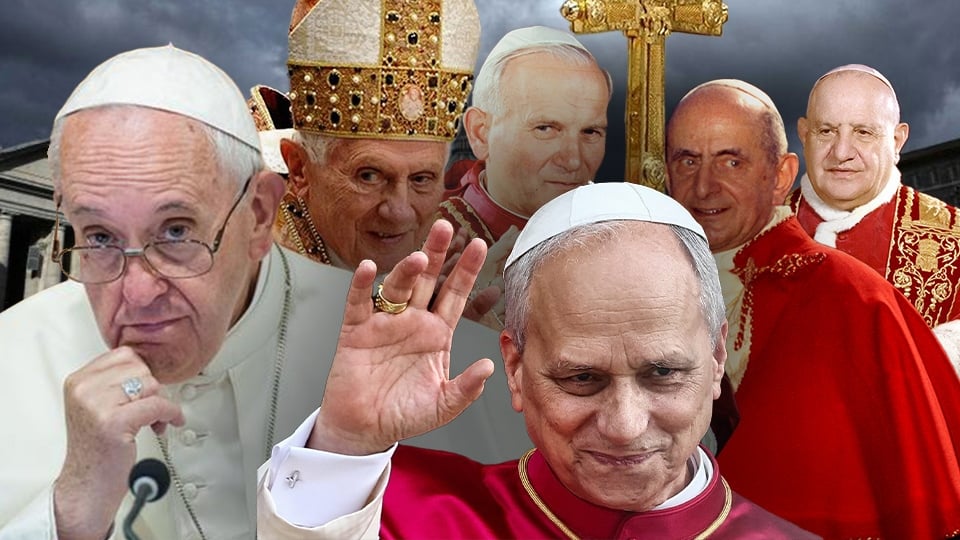

During his May 28, 2026 address to participants in the plenary assembly of the dicastery for evangelization, Leo XIV bemoaned the “crisis of faith” that has given rise to religious indifference:
“We cannot underestimate the fact that, especially in Western countries, the crisis of faith, together with other socio-cultural factors, has given rise to widespread religious indifference. To many, faith no longer appears relevant to their lives.”
These are perhaps the most relevant and important words that Leo XIV has spoken in his entire papacy, regardless of whether he actually appreciates their real significance. We are indeed suffering a crisis of faith that has led to widespread religious indifference, especially in Western countries. Unfortunately, though, Leo has thus far done nothing to curtail this plague, and indeed has contributed to its spread.
The answer to the crisis of faith may be right in front of Leo XIV—but the errors that have shaped Rome since Vatican II prevent him from seeing it.
Gregory XVI provided one of the most important explanations of this religious indifferentism in his 1832 encyclical on liberalism and religious indifferentism, Mirari Vos. Gregory XVI introduced his discussion of the evil of indifferentism as follows:
“Now We consider another abundant source of the evils with which the Church is afflicted at present: indifferentism. This perverse opinion is spread on all sides by the fraud of the wicked who claim that it is possible to obtain the eternal salvation of the soul by the profession of any kind of religion, as long as morality is maintained. Surely, in so clear a matter, you will drive this deadly error far from the people committed to your care. With the admonition of the apostle that ‘there is one God, one faith, one baptism’ may those fear who contrive the notion that the safe harbor of salvation is open to persons of any religion whatsoever. They should consider the testimony of Christ Himself that ‘those who are not with Christ are against Him,’ and that they disperse unhappily who do not gather with Him. Therefore ‘without a doubt, they will perish forever, unless they hold the Catholic faith whole and inviolate.’”
From these words, we can see why there is such widespread religious indifferentism today: it is spread through the ideas that animate the false ecumenism that has dominated in Rome since the death of Pius XII. Indeed, in the Vatican II documents themselves, we can see what Gregory XVI described as “the fraud of the wicked who claim that it is possible to obtain the eternal salvation of the soul by the profession of any kind of religion.” Here, for example, are words from the Decree on Ecumenism, Unitatis Redintegratio, which Gregory XVI surely would have condemned at first glance:
“Moreover, some and even very many of the significant elements and endowments which together go to build up and give life to the Church itself can exist outside the visible boundaries of the Catholic Church: the written word of God; the life of grace; faith, hope, and charity, with the other interior gifts of the Holy Spirit, and visible elements too. All of these, which come from Christ and lead back to Christ, belong by right to the one Church of Christ. The brethren divided from us also use many liturgical actions of the Christian religion. These most certainly can truly engender a life of grace in ways that vary according to the condition of each Church or Community. These liturgical actions must be regarded as capable of giving access to the community of salvation. It follows that the separated Churches and Communities as such, though we believe them to be deficient in some respects, have been by no means deprived of significance and importance in the mystery of salvation. For the Spirit of Christ has not refrained from using them as means of salvation which derive their efficacy from the very fullness of grace and truth entrusted to the Church.”
Although defenders of Vatican II imagine these words to be sufficiently orthodox, most rational people can understand why this conflicts with what Gregory XVI wrote. If the Catholic Church teaches that non-Catholic religions “can truly engender a life of grace” and are used by God as means of salvation, then obviously one does not need to be a Catholic.
Gregory XVI continued with words that are even more problematic for those who promote the ecumenism of Vatican II:
“With the admonition of the apostle that ‘there is one God, one faith, one baptism,’ may those fear who contrive the notion that the safe harbor of salvation is open to persons of any religion whatsoever. They should consider the testimony of Christ Himself that ‘those who are not with Christ are against Him,’ and that they disperse unhappily who do not gather with Him. Therefore, ‘without a doubt, they will perish forever, unless they hold the Catholic faith whole and inviolate.’”
If we want to save our souls, we must “hold the Catholic faith whole and inviolate.” While the Church’s teaching on invincible ignorance still applies, this does not in any way suggest that it is the Church’s role to foster invincible ignorance by misleading souls into believing that they can save their souls in false religions! In other words, the Catholic Church’s mission is to lead all souls to the religion given to us by God; only Satan and the Church’s enemies benefit from Rome’s message that non-Catholics do not really need to convert. If we understand this, then we can better grasp the diabolical insanity of the false ecumenism that has proliferated so freely since the Council.
A Church that teaches non-Catholic religions can be means of salvation should not be surprised when souls conclude that conversion is unnecessary.
Still, some might argue that the Council’s teachings are merely ambiguous and not really problematic. Here, though, is what Gregory XVI taught about the need for vigilance against ambiguity:
“Therefore, united in spirit, let us promote our common cause, or more truly the cause of God; let our vigilance be one and our effort united against the common enemies. Indeed, you will accomplish this perfectly if, as the duty of your office demands, you attend to yourselves and to doctrine and meditate on these words: ‘the universal Church is affected by any and every novelty’ and the admonition of Pope Agatho: ‘nothing of the things appointed ought to be diminished; nothing changed; nothing added; but they must be preserved both as regards expression and meaning.’”
If the truths of the Faith “must be preserved both as regards expression and meaning,” then the ambiguity of Vatican II is itself a tremendous evil, not something that absolves the Council documents from blame.
Leo XIV was just ten years old when Vatican II closed, so his religious formation has been dominated by teachings that are full of the ambiguities and errors that both flow from, and contribute to, the evil of religious indifferentism. Thus, we should not be surprised to find that some passages from his address against indifferentism actually tend to foster indifferentism. Here, for example, is a passage in which it seems to be deliberately referring to the Christian faith (including non-Catholic beliefs) as opposed to Catholicism:
“Thanks be to God, there are numerous and varied initiatives throughout the world through which Christian communities, associations, movements, and ecclesial groups meet young people, listen to them, and engage in dialogue with them. . . . The transmission of faith, in this context, necessarily involves encountering people and communities who express the joy of the Christian faith and the coherence of a Gospel-inspired way of life. It is certainly not by watering down the content or softening the demands that Christianity can be made attractive, but by bearing witness with humility and courage to ‘the way, the truth, and the life’ that has converted and sanctified so many people.”
He speaks of “Christian communities,” “the joy of the Christian faith,” and “the coherence of a Gospel-inspired life.” If, as it seems, he means all Christian denominations — such that Catholicism would be alongside Protestantism — this is indifferentism. If, on the other hand, he is simply speaking with ambiguity, then this too contributes to indifferentism. Besides, after sixty years of false ecumenism and five years of the Synod on Synodality, we know that the expressions used by Leo typically refer to all Christians.
At least indirectly, Leo’s praise of Francis’s Evangelii Gaudium also tends to promote the spirit of indifferentism:
“Pope Francis’ Apostolic Exhortation Evangelii Gaudium ‘continues to be a significant point of reference. In addition to introducing new content, it refocuses everything on the kerygma as the heart of our Christian and ecclesial identity’ (Letter to the Cardinals, 22 April 2026). I therefore invite you too to revisit Evangelii Gaudium in your work at every level, to promote a mission that is ‘Christ-centred and kerygmatic . . . born of an encounter with Christ that is capable of transforming lives.’”
Here is what Francis’s Evangelii Gaudium says about the need for Christians to focus on what unites rather than what divides, for the sake of spreading the Gospel in Asia and Africa:
“Given the seriousness of the counter-witness of division among Christians, particularly in Asia and Africa, the search for paths to unity becomes all the more urgent. Missionaries on those continents often mention the criticisms, complaints, and ridicule to which the scandal of divided Christians gives rise. If we concentrate on the convictions we share, and if we keep in mind the principle of the hierarchy of truths, we will be able to progress decidedly towards common expressions of proclamation, service, and witness. The immense numbers of people who have not received the Gospel of Jesus Christ cannot leave us indifferent. Consequently, commitment to a unity which helps them to accept Jesus Christ can no longer be a matter of mere diplomacy or forced compliance, but rather an indispensable path to evangelization. Signs of division between Christians in countries ravaged by violence add further causes of conflict on the part of those who should instead be a leaven of peace.”
It is abundantly clear from these words that Francis was promoting an indifferentism that was completely antithetical to the words of Gregory XVI above. Whether Leo would agree with this passage or not, he endorsed it through his encouragement to revisit the entire document as a resource for evangelization.
Until Rome returns to the principles taught by Gregory XVI in Mirari Vos, religious indifferentism will continue to flourish under the banner of ecumenism.
Tragically, the plague of indifferentism is also perpetuated by Leo’s failure to condemn the errors that have thrived in Rome since the Council. This is not a surprise, for he shares this failure with his predecessors, but we sometimes forget that the Vatican’s tacit approval of heretical beliefs signals that the truth is not actually worth defending.
It seems entirely possible that Leo is genuinely concerned about the crisis in the Church in general and religious indifferentism in particular. However, the remedies for these evils have been rejected by Rome since the Council and replaced by the false ecumenism movement that invariably promotes religious indifferentism. It is as though the answer is right in front of him, but he is blind to it because he is infected with errors that have defined Rome since the Council.
If Leo truly wants to address the crisis of faith and indifferentism he bemoaned in his address, he has no choice but to return to what Gregory XVI taught in Mirari Vos. Until he (or a successor) does that, the Vatican will continue to spread the heretical message that any set of Christian beliefs — other than Traditional Catholicism — is sufficient for salvation. For this reason, the true friends of the Catholic Church, and even of Leo, are those who would rather die than abandon the Faith that Gregory XVI sought to safeguard. Immaculate Heart of Mary, pray for us!