
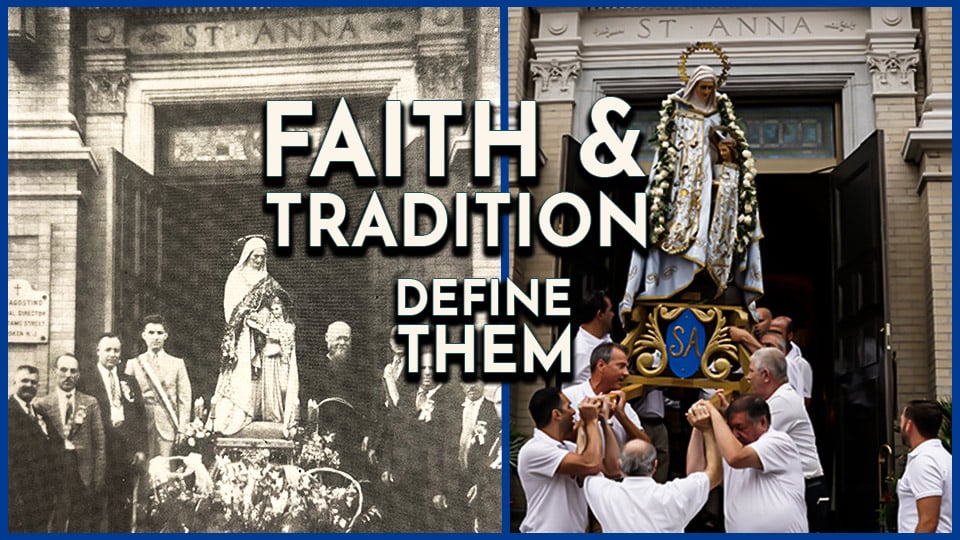

The recent reporting that Mayor Mamdani’s administration temporarily erased Little Italy from official New York City maps arrives with a kind of bitter irony.
At the very moment the rookie mayor decided to scrub one of the city’s oldest ethnic enclaves off the map, the Pennsylvania Coal Region was preparing to celebrate the feast of San Marziale, a festival that keeps Italian‑American identity alive in the most grassroots way possible: parish halls, family recipes, and traditions carried forward by people who never needed a tourism brochure to know who they are.
Italian-American identity was never confined to a single neighborhood—it lives wherever families keep their traditions alive.
The Italian‑American communities of Kulpmont, Shamokin, and Mount Carmel, where the scent of peppers and onions still drifts through parish halls, offer a cultural richness that practically begs to be celebrated during San Marziale’s festival weekend. Last year, I wrote a playful satire about Pennsylvanian Italians that struck a chord locally, not because it was provocative, but because it was rooted in affection for the people who keep these traditions alive.
At its heart, that earlier piece was a celebration a humorous look at the quirks, customs, and culinary habits that make Pennsylvanian Italians distinct. The humor worked because it came from familiarity. Having grown up among Italian-Americans in New York, I know the cadence of the community and the difference between gravy that simmers for five hours and a jar of Ragu that should never see the light of day. My last name and my mother’s maiden name, Ferraiuolo, sing all the vowels of southern Italy.
The point then and now is simple: Italian‑American identity is not monolithic. New York Italians, Pennsylvania Italians, New Jersey Italians are all branches of the diaspora which nurtures its own customs, its own culinary traditions, and its own lexicon of endearments, insults, and unmistakable accents.
The Coal Region preserved something no government can erase: faith, family, sacrifice, and memory.
This diversity is no weakness. It is the very thing that made Italian‑American culture so durable, so adaptable and so beloved.
The deeper truth behind the satire is historical. The divide between Northern and Southern Italians predates Ellis Island by centuries. The comparison to America’s own North/South tensions helps explain why the Italian migration was not a single wave of identical families arriving with identical stories. It was a mosaic of regions, dialects, and traditions that collided, blended, and eventually became the Italian‑American identity we know today.
And nowhere is that mosaic more poignant than in Pennsylvania’s Coal Region.
The descendants of those “Coal Cracker” miners who clawed anthracite from the earth carry a heritage forged in danger, sacrifice, and unshakeable loyalty. These were the people who sent the coal that powered the steel mills that built New York City.
They formed the backbone of an industrial chain stretching from the mines of Northumberland County to the skyscrapers of Manhattan. To tease them about plastic wrapped furniture or mispronounced Italian dishes is not to diminish them. It is to acknowledge the fullness of their story: the grit, the humor, the stubbornness, the pride.
The satire also paid tribute to the immigrant experience itself from Italian, Polish, Lithuanian, Irish, Slovak, Ukrainian, and every other nationality that carved out a life in the hardscrabble Coal Region towns.
Little Italy is more than a place. It is a people.
These communities did not merely survive hardship; they transformed it into culture, cuisine, faith, and family. They built churches, raised children, buried their dead, and kept traditions alive even when the mines closed and the world moved on.
Satire is a mirror angled just enough to make the truth uncomfortable. Taken literally, it sounds absurd. Taken contextually, it hits like a confession. The problem isn’t satire missing the mark; it’s readers missing the wink.
When done well, satire is an act of affection a way of saying: I know you. I see you. I am one of you. It honors the Coal Region’s Italian-American heritage by celebrating its quirks, its contradictions, and its enduring spirit.
In the end, the piece was not a jab; it was a toast.
A toast to the Zanellas, the DeFrancescos, and the various ways you spell Scicchitano. To every family that keeps a pot of gravy simmering on Sunday morning even as the world outside is collapsing. A toast to the shared heritage that binds New York Italians and Pennsylvania Italians far more than it divides them.
Vittoria Italiana, indeed.