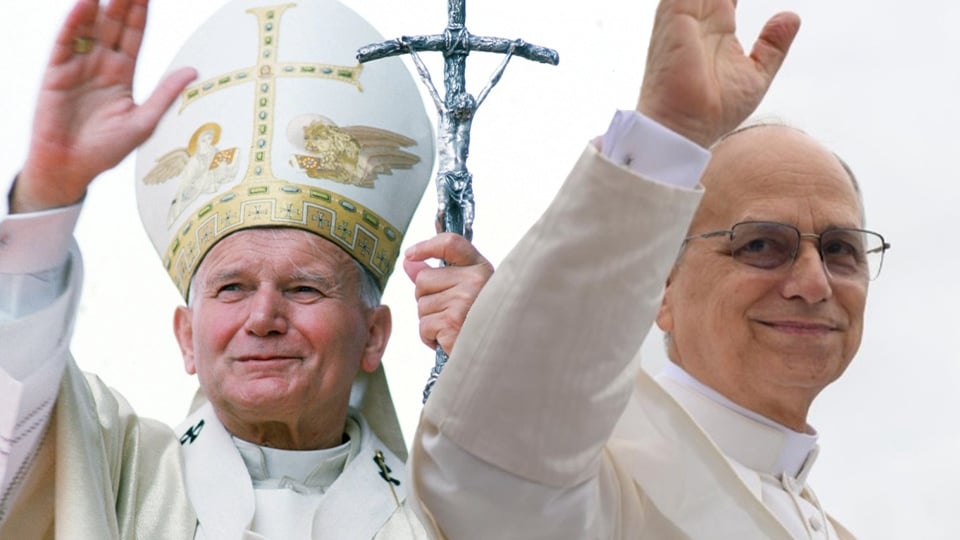

We do not yet know how, if at all, Pope Leo XIV will attempt to resolve the conflict between the thoughts of Francis and John Paul II on the one hand, and those of St. Augustine on the other. To better understand how Catholics should want Leo XIV to resolve the conflict, though, we can consider the ways in which John Paul II’s Ut Unum Sint contradicts what St. Augustine taught.
May 25, 2025 was the thirtieth anniversary of John Paul II’s encyclical “on commitment to Ecumenism,” Ut Unum Sint. It was also the publication date of Austen Ivereigh’s article on Pope Leo XIV, in which he described both the close relationship between the pope and Francis, as well as the way in which the ideas of St. Augustine may shape the new pontificate:
“Leo has already used the freedoms Francis won to make his own decisions about how to dress and where to live. He is much younger than Benedict and Francis were when they were elected; he uses X and WhatsApp; he speaks fluent American English. But he has made clear that he will continue to build the synodal Church of which Francis dreamed, while likely reformulating some of the themes of Francis’s pontificate in more Augustinian terms.”
Leo XIV was close to Francis, but he is also an Augustinian who has already quoted St. Augustine in many of his public statements since the conclave. We do not yet know how, if at all, he will attempt to resolve the conflict between the thoughts of Francis and John Paul II on the one hand, and those of St. Augustine on the other. To better understand how Catholics should want Leo XIV to resolve the conflict, though, we can consider the ways in which John Paul II’s Ut Unum Sint contradicts what St. Augustine taught.
One who believes what the Church taught so clearly prior to Vatican II knows that it is truly a matter of spiritual life and death to belong to the Church. Conversely, one who believes what John Paul II taught in Ut Unum Sint thinks that people can please God and be saved as Protestants.
To begin with, we can simply look at five statements from St. Augustine that Pope Leo XIII quoted in his 1896 encyclical on the unity of the Church, Satis Cognitum:
* “Another head like to Christ must be invented – that is, another Christ – if besides the one Church, which is His body, men wish to set up another. ‘See what you must beware of — see what you must avoid — see what you must dread. It happens that, as in the human body, some member may be cut off – a hand, a finger, a foot. Does the soul follow the amputated member? As long as it was in the body, it lived; separated, it forfeits its life. So the Christian is a Catholic as long as he lives in the body: cut off from it he becomes a heretic — the life of the spirit follows not the amputated member” (S. Augustinus, Sermo cclxvii., n. 4).”
* “St. Augustine notes that other heresies may spring up, to a single one of which, should any one give his assent, he is by the very fact cut off from Catholic unity. ‘No one who merely disbelieves in all (these heresies) can for that reason regard himself as a Catholic or call himself one. For there may be or may arise some other heresies, which are not set out in this work of ours, and, if any one holds to one single one of these he is not a Catholic’ (S. Augustinus, De Haeresibus, n. 88).”
* “But he who dissents even in one point from divinely revealed truth absolutely rejects all faith, since he thereby refuses to honour God as the supreme truth and the formal motive of faith. ‘In many things they are with me, in a few things not with me; but in those few things in which they are not with me the many things in which they are will not profit them’ (S. Augustinus in Psal. liv., n. 19). And this indeed most deservedly; for they, who take from Christian doctrine what they please, lean on their own judgments, not on faith; and not ‘bringing into captivity every understanding unto the obedience of Christ’ (2 Cor. x., 5), they more truly obey themselves than God. ‘You, who believe what you like, believe yourselves rather than the gospel’ (S. Augustinus, lib. xvii., Contra Faustum Manichaeum, cap. 3).”
* “Those who acknowledge Christ must acknowledge Him wholly and entirely. ‘The Head and the body are Christ wholly and entirely. The Head is the only-begotten son of God, the body is His Church; the bridegroom and the bride, two in one flesh. All who dissent from the Scriptures concerning Christ, although they may be found in all places in which the Church is found, are not in the Church; and again all those who agree with the Scriptures concerning the Head, and do not communicate in the unity of the Church, are not in the Church’ (S. Augustinus, Contra Donatistas Epistola, sive De Unit. Eccl., cap. iv., n. 7).”
St. Augustine had many other things to say about the need to be united to the Catholic Church to please God and be saved, but these quotations from Leo XIII’s Satis Cognitum suffice to set forth the following truths:
- Even a single heresy cuts one off from the Catholic Church
- The life of the Body of Christ is cut off in those who separate from the Church
- The fact that heretics and schismatics believe many truths of the Catholic Church does not profit them
- Those who dissent from Catholic teaching believe themselves rather than the Gospel
As discussed in a previous article, Leo XIV showed at least some acceptance of these ideas in his response to a 2023 interview question:
“How does the figure of St Augustine help you in your daily life? When I think of St Augustine, his vision and understanding of what it means to belong to the Church, one of the first things that springs to mind is what he says about how you cannot say you are a follower of Christ without being part of the Church. Christ is part of the Church. He is the head. So people who think they can follow Christ ‘in their own way’ without being part of the body, are, unfortunately, living a distortion of what is really an authentic experience. St Augustine’s teachings touch every part of life, and help us to live in communion. Unity and communion are essential charisms of the life of the Order and a fundamental part of understanding what the Church is and what it means to be in it.”
It is not clear from this that he agrees with St. Augustine that non-Catholics are on the path of perdition, but in all other points Leo XIV appears to share Leo XIII’s proper understanding of St. Augustine’s positions, as quoted above.
To the extent that Leo XIV truly believes what St. Augustine wrote about the need for souls to belong to the Catholic Church, his views would necessarily conflict with some passages from John Paul II’s Ut Unum Sint.
To the extent that Leo XIV truly believes what St. Augustine wrote about the need for souls to belong to the Catholic Church, his views would necessarily conflict with the following passages from John Paul II’s Ut Unum Sint:
Non-Catholic Religions Are Means of Salvation: “Many elements of great value (eximia), which in the Catholic Church are part of the fullness of the means of salvation and of the gifts of grace which make up the Church, are also found in the other Christian Communities.”
Non-Catholic Religions Produce Saints: “While for all Christian communities the martyrs are the proof of the power of grace, they are not the only ones to bear witness to that power. Albeit in an invisible way, the communion between our Communities, even if still incomplete, is truly and solidly grounded in the full communion of the Saints—those who, at the end of a life faithful to grace, are in communion with Christ in glory. These Saints come from all the Churches and Ecclesial Communities which gave them entrance into the communion of salvation.”
Non-Catholic Sects Are Linked to the Church in Union with the Holy Spirit: “Indeed, the elements of sanctification and truth present in the other Christian Communities, in a degree which varies from one to the other, constitute the objective basis of the communion, albeit imperfect, which exists between them and the Catholic Church. To the extent that these elements are found in other Christian Communities, the one Church of Christ is effectively present in them. For this reason the Second Vatican Council speaks of a certain, though imperfect communion. The Dogmatic Constitution Lumen Gentium stresses that the Catholic Church ‘recognizes that in many ways she is linked’ with these Communities by a true union in the Holy Spirit.”
The Union Between the Church and Non-Catholic Sects is Not Broken: “Speaking of the lack of unity among Christians, the Decree on Ecumenism does not ignore the fact that ‘people of both sides were to blame,’ and acknowledges that responsibility cannot be attributed only to the ‘other side.’ By God’s grace, however, neither what belongs to the structure of the Church of Christ nor that communion which still exists with the other Churches and Ecclesial Communities has been destroyed.”
Non-Catholics Are Following the Gospels: “These brothers and sisters of ours, united in the selfless offering of their lives for the Kingdom of God, are the most powerful proof that every factor of division can be transcended and overcome in the total gift of self for the sake of the Gospel.”
If Leo XIV perpetuates this wicked aspect of Synodality, he will be leading souls to hell. We hope and pray that he will instead follow St. Augustine and Leo XIII in defending what the Catholic Church has always taught about true Christian unity.
Although defenders of Vatican II and Ut Unum Sint could try to argue that these passages are compatible with what St. Augustine taught, it is undeniable that they differ radically both in substance and spirit. To better appreciate the difference and its consequences, it is worth considering a passage from Professor Romano Amerio’s Iota Unum: A Study of Changes in the Catholic Church in the XXth Century:
“The principle that the separated brethren must return has been replaced by that of a conversion of everybody to a total Christ who is supposed to be immanent in all denominations. . . Conversions to Catholicism cannot but decline if conversion ceases to be regarded as a passage from one kind of thing to something very different, a matter of life and death for the individual concerned. If nothing essential changes on becoming Catholic, then conversion is an irrelevance and those that take that step may come to feel it was a waste of time doing so. Living in a country where religions are mixed, I have had occasion to discover that converts from Protestantism these days often come to regard the change they have made as being futile and mistaken. The great French writer Julien Green says frankly and bitterly that in today’s circumstances he would not have become a Catholic: why leave one religion for another when there has ceased to be any difference between the two, barring their names?” (pp. 555-556)
One who believes what the Church taught so clearly prior to Vatican II knows that it is truly a matter of spiritual life and death to belong to the Church. Conversely, one who believes what John Paul II taught in Ut Unum Sint thinks that people can please God and be saved as Protestants. This difference is one reason why serious people are attracted to Traditional Catholicism, which retains what the Church has always taught, despite persecution from Rome; and this difference is one reason why serious people are repulsed by the Synodal Church, which had the following to say in the Final Document of the October 2024 session of the Synod:
“Saint John Paul II applied the following expression to ecumenical dialogue: ‘Dialogue is not simply an exchange of ideas. In some way it is always an ‘exchange of gifts’.’ [Ut Unum Sint]. Previous and ongoing efforts to incarnate the one Gospel by various Christian traditions within a diversity of cultural contexts, historical circumstances and social challenges – attending to the Word of God and the voice of the Holy Spirit – have generated abundant fruit in holiness, charity, spirituality, theology, social and cultural solidarity. The time has come to treasure these precious riches: with generosity, sincerity, without prejudice, with gratitude to the Lord, and with mutual openness, gifting them to one another without assuming they are our exclusive property. The example of the saints and witnesses to the faith from other Christian Churches and Communions is also a gift that we can receive, including by inserting their memorial – especially that of the martyrs – into our liturgical calendar.”
St. Augustine and Pope Leo XIII would have recognized this as pure heresy. If Leo XIV perpetuates this wicked aspect of Synodality, he will be leading souls to hell. We hope and pray that he will instead follow St. Augustine and Leo XIII in defending what the Catholic Church has always taught about true Christian unity. Immaculate Heart of Mary, pray for us! St. Augustine, pray for us!