

We are delighted by stories of saints and miracles. In particular, the levitation of saints always draws attention (sometimes even that of nonbelievers). This fascination has left behind not only extraordinary histories, but even films produced in Hollywood. I am convinced that everyone who has seen The Reluctant Saint (1962) was delighted by the life of Saint Joseph of Cupertino, O.F.M. Conv. (1603–1663). Still, the question remains: beyond the miraculous aspect of levitation, what is the meaning of such an extraordinary fact?
The Fall and the Fascination with Flight
In the Gospel according to Luke, our Lord Jesus Christ makes a statement referring to one of the most tragic events in the history not only of our world, but of all creation:
“I saw Satan like lightning falling from heaven” (Luke 10: 18).
The fall of the brightest of God’s angels brought with it, as we know, both the downfall of a part of the other angels, and the temptation of Adam and Eve. Reflection on such events reveals that these are not physical acts, but spiritual ones. They recall how some of the Holy Fathers speak of the “fall” into sin. It is not a physical fall, but a moral-spiritual one: the loss of sanctifying grace through sin. For our earthly minds, like those of “little children” who still need milk (Hebrews 5: 12-14), the fitting representation of such acts is that of anti-flight: falling. Obviously, this presupposes the ability to fly—for only one who can fly can fall.
It is no accident that the fascination with flight has accompanied humanity since the earliest times. It indicates a certain nostalgia for a state in which man was endowed with qualities and capacities far superior to those of today. The ancients reflected this nostalgia well in their religious beliefs and artifacts. For example, Egyptian tombs contained toys and figurines of birds. Moreover, the human soul itself was always represented as a bird. The ancient Greeks—and not only they—left behind numerous depictions of winged beings. They believed that in dreams the soul could “fly,” visiting strange and distant places.
Charlatans, magicians, and sorcerers of all ages have dreamed of flying to impress their contemporaries. Famous illusionists of our own time compete to put on levitation shows. Perhaps, however, none is as famous as the sorcerer Simon Magus (Acts 8: 9–24). Although the Apostle Luke says nothing of the sort in Acts of the Apostles, other apocryphal texts from the time speak of levitation tricks with which Simon deceived his “fans.”
First, the angels underline the physical posture of the apostles—with their heads raised, looking upward—in order to show us that the “flight” of the Savior was indeed physically perceptible.
Did Our Lord, Jesus Christ, Levitate?
But let us stop here with the inventory of false flyers and ask, for example, whether our Lord Jesus Christ ever performed the miracle of levitation. We immediately recall something of the sort when revisiting the episodes where He walked on water: Matthew 14: 22-34, Mark 6: 45-53, and John 6: 15-21. The ability to walk upon the surface of the waters or on the crest of stormy waves evokes the ability to fly. But obviously, that is not enough, for there is no visible rising from the ground.
The climactic moment we find not in the Gospels, but in Acts of the Apostles. There we encounter the episode of the Savior’s ascension into heaven after His glorious resurrection:
“(…) while they looked on, he was raised up: and a cloud received him out of their sight” (Acts 1:9).
Of course, we also think of flight when it comes to the Resurrection of our Savior Jesus Christ: but no one witnessed that extraordinary event to recount it to us. The Ascension of our Lord, however, as we see in the verse above, had as witnesses all the apostles, whose representative was Luke, the one who recounted the episode. Something important happens immediately after they witnessed the Ascension:
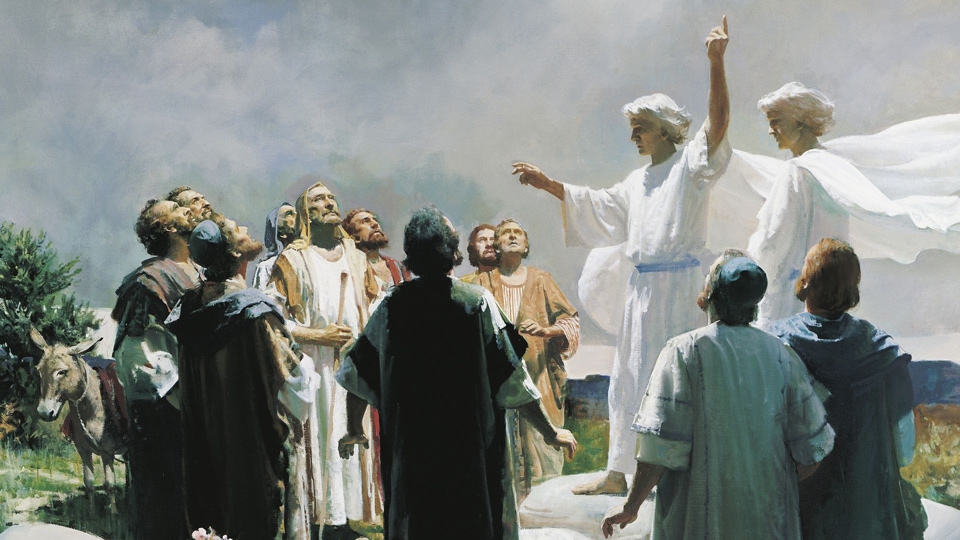
“And while they were beholding him going up to heaven, behold two men stood by them in white garments. Who also said: Ye men of Galilee, why stand you looking up to heaven? This Jesus who is taken up from you into heaven, shall so come, as you have seen him going into heaven” (Acts 1: 10-11).
First, the angels underline the physical posture of the apostles—with their heads raised, looking upward—in order to show us that the “flight” of the Savior was indeed physically perceptible. On the other hand, however, we seem to perceive a certain wonder in the angels’ question. Being bodiless, the physical contemplation of flight is, in a way, incomprehensible to them. To their angelic eyes, which see the spiritual plane of existence, the Ascension was revealed altogether differently. Here we are faced with a major difference in perspective, to which I will return. Secondly, and not least, the intervention of the angels contains a message about the second coming of our Lord Jesus Christ: this will be a universally perceptible physical event. (How exactly it will be possible for all people at that moment in history to see Him simultaneously is not easy to explain.) For now, we retain that it will be a unique event, perceptible with bodily eyes—just as the apostles, with those same eyes, beheld the Ascension of the Lord.
Saints Francis of Assisi (c.1181–1226), Catherine of Siena (1347–1380) and Teresa of Avila (1515–1582) are especially known for their ecstasies accompanied by levitation. Likewise, Saint Thomas Aquinas (c.1225–1274) levitated during a visit to the Dominican friars in Salerno.
Extraordinary Charisms
Throughout two thousand years of Church history, saints have received various charisms. Usually invisible and unspectacular, these charisms relate especially to serving God and one’s neighbor. On much rarer occasions, however, and with the purpose of strengthening our faith, certain charisms are out of the ordinary. It is enough to mention the gift of bilocation (being present simultaneously in two places) and translocation (instant travel to another distant place), enjoyed by Saint Padre Pio. But the most spectacular charism has been, and remains without doubt, levitation.
Saints Francis of Assisi (c.1181–1226), Catherine of Siena (1347–1380) and Teresa of Avila (1515–1582) are especially known for their ecstasies accompanied by levitation. Likewise, Saint Thomas Aquinas (c.1225–1274) levitated during a visit to the Dominican friars in Salerno—an event seen by ecclesiastical interpreters as a sign of the Angelic Doctor’s mind being lifted up in contemplation. But the “champion” of levitation was, and remains, Saint Joseph of Cupertino, O.F.M. Conv (1603–1663).
The fame of his miracles was so great that large populations from the regions where the monasteries of the saint were located came to witness his ecstasies. Sometimes, even at the beginning of the Holy Liturgy, Saint Joseph would begin to float, rising—according to some testimonies—up to the altar itself. In any case, for anyone who saw him it was clear that he was in a heavenly state of deep adoration of God. The public’s curiosity was so great that his superiors had to hide him to prevent overcrowding in the churches where Saint Joseph might appear. A complete ascetic (he ate solid food only twice a week), he submitted to the harshest investigations of the Inquisition with angelic patience. His simplicity, humility, and perfect obedience, well represented in the film The Reluctant Saint (1962), proved in the end that he was not a fraud, but a saint endowed with extraordinary charisms. Yet the gift of levitation seems to speak to us of the condition of another world.
The Paradise State and the Meaning of Flight
When asked by the crafty Sadducees whose wife a woman would be if she had been, in turn, the wife of seven brothers who had died one after another (Matthew 22: 23-33), our Lord Jesus Christ answered by recalling the condition of those who will enter the Kingdom of God:
“You err, not knowing the Scriptures, nor the power of God. For in the resurrection they shall neither marry nor be married; but shall be as the angels of God in heaven” (Matthew 22: 29-30).
Reflecting on the likeness of humans to angels, many Church Fathers emphasized the aerial condition—today associated only with angels, always depicted in icons and religious paintings with wings. In other words, Adam and Eve would have flown in Paradise before the “fall.” Likewise, after the end of the world, the righteous will recover the ability to fly. Saint Basil the Great’s brother, Saint Gregory of Nyssa, speaks in his treatise On the Soul and the Resurrection about the flight of souls that rise continually, toward ever deeper and broader union with God.
“Ye men of Galilee, why stand you looking up to heaven?” I would dare to interpret their question by rephrasing it: “Why do you look at the physical sky instead of looking, through contemplation, at the heaven within you?”
Of course, we may tell such beautiful stories to our younger children and grandchildren at first. But if we truly believed that Adam and Eve literally flew like doves in Eden, we would verge on the ridiculous. For such metaphors have meaning for us who live in the current physical world, with all its properties—related, of course, to weight, volume, length, height, and width. But if our world is three-dimensional, with measurable physical properties, what the spiritual world is like we can only conceive through metaphors, symbols, and analogies.
I have dedicated this article to such a subject because of certain past events. A few years ago, I wrote articles in which I mentioned visions of Saint Hildegard of Bingen and developed speculations about the subtlety of Adam and Eve’s prelapsarian bodies. In other words, though they were people with bodies, their bodies cast no shadows. They were—we might say—transparent. To my great surprise, I later read dissatisfied comments on some forums where this transparency was discussed as if it were a physical fact. Which, of course, would be just as wrong as imagining that Adam and Eve literally flew like birds in Eden.
That is why I must emphasize here that such descriptions are purely metaphorical. Though they refer to undeniable realities, we must also understand that this way of speaking is limited by our present experience. In other words, it is our fallen perspective, as beings trapped in a material world steeped in death, corruption, and the slow process of decay leading to its end. But what Paradise looks like from the perspective of the angels, we do not know. That is why the two angels asked the apostles, who remained with their heads lifted toward the physical sky: “Ye men of Galilee, why stand you looking up to heaven?” I would dare to interpret their question by rephrasing it: “Why do you look at the physical sky instead of looking, through contemplation, at the heaven within you?”
I believe, however, as I have already said, that the angels’ perspective on the Ascension of our Lord Jesus Christ is completely different from ours. Hence what seems to me the nuance of wonder in their question. For them, physical posture has no meaning: they do not need to turn their necks (which they do not even have, being bodiless) in order to see God.
Similarly, then, to the transparency of prelapsarian bodies, the ability of saints to fly/levitate is adapted to our current understanding. In a three-dimensional world, that is how even the flight of spiritual beings appears. But if we were in the world of the spirit, as the angels are, what we would see would be altogether different. Entirely different—and unimaginable to us, still marked as we are by the bondage of mortal existence. That is why we need metaphorical-symbolic images such as the flight of birds: because, for now, that is all we can conceive, all we can imagine. Just as we cannot concretely picture the “celestial bodies” of which Saint Paul speaks (1 Corinthians 15: 40), neither can we picture their flight except in physical terms. Like an underwater creature which, looking upward from the depths, sees a ship sailing on the water’s surface or a man swimming, so too what we see is completely different from what those who live on the surface see—and likewise from what spiritual beings, in their fullness, can see and know. Beings who, during our earthly life, remain shrouded in mystery. Only once we pass “beyond” will we truly know…
