

For most of the conciliar and post-conciliar “reformers,” both the Holy Liturgy—whether it be the Roman rite of Pope Gregory the Great, the Byzantine rites of Saints John Chrysostom and Basil the Great, or any other—and the canons of sacred art are regarded as nothing more than human creations—an idea that is profoundly mistaken. On the contrary, both Holy Scripture and Holy Tradition have always affirmed that their origin lies in Divine Revelation, having been developed by divinely inspired persons such as Moses, the prophets, and the Apostles.
The Roots of the “Reformist” Mentality
I have had on several occasions the chance to talk with “specialists” in liturgical theology. A Catholic priest from this category told me how the Liturgy of the ages had been “manufactured” and how many things, in his opinion, would need substantial changes in order to make it clear and coherent. Yes, you understood correctly: this priest was convinced that the Roman Catholic centuries-old traditional Liturgy had been “fabricated by men” and that, in certain respects, they had made mistakes. According to such convictions, the traditional Holy Liturgy not only can be modified by people, but must be changed in order to “correct” the errors of the forefathers. For such “theologians,” the liturgy is a kind of sophisticated artifact which, like everything human, can be altered, modified, transformed. (Actually, they think the same thing about Holy Scripture, don’t they? That is the “historical-critical” method.)
Similarly, I have heard Roman Catholic priests casually discussing what modifications should have been made to the Byzantine rite of Saint John Chrysostom, in order to allow Greek-Catholic faithful to follow the path of reforms inaugurated by the Second Vatican Council. Practically, according to this “reformist” perspective, in liturgical matters almost nothing is fixed and worthy of being preserved as it is. The mentality behind such an attitude is one that presumes that the Liturgy and all worship were created by man and therefore can, consequently, be modified by man.
Only with much toil and meditation can we understand that the material world, which we consider so very “real,” is, in fact, more like an illusory smoke that is here today and gone tomorrow.
Engaged in their “work” of adapting the Holy Liturgy to the mentality of modern man, the pseudo-reformers of the last century completely ignore the most important aspect of divine worship: both the Liturgy and all other aspects of the cult owed to God have their origin in divine revelation. Neither the canons of sacred architecture and art (i.e., the temple, the church), nor the worship offered to the Creator, are man’s creation. They came into being in a way similar to Holy Scripture, which was written by Moses, the prophets, and the apostles, but whose true author, who inspired them, is God Himself. The disregard of this principle represents the root of all catastrophic changes – culminating with the replacement of the Holy Liturgy by a rite manufactured by “specialists” – from the post-conciliar period.
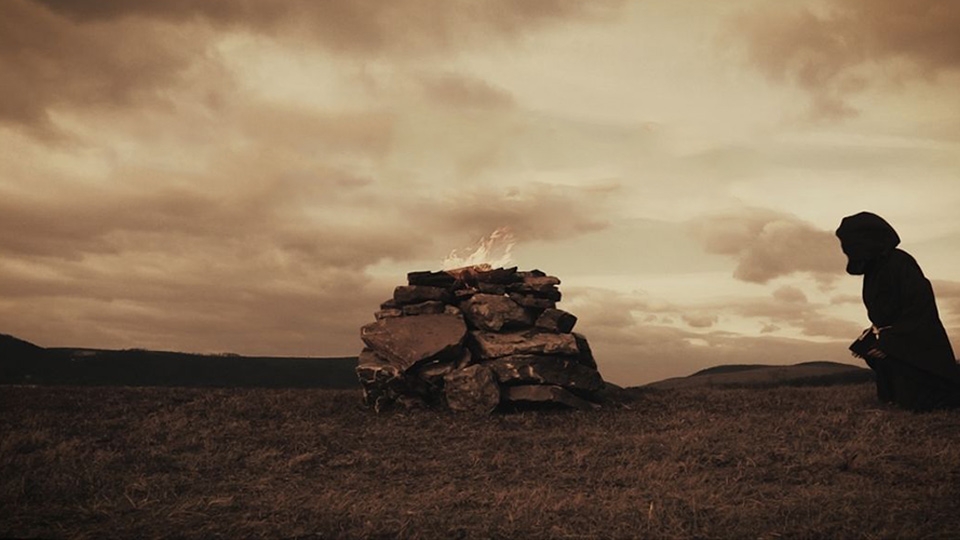
This is why it is absolutely necessary to always recall those passages from the sacred texts which clearly show us the divine origin of worship and of places of worship – the Jewish temple and Christian churches. For example, before the great work of building the temple by Solomon, Moses himself had already – just like David later – received precise instructions from God regarding the key elements of worship. One of these elements concerns the most important sacred object: the Holy Altar. This has been and remains the focal point of both the Temple and our churches. Regarding its properties, I have identified in the Old Testament at least three places recording divine revelation about the making of the stone altar: Exodus (20: 25), Deuteronomy (27: 5–6), and Joshua (8: 31).
God’s Design
The first of them states what the other two only repeat. It also contains a unique detail that astonished me. This is why I will be content to quote only the text from the Book of Exodus:
“And if thou make an altar of stone unto me, thou shalt not build it of hewn stones: for if thou lift up a tool upon it, it shall be defiled” (Exodus 20: 25).
This passage is most interesting, raising a difficult question. First of all, it is absolutely clear that the use of the pronoun mihi indicates plainly that it is God who speaks, revealing clearly His will regarding the stone altar. I will not tire of repeating that such is the case with every aspect of worship and all that relates to it: everything has its origin in divine revelation. Nothing is man’s invention, the product of his creativity. This has very important consequences. God’s request in the cited verse appears at first sight quite strange: no tool must be used to carve the stone of the altar. Otherwise, the stone is “defiled.” We can deduce from this that the sacrifices themselves, offered on a carved altar, would very likely also be defiled.
But why would human intervention upon the altar stone have such a harmful effect as to render it impure and unfit for sacrifices offered to God? For years I tried to find the answer to this question. Recently, a reading of one of the most important theologians in the entire history of Christian Tradition, Saint Gregory of Nazianzus (c.329–390), gave me a remarkable clue. The key passage is found in the discourse the great Doctor delivered on the occasion of his father’s death. Here, referring to the qualities of Saint Nonna, his mother, he emphasized her exceptional reverence toward the Holy Altar:
“And if it was a great thing for the altar never to have had an iron tool lifted upon it, and that no chisel should be seen or heard, with greater reason, since everything dedicated to God ought to be natural and free from artificiality, it was also surely a great thing that she reverenced the sanctuary by her silence; that she never turned her back to the venerable table, nor spat upon the divine pavement.”[i]
Before returning to our question regarding the reasons why God demanded that the altar stone not be worked with human tools, I will note a detail known only to those familiar with the code of manners in the presence of Catholic kings and emperors: one must never turn his back to sovereigns when leaving an audience. Withdrawal is done while always facing the sovereign. Much more important than earthly kings, God received from Saint Nonna that very same reverence: she never left the Church turning her back to the Holy Altar – symbol of the absolute Creator. Such details about reverence due to God are always worth remembering, as Dr. Peter Kwasniewski often rightly reminds us.
Does not the modern world make its glory out of technique and technology? Well, precisely such things, which belong to the realm of “technology,” must be excluded in the case of the stone altar on which sacrifices are to be offered to the living God of Moses, of the patriarchs and prophets of the Old Testament.
Saint Gregory of Nazianzus and “Technology”
The quotation from Saint Gregory of Nazianzus underlines that everything consecrated to God must be exactly as it can be found in nature, without human intervention. The two adjectives used in the original Greek text to describe the altar are very important: φυσιχὸν χαὶ ἄτεχνον (physichòn kaì átechnon). The first adjective raised no problem in translation: it is rendered in English as “natural,” the equivalent of the Greek φυσιχὸν. The second adjective, ἄτεχνον (átechnon), was translated as “free from artificiality.” Although not wrong, the translation loses the essential meaning: for ἄτεχνον is an adjective derived from the noun τέχνη (téchnē), which means “craft, skill, trade,” but also “cunning” or “means.” Already a simple contemplation of these meanings opens surprising avenues of thought. For they are at the origin of some of the most common terms in modern vocabulary: “technical, technology.” If originally the noun τέχνη referred to everything belonging to human craftsmanship, in time it came to indicate those aspects of human life which, today, are omnipresent.
Does not the modern world make its glory out of technique and technology? Well, precisely such things, which belong to the realm of “technology,” must be excluded in the case of the stone altar on which sacrifices are to be offered to the living God of Moses, of the patriarchs and prophets of the Old Testament. This aspect deserves our attention – all the more so as one of the most brilliant Saints and Doctors of the Church, as we saw above, extends this principle to all things destined for worship. But why would the use of “technique,” that is, of human craftsmanship, be “defiling” when applied to the altar stone? This is a question that cannot be answered correctly unless we meditate upon man’s state before the Fall, and the state that resulted after the original sin committed by Adam and Eve.
Back to Paradise
Only with much toil and meditation can we understand that the material world, which we consider so very “real,” is, in fact, more like an illusory smoke that is here today and gone tomorrow, while the “intelligible,” unseen world is the only one truly “real” – because of its eternity. Similarly, it requires sustained effort of thought and prayer to grasp that the life of fallen man is falsified by a multitude of technical artifacts which, in Paradise, would never have existed.
Let us take them one by one, starting with those which, in Maslow’s hierarchy of needs, occupy the lowest levels: Physiological Needs and Safety Needs. On the first step are all those needs that keep us alive: air, water, food, shelter, clothing, etc. None – absolutely none – of these were necessary in Paradise. There was no air conditioning in Eden. The climate was perfect (there are extended Patristic and Scholastic speculations about Eden’s climate which I will present in other articles). For this reason, with no storms or climatic dangers (extreme temperatures, volcanoes, eruptions, etc.), Adam and Eve did not need a house. Their food – like that of the other animals – was strictly vegetal (Genesis 1: 29). It also required no effort – so it did not need to be “cooked” – and was tastier than anything we could imagine here on earth. As for clothing, we know well that, being clothed in the royal light of divine glory that shone upon them, Adam and Eve did not need it. In a word, they needed nothing.
I don’t think it is necessary to prolong this brief meditation with reflections on what Maslow calls Safety Needs. Being immortal, in God’s world, the first parents could neither die (except by an act of their own will – the eating of the forbidden fruit), nor be endangered by any “physical” enemy – none existed there. Think for a moment about the consequences of what I have said: Adam and Eve had no need to manufacture, through manual skill or practical wisdom, anything to protect, feed, shelter, or clothe them. Likewise, being immortal and forever young and beautiful, they had no need of medicine, treatments, cosmetics, etc. I repeat and emphasize: they needed nothing. Reflecting on their happy state, Saint Basil the Great saw in such a privileged situation even the premise of their terrible sin: for “they had everything too easily given.” In other words, Adam and Eve behaved toward God like spoiled children who become insolent toward parents far too good, gentle, and generous. In any case, what I wish to stress is that in Paradise, technology related to food, clothing, housing, etc. was unnecessary.
If someone were to raise questions about other inventions, such as means of flight and locomotion, we can immediately deduce that neither cars, nor planes, rockets, and helicopters were necessary. The agility of prelapsarian bodies implied – as we see in the case of the gift of levitation granted to certain saints, or in the case of the capacity for translocation (i.e., the extraordinary ability to move instantly from one place to another), bilocation (i.e., the extraordinary ability to be present simultaneously in two places), multilocation (i.e., the extraordinary ability to be present simultaneously in several places) – all these were inherent. Similarly, the bodies of the righteous after the second coming of Christ will regain – even amplified – all these preternatural qualities. Let us stress this: what God’s power can do through His saints is absolutely superior to the achievements of human technology. Saint Joseph of Cupertino would laugh at our planes and rockets. Moreover, some saints tend to return to the same condition, as we see Saint Francis did through his complete poverty, following in the footsteps of the Desert Fathers.
Against such a context, in which man and his artifacts become the measure of all things, behold, God asks Moses to use as altar a stone untouched by human craftsmanship. A stone coming directly from the hand of the Creator, without any intervention.
From what has been said so far, I hope it is clear enough that the conditions of Paradise, that is, of the original, innocent, and good world created by God, were absolutely extraordinary and wonderful: completely dedicated to great contemplation oriented to the acquiring of beatific vision, man at that time did not have to waste his intelligence and abilities in order to protect himself and survive in a profoundly hostile and ephemeral world. The life of fallen man, Saint Gregory of Nyssa tells us, is a life wrapped in a terrible illusion, “a life in death.” Saint John Chrysostom, in the same vein, said that habitual sinners wandering in the labyrinth of this grace-closed world “though alive are dead.” Indeed, the Church itself draws our attention to the most terrible mystery: those born physically into this world, before receiving Holy Baptism, are spiritually dead even though biologically alive. This is why the baptism of infants – when the minimal conditions required by the Church are fulfilled – is absolutely necessary: original sin, under whose burden every newborn comes into the world, destroyed in man the supernatural life of grace. If the image of God remained in man, the likeness which sanctifying grace created was erased.
The fallen state, marked by corruption, degeneration, aging, and death after original sin, requires all the “props” necessary to help us live in a hostile world. For, as Saint Maximus the Confessor says – after the fall, human nature, corrupted, was not only torn apart, but led to a state of spirit in which people devour one another like snakes. The triumph of hatred – beginning with the killing of Abel by his brother Cain, the proliferation of wars, vices, sins – which provoked God’s decision regarding the Flood, shows us the dreadful sinking into darkness and the shadow of death of all that belongs to the fallen, corporeal, physical realm. To confront such a grim reality, man continued to create all sorts of things and artifacts meant to keep him alive and protect him. Their abundance, which in the last decades of technological excess has become downright suffocating, has made us completely forget that one can live without planning, without control, without mobile phones, banks, computers, cars, planes, and rockets. Thus we have forgotten to look at the sky, where for thousands of years the stars of day and night have tirelessly continued their courses established by Holy Providence. Or, if we do remember the sky, often in the midst of the visual pollution of hundreds of thousands of lights at night, we find we can hardly see it anymore. In short, we live submerged in the tsunami of technology, from which we no longer wish to emerge, and even if we did, we would not know how.
Against such a context, in which man and his artifacts become the measure of all things, behold, God asks Moses to use as altar a stone untouched by human craftsmanship. A stone coming directly from the hand of the Creator, without any intervention. For, let us not forget, everything that exists in nature is created and sustained in existence directly by God – nothing is the result of “chance” or “coincidence,” as agnostics and atheists believe. For consecration, therefore, God demands such a stone – untouched by man’s hand. Which means, by implication, that it has been touched exclusively by the hand of God.
Here then are the two crucial lessons we can draw from a single verse of the Old Testament:
- The rules of sacred architecture were established by God (this is seen in great detail in the description of the construction of the Temple);
- God wishes to draw our attention to those things in nature which, in their discreet way, speak of the fact that everything that exists – except the artifacts and things created by man in this fallen world in order to survive and protect himself – was created by God (like the altar’s stone).
Without insisting further on the first point above, the interpretation of Saint Gregory of Nazianzus drew our attention, through his use of the adjective ἄτεχνον, to the second point, which reveals the priority of things created by the Creator over those created by man. God wants to draw us out of the sphere of the artificial objects, created by ourselves, in order to reintroduce us into the original sphere of things created directly by Him (in the metaphysical language of Saint Thomas, the spiritual world of “substantial forms” – which are always the immediate creation of God). Indeed, as we see in the great masters of spiritual exegesis such as Saints Gregory of Nyssa, Maximus the Confessor, Bonaventure, and Francis de Sales, meditation upon creatures – as they came from the Creator’s hand – is their chief concern, alongside meditation upon Holy Scripture and the Holy Liturgy. For just as God teaches us through the texts of which He is the author, so too does He speak to our hearts through His entire creation – as He showed us wonderfully through St. Francis of Assisi:
Be praised, my Lord, through all your creatures!
[i] Saint Gregory of Nazianz, Oratio 18: Funeral Oration on His Father, in the Presence of S. Basil, art. 10: https://www.newadvent.org/fathers/310218.htm [Accessed: 15 August 2025].
