
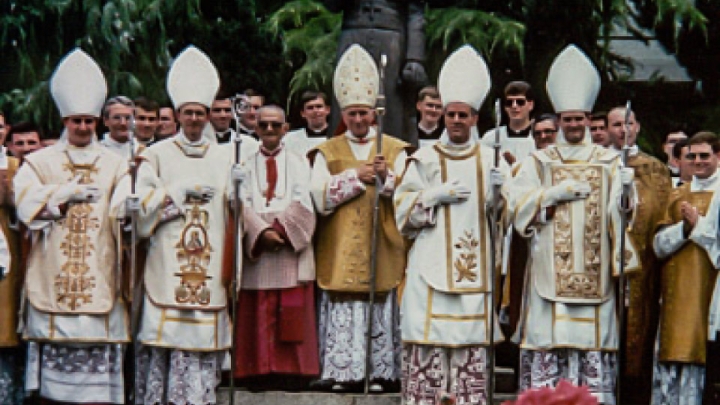

Today—2 February 2026—a press release from the Fraternity of Saint Pius X (FSSPX) made public the decision of its superiors “to entrust the bishops of the Society with the task of proceeding with new episcopal consecrations, on 1 July next.” 1
As I have said in other articles published in The Remnant, the only question I asked myself—just as many of you have—was not if, but when. Therefore, today’s news comes as a confirmation of what was already anticipated.
What is distressing, however, is the fact that from the official statement we learn how the attempt of the Reverend Father Davide Pagliarani, Superior General of the Priestly Society of Saint Pius X, to obtain an audience with Pope Leo XIV unfolded: despite his efforts, he was, practically speaking, refused. Here is the account of Father Pagliarani’s attempt as presented in the official communiqué:
“Last August, he sought the favour of an audience with the Holy Father, making known his desire to present to the Holy Father, in a filial manner, the current situation of the Priestly Society of Saint Pius X. In a second letter, he explicitly expressed the particular need of the Society to ensure the continuation of the ministry of its bishops, who have been travelling the world for nearly forty years to respond to the many faithful attached to the Tradition of the Church and desirous, for the good of their souls, that the sacraments of Holy Orders and Confirmation be conferred.
After having long matured his reflection in prayer, and having received from the Holy See, in recent days, a letter which does not in any way respond to our requests, Father Pagliarani, in harmony with the unanimous advice of his Council, judges that the objective state of grave necessity in which souls find themselves requires such a decision.”
For the entire world of those Catholics who love the Apostolic Tradition—whether or not they are supporters of the Fraternity of Saint Pius X—this can only point to one thing: that indeed we are all living, as Father Pagliarani put it, in “an unprecedentedly tragic era.”
The very act that the most important priestly fraternity—the only one that has its own bishops—devoted to the defense of Tradition is being kept at the door says everything.
Unfortunately, however, this too is not entirely unexpected. The current Superior of the FSSPX made it clear in his message that the decision is motivated, just as in the case of Archbishop Marcel Lefebvre, by “the objective state of grave necessity in which souls find themselves.” For those who, especially beginning with the pontificate of Benedict XVI, have deluded themselves into thinking that the state of the Church had changed, such a statement is a cold shower. Certainly, we understood the weariness of souls and their bitterness in a situation without precedent in all of history. And yet, we cannot deceive ourselves: until grave errors such as ecumenism, pluralism, freedom without God, and others like them are condemned by pontifical authority, the situation will remain one of emergency.
And since ecumenism and religious pluralism have been mentioned, it must be said once again that this is one of the motivations for the profound disagreements between the Vatican and the FSSPX. First of all, we must recall that ecumenism has become a true ecclesiastical discipline. The hierarchs of the Catholic Church are all bound by this discipline, as we learn from §1 of canon 755 of the Code of Canon Law of the Catholic Church:
“It pertains especially to the entire College of Bishops and to the Apostolic See to foster and direct among Catholics the ecumenical movement, the purpose of which is the restoration of unity between all Christians which, by the will of Christ, the Church is bound to promote.” 2
If, prior to the Second Vatican Council, Catholic hierarchs in predominantly “Orthodox” countries sent reports to the Vatican showing that they had avoided—on the occasion of certain events—any form of communicatio in sacris, 3 now, on the contrary, through a 180-degree turn, they are required to “foster and direct among Catholics the ecumenical movement.”
If dialogue and maximum “ecumenical” indulgence are shown not only to Eastern “Orthodox” schismatics— with whom we nonetheless share the Sacraments and a good part of dogmatic theology—but also to post-Reformation church bodies, some of which already have women (pseudo-)bishops and (pseudo-)priests, why should such indulgence not also be shown to the Fraternity of Saint Pius X?
As we all know, for a true apostle such as Archbishop Marcel Lefebvre was, and likewise for his successors today, such a thing is unacceptable. This is one of the major reasons why the ecumenical and pluralist Vatican does not desire new FSSPX bishops with the same vision. And precisely because of that they are as necessary as fresh air. Of course, there are also other major reasons for keeping the Fraternity of Saint Pius X at the margins of mainstream Catholicism.
And, as I said, this is not only about a single fraternity, but about all those who place emphasis on the priceless treasure of Apostolic Tradition. Beyond doctrinal questions and matters of ecclesiastical discipline, what is most distressing is what becomes evident: the lack of a truly pastoral attitude toward all these people.
Is it not strange that a council defined par excellence as pastoral should generate such an attitude? If dialogue and maximum “ecumenical” indulgence are shown not only to Eastern “Orthodox” schismatics— with whom we nonetheless share the Sacraments and a good part of dogmatic theology—but also to post-Reformation church bodies, some of which already have women (pseudo-)bishops and (pseudo-)priests, why should such indulgence not also be shown to the Fraternity of Saint Pius X? For the time being, such questions remain unanswered. What remains for us, as always, is prayer.
- “The General House of the FSSPX announces future consecrations:” https://sspx.org/en/news/general-house-fsspx-announces-future-consecrations-57009 [Accessed: 02 February 2026]. ↩︎
- I quote the Code of Canon Law of the Catholic Church from the official Vatican website: https://www.vatican.va/archive/cod-iuris-canonici/eng/documents/cic_lib3-cann747-755_en.html#BOOK_III [Accessed: 02 February 2026]. ↩︎
- See my article “The Interdiction on ‘Communicatio in Sacris’ Before the Second Vatican Council:” https://www.remnantnewspaper.com/web/index.php/articles/item/7026-the-interdiction-on-communicatio-in-sacris-before-the-second-vatican-council [Accessed: 02 February 2026]. ↩︎
