
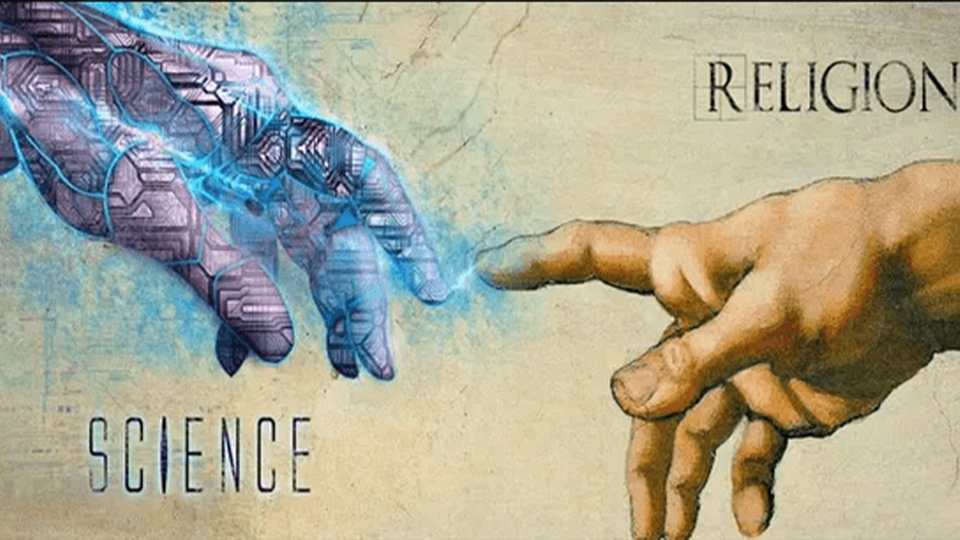

One of the illusions that still blinds many Christian minds is the idea of a supposed harmonious dialogue between religion and science.
A dialogue that looks much like that televised discussion in 2012 between Richard Dawkins and the regretted Cardinal George Pell. I’ve even met theologians specialized in this type of dialogue. Naturally, outside their narrow circle, almost no one has heard of them. Even less so scientists, who remain locked in the tower of their own theories and concepts, which they would never leave for “metaphysical” discussions or, worse (from their point of view), “theological” ones.
I began to grow skeptical about thirty years ago, when I noticed that those interested in this type of “dialogue” were usually only theologians. Never scientists. Then came the most revealing conversation possible, which I had with an honest political science professor, where we touched on the subject. Without any hesitation, he told me: “There can be no talk of dialogue with the Catholic Church on any topic. Christian theology and metaphysics must not be allowed access to the public sphere. The dominant paradigm is secular, agnostic, atheist. That’s it.” Surprised by such a candid confession, I fell silent. But everything confirms what the professor said. It seems that almost no one in the secular universities and academies is interested in truth. And how could they be, when the majority of the existing professors and scientists question the very existence of an eternal, unchangeable Truth?
Aha! Finally, here is something truly dangerous. So Galileo implied that his experimental thinking could contradict the treasury of supernatural Revelation contained in the inspired texts of Holy Scripture. That is extremely serious.
Even so, Catholic historians persist. Just last week I read an old article on The Imaginative Conservative, titled “The Galileo Affair,”[i] by the learned French historian Henri Daniel-Rops (1901–1965). The author’s motivation for writing this essay is clearly tied to the way the scientistic-Enlightenment propaganda has used the case of Galileo to strike at the Church whenever the opportunity arises:
“The affair, as we know, has been tirelessly exploited against the Church; anti-clerical polemists have elected to charge her in this matter with obscurantism and ferocity. We are all familiar with the picture of a brilliant scientist imprisoned for his discoveries and stigmatizing his judges in the eyes of posterity with a few devastating words. That picture, however, is not altogether accurate.”
An excellent connoisseur of historical sources, Rops writes with enthusiasm, accurately outlining the entire history of Galileo Galilei’s life and conviction. His conclusion is the following:
“The affair of Galileo then was not played out in the atmosphere of inquisitorial terror that some writers have imagined; one cannot even say that the high ecclesiastical authorities posed systematically, a priori, as enemies of scientific progress. If Galileo (and this applies even more to many of his supporters) had not implied, or even expressly declared, that the new astronomy negated the biblical text, the second trial would have been avoided. It is, however, none the less true that the attitude taken by the Holy Office in this matter is open to criticism.”
So everyone can be happy. The Inquisition was cool, Galileo was treated with leniency, the Pope was okay. The debates could be held casually over a bottle of wine, and the inquisitors could be criticized after the third glass is emptied. And yet, the reader might ask: so much ado about nothing? What was, after all, the issue (or issues) that made both theologians and scientists react—and the latter still do—so vehemently? A single fragment from Rops’s essay gives us a small clue, though not a very detailed one:
“It does not seem that Galileo’s judges detected the most dangerous threat of his ideas. The whole of his defence was based ultimately upon a formula which can be expressed as follows: ‘The Bible says one thing; my eyes have seen something quite different.’ He sought to draw a hard and fast line between the domain of faith and that of experience. But such a line was going to hallow the divorce between faith and science, revelation and reason.”
Aha! Finally, here is something truly dangerous. So Galileo implied that his experimental thinking could contradict the treasury of supernatural Revelation contained in the inspired texts of Holy Scripture. That is extremely serious. But do you think Rops developed this statement? Not at all! He was content to suggest that the Church Fathers and medieval Doctors had been so busy that, up to that point, they hadn’t provided any explanation to show how theology and science could be compatible. Of course that was a weak—or even wrong—suggestion. But, since he was only a historian, we can’t blame him for offering just that much on a theoretical level.
However, I hasten to assure you that in Galileo’s case there are many more issues at stake than the one Rops hinted at. And we must accept that these conciliatory expositions—which we will find in numerous other authors (I will mention only Christopher Dawson and Jean Sévillia)—cannot stop the use of Galileo’s case as an ideological cudgel by scientists.
This became crystal clear in 2008, when Pope Benedict XVI was scheduled to deliver the opening address at the Sapienza University of Rome. Intense public protests and a petition signed by students prevented the event. All the professors from the Department of Physics also signed the document. Now that’s democracy! But what’s truly significant is the main reason they mentioned: the fact that, back when he was only a Cardinal, Pope Benedict XVI had allegedly defended the Inquisition’s verdict against Galileo. (I’m surprised they didn’t call for the Holy Father to be arrested.)
Novalis defends the decision of the Pope of that era by criticizing the consequences of the theories of Copernicus and Galileo (exegesis unanimously recognizes the two as those Novalis called “bold thinkers”). But what exactly is Novalis targeting?
Well, what do you think Henri Daniel-Rops would say if he could hear something like that today? What is even more tragic is not just the loss of any value that might evoke the Wisdom alluded to in the university’s name (“la sapienza”), but also the fact that this university was founded in the year of his death, 1303, by Pope Boniface VIII (c.1230–1303). Ironic, some would say. It would be worth having a serious historian explain how a university founded by a pope came to bar another pope, seven centuries later, from setting foot inside it.
Setting the polemics aside now, let us refocus our attention on the truly important core: the debates surrounding Galileo’s theories and the enormous crisis they triggered. In this article, I will present only the reaction—much shorter than Rops’s article, but far more dense and interesting—of one of the most important German poets and thinkers: Georg Philipp Friedrich Leopold, Baron von Hardenberg (1772–1801), known by his pen name Novalis. This remarkable Catholic-minded author diagnosed Galileo’s ideas and the Copernican implications far better than Rops ever did.
While revisiting, for an extended article, a fascinating lecture given by Novalis in 1799—titled Christendom or Europe?—I was electrified by the following passage:
“With good cause the wise Head of the Church countered insolent excrescences of human talents at the expense of the sacred sense, as well as untimely, dangerous discoveries in the area of knowledge. Thus he prevented bold thinkers from asserting publicly that the earth was an insignificant planet, for he realized that humans, together with respect for their dwelling place and their earthly homeland, would also lose respect for their heavenly home and for their race, would prefer circumscribed knowledge to infinite faith, and would become accustomed to scorning everything great and worthy of wonder and look upon these as dead legalisms.”[ii]
The depth of Novalis’s understanding amazed me as much as his attitude toward the Catholic Church. Without going into details, I note that although he never formally converted from Lutheranism to the true Faith, in his speech he argued that avoiding conflicts and achieving the unity of the Western world can only be accomplished through the recognition of the authority of the Pope and the Catholic ecclesiastical hierarchy by all states (it is truly worth reading the text recently reissued by Angelico Press). Besides this idea—incredible for a non-Catholic author—in the fragment I quoted, he defends the decision of the Pope of that era by criticizing the consequences of the theories of Copernicus and Galileo (exegesis unanimously recognizes the two as those Novalis called “bold thinkers”). But what exactly is Novalis targeting?
First of all, by welcoming—without naming him—the attitude of Pope Urban VIII (Maffeo Vincenzo Barberini) toward the ideas of the pioneers of the scientific revolution, he identifies their terrible consequences. The exclusion of geocentrism, which represented the foundation of a symbolic, theological-metaphysical interpretation of the entire cosmos, led to the “frozen,” lifeless vision of empiricist mechanism criticized by those who today are seeking “the re-enchantment of the world.” The enthronement of the scientific worldview led to the ruthless exploitation of the environment, hypocritically lamented in a context where the power to do anything that brings profit, regardless of consequences, is the only “value” followed by industry and subsequent technologies. Most serious, however, is the fact that the modern man’s conception about his place and role in the universe has undergone the most terrible mutation, perfectly intuited by Novalis: deprived of the unseen dimension of creation, that which is confessed in the Creed where we are reminded that God is the creator of both “the visible” and “the invisible” (the world of spiritual beings where God Himself is King), man has lost all respect for his quality as a being created “in the image and likeness of God.” If we add the hallucinatory chronologies of millions and billions of years to the false image of an infinite universe, the result of chance, we obtain a labyrinth from which most contemporaries do not know how to escape.
Moreover, in some of the pages left to us by this brilliant thinker, who died at only 28 years old, we find lines showing how he sought a way out of the labyrinth of rationalism and secular scientism.
The second point of Novalis’s critique refers to the mutation suffered by the vision of knowledge. By excluding (on the grounds that they are “irrational” and “unscientific”) the supernatural gift of Faith and theology from the hierarchy of knowledge, where they occupied the highest place, man has become a slave to the lower forms of knowledge, those based only on the senses and the exercise of discursive-rational capacity. Practically, his highest dimension, the mystical-contemplative intellect, was eliminated simultaneously with the exclusion of imagination from the horizon of “science.”
Finally, the third and last point concerns the attitude toward creation: without recognizing in it the “jewel” (the meaning of the Greek word “kosmos”) fashioned by the Creator for us, created “in His image and likeness,” man approaches it strictly legalistically, seeing in all aspects of nature only the blind laws that govern it relentlessly. The miracle of life is ignored, and the capacity of any creature, organic or inorganic, to become a vehicle of grace and a symbol of the unseen world is ignored and considered to belong to the dubious domains of occultism and “spirituality.” With a mentality in which everything around him is only the sum of physical-mechanistic laws and the human being himself a kind of sophisticated robot, mystagogy is abandoned and our churches slowly become, without symbols, without icons, without the Liturgy of the ages, soulless buildings that pitifully try to compete with concert halls or, at best, sports arenas. All these were anticipated, more or less explicitly, by Novalis.
An authentic genius poet, he had a rare anticipatory capacity for the consequences of the scientific revolution. Moreover, in some of the pages left to us by this brilliant thinker, who died at only 28 years old, we find lines showing how he sought a way out of the labyrinth of rationalism and secular scientism. Without denying the value of the fields of science, he sought to reinterpret them, not without criticizing and correcting their errors. As for the concrete contribution of Galileo Galilei’s ideas to all of this, we will certainly speak more about it.
[i] Henri-Daniel Rops, “The Galileo Affair,” article taken with the permission of the Cluny publishing house from Rops’ volume, The Church of the Classical Age: The Era of Great Splintering, Volume I, Providence, Rhose Island: Cluny, 2024: https://theimaginativeconservative.org/2025/05/galileo-affair-henri-daniel-rops.html [Accessed: 23 May 2025].
[ii] Novalis, Christendom or Europe?, Introduction by Michael Martin, Translated by Charles E. Passage, New York: Angelico Press, 2024, p. 34.
