
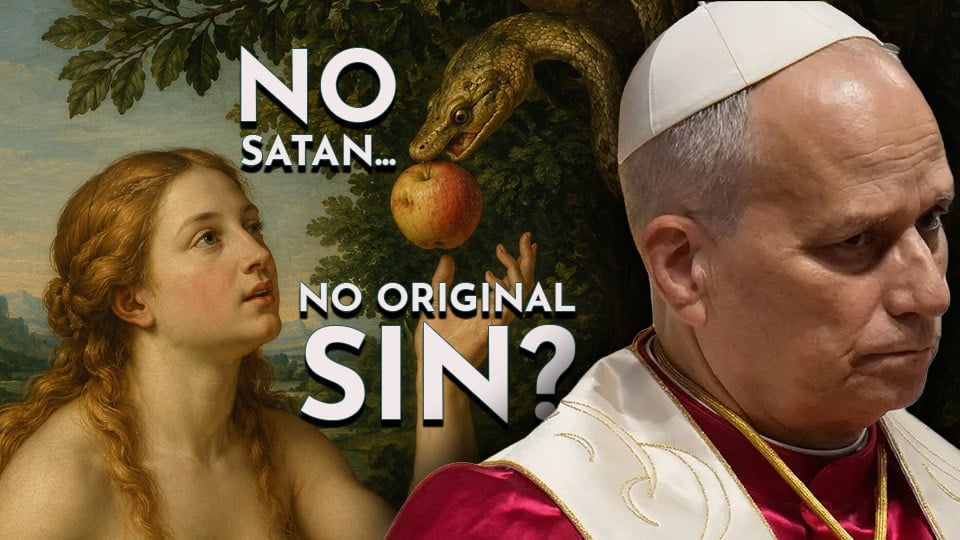

The Holy See’s Official Newspaper Openly Denies Original Sin: Why?
On July 4, an article by Marinella Perroni entitled “The Serpent, the Woman and the Fruit. And Satan?” was published in L’Osservatore Romano (it should be noted: this is the official newspaper of the Holy See, that is, of the Pope). The subtitle anticipates the conclusion of the brief essay: “He [Satan] is not in Genesis: at the origins of a misunderstanding.” According to the author, the traditional exegesis of Genesis 3 is mistaken, being based on a major misunderstanding. The narrative contains no trace either of the devil or of original sin.
The fact that such an article was published in none other than the Pope’s newspaper should not, however, arouse excessive surprise, because this is not the first time that heterodox theses have been promoted by official media outlets of the Catholic Church (one need only consider the aberrant articles published in Avvenire, the official newspaper of the Italian bishops). By now, this has become the norm.
The event itself is nevertheless worthy of emphasis, since it is not an isolated occurrence, nor merely the bizarre outburst of a theologian who professes to be Catholic while simultaneously advancing exegetical interpretations—as we shall see—that are comparable to the thought of the Gnostic sects of the first centuries after Christ. Rather, it is one piece of a broader pattern, whose ultimate aim is the refoundation of the Catholic Church. Let us proceed in order.
To deny original sin is to empty Christ’s Redemption of its meaning.
Who Is The Author?
First of all, something must be said about the author. Marinella Perroni is an internationally renowned Italian theologian and biblical scholar, particularly known for her studies on the New Testament, biblical hermeneutics, feminist exegesis (whatever that may mean), and the role of women in early Christianity, naturally reinterpreted in such a way as to justify the introduction of the female diaconate today.
Perroni taught Sacred Scripture at the Pontifical Athenaeum of Sant’Anselmo and has been an authoritative voice in promoting “dialogue” between theology and contemporary culture. She is also the founder and former president of the Coordinamento Teologhe Italiane (“Italian Women Theologians’ Coordination”), an association that promotes greater female participation in theological research “from a gender perspective” and in the life of the Church.
In an interview published by Avvenire on March 14, 2025, Perroni explained how, since the Second Vatican Council, the “great march” of qualified female participation in the Church has grown—a process not without academic obstacles and persistent preferences for priests in hiring decisions.
She stated that the high point was reached with the most recent Synod, where women—i.e. feminist theologians—finally obtained both speaking and voting rights. Perroni credited Pope Francis with initiating a process of “de-masculinizing the Church,” while avoiding the “clericalization of women.” Regarding the female diaconate, she specified that the question remains open and that, for the time being, it is necessary to “move beyond it.”
Francis did not avoid the issue for doctrinal reasons, but in order to avoid further dividing the Church. In other words, the strategy adopted is one of waiting: work on other fronts until broad consensus matures within the People of God. Only then can the issue be raised again. On December 4, 2025, under Leo XIV, the Church said “no” to the female diaconate, but this “no” was presented as temporary and therefore destined to be reconsidered when the ecclesial climate becomes more favorable.
When the foundation changes, the entire structure must be rebuilt.
A Waiting Strategy and the Reform Agenda
This waiting strategy is not exclusive to Perroni; it is the official position of the Italian Church. Indeed, the much-discussed synodal document issued at the end of October 2025 recommended that studies on the female diaconate in the Church should not be interrupted and, at the same time, called for new proposals for liturgical reforms.
More recently, Erio Castellucci, Bishop of Modena-Nonantola, deputy president of the Italian Episcopal Conferenc, and one of the most influential figures within the Italian episcopate (it is rumored that he is about to be promoted to the Chair of Saint Ambrose in Milan), proposed exploring a form of “co-presidency” at Mass, in which women would lead the Liturgy of the Word while (male) priests would preside over the Eucharistic Liturgy.
Castellucci argues that co-presidency would avoid the issues connected with the male representation of Christ in the act of consecration and would circumvent the “deadlock” created by the Church’s repeated “no” to the female diaconate. Furthermore, Castellucci suggests that when, in the near future, the “process of maturing consensus” has been completed, the decisions of consultative councils will become “binding” upon the Church. This is the reformist ferment currently felt in Italy and around the Vatican.
The Agenda, however, pursues more ambitious and broader objectives. The neo-modernists are giving many hints that they are aware that doctrine—and Christology in particular—must be refounded in order to refound the Church. The Church, after all, is the Mystical Body of Christ. In the early centuries, Christological controversies were taken very seriously by the conciliar Fathers because they knew that the way Christ is understood determines the way the Church is understood.
The Cross loses its objectively salvific character and becomes merely a symbol.
Recently, the extremely progressive Cardinal Walter Kasper declared to Kathpress that the German Synodal Way must recover Christological studies before addressing ecclesiological ones. “We have become entangled in ecclesiological issues and the question of ministries,” he said. “But this is too narrow. It would be important to return to the center of Christian theology and to Christological questions.” He has even published a book on the subject, Jesus Christus auf der Spur (“In the Footsteps of Jesus Christ”). This is not an expression of conversion or repentance on the part of the German Cardinal, but rather a declaration of intent.
Christology must be refounded in order to refound Ecclesiology.
The Second Vatican Council was essentially an ecclesiological council, as Pope Benedict XVI pointedly emphasized before his election to the See of Peter, but now, in order to justify and implement further reformist initiatives, it is necessary to return to work on the doctrinal foundations.
Perroni’s Hermeneutical Framework
Perroni’s article in L’Osservatore Romano forms part of a broader undertaking, a process that is already underway. It should be noted that the theses Perroni advances are not, in themselves, innovative. The article simply reasserts the now well-established neo-modernist dogma of the historical-critical method and the Documentary Hypothesis, which takes as scientifically settled the notion that Genesis is a late text dating from the sixth century B.C., composed and manipulated by a caste of Jewish priests returning from Babylon, who needed to preserve the cohesion of the Israelite nation through a sacred text that was both mytho-poietic and ethno-poietic.
I would take the liberty of recommending to the reader my recent book, in which I attempt to demonstrate the inconsistency of the Documentary Hypothesis and to propose a traditional Catholic exegesis of the first three chapters of Sacred Scripture.
If Christ is no longer the Redeemer from sin, the Church itself becomes something entirely different.
The truly interesting element, however, is the hermeneutical key that Perroni adopts to justify her feminist reading of Genesis 3, because it consists in restating, in modern terms, what the ancient Gnostic sects preached.
According to the theologian, the Garden of Eden is the “original metaphor of life, of its beauty, but also of its tragic contradictoriness”: the tension between the human and the divine would therefore not be the consequence of the Fall but an original characteristic of creation itself. Already in this premise one of the most problematic assumptions of the entire interpretation becomes apparent.
In Catholic Tradition, the creaturely limitation certainly belongs to human nature, but evil does not belong to creation as such. The original order is “very good” (Gen 1:31), and moral disorder appears only with sin. If, on the other hand, danger and tension structurally belong to Eden itself, then the distinction between nature and the Fall inevitably becomes blurred. This approach closely resembles Gnostic dualism, according to which good and evil coexist in God as eternal principles.
The Reinterpretation of Eve and the Serpent
Against this background, Perroni proposes a radical reinterpretation of the dialogue between the serpent and the woman. She writes:
“The dialogue between the serpent and the woman is the first great theological discourse in the Bible. […] To be like God, that is, to be able to eat from the tree of life. […] It is very beautiful that, in Eden, the woman takes on the role of the one who has the courage to enter into this desire, to claim the right to it, and to discuss its limits.”
Here the traditional exegesis is completely overturned. According to the Church’s constant interpretation, temptation consisted precisely in the pride of the intellect: man seeks autonomously to appropriate what belongs to God alone. This is represented allegorically by the Tree that—significantly—is called the “Tree of the Knowledge of Good and Evil.” It is not the Tree of Life (as Perroni suggests), which instead represents divine grace and to which our first parents had access, as becomes evident from a more careful reading of Sacred Scripture.
For Perroni, by contrast, the desire to be like God no longer appears as a temptation suggested by the serpent but as an almost natural, instinctive aspiration of (wo)man. Eve is no longer the one who falls into deception, but rather the figure who finds the courage to explore this desire and to claim its dignity. Transgression ceases to be guilt and becomes a moment of awakening to consciousness.
The reinterpretation of Genesis is not an isolated academic exercise but part of a broader project to refound the Church.
It is precisely here that the comparison with certain currents of ancient Gnosticism becomes especially significant. In the principal Gnostic schools of the first centuries—one need only think of the Ophites, the Naassenes, or certain Sethian traditions—the serpent is not humanity’s seducer but its benefactor: Lucifer, that is, “the bearer of light,” the light of Knowledge. He is the one who frees Adam and Eve from the ignorance imposed by the Creator God, enabling them to attain the true knowledge (gnosis, in Greek) of their own divine nature.
Within this perspective, Eve also assumes a role completely different from that assigned to her by Catholic Tradition. She becomes the first initiate, the one who opens for humanity the path to salvific knowledge. It is no coincidence that several Gnostic texts attribute to the female figure a privileged role in transmitting revelation. The rehabilitation of Eve does not arise merely from a concern for justice toward women, but from an entirely different understanding of salvation, one based not on redemption from sin, but on the awakening of consciousness.
Naturally, Perroni is not proposing historical Gnosticism. Nevertheless, the structural parallel is evident: what, in Catholic Tradition, constitutes man’s fundamental temptation—the desire to become like God—is reinterpreted as the positive moment of an awakening of consciousness, while Eve ceases to be the paradigm of disobedience and becomes the symbol of the courage to break an oppressive system.
The Denial of Original Sin
The consequences become even more explicit when Perroni directly addresses the meaning of Genesis 3. She writes that “in the ancient biblical myth called the Fall there is no devil, no divine power to which human beings are subject.” The narrative would simply describe the permanent tension between being a creature and the human desire to transcend one’s own limits: “there is no sin.”
Such an exegesis is, of course, heterodox, and the fact that it has been published in L’Osservatore Romano is highly revealing. The Catechism of the Catholic Church teaches that the account of the Fall employs allegorical language but affirms a real event that took place at the beginning of human history: an original fault committed under the temptation of the devil and transmitted to all humanity. Likewise, the Council of Trent dogmatically defines both the reality of original sin and its universal transmission, both in its guilt and in its effects.
As though this were not enough, Perroni also casts doubt on classical demonology, the historical reliability of the Gospels, and the theological consistency of the Pauline Epistles, which—let it be recalled, to avoid any misunderstanding—are themselves the “Word of God.”
Classical demonology is presented as a relatively late mythological development, emerging only after the Babylonian exile and subsequently absorbed into Christianity. All New Testament references to the devil, Christ’s temptations in the desert, the “ancient serpent” mentioned in the Book of Revelation, and even the doctrine of original sin as expounded by Saint Paul, would be nothing more than reinterpretations of cultural categories belonging to the Judaism of that period.
If the foundation changes, the entire structure must be rebuilt.
Scripture, Dogma, and the Collapse of Tradition
If this approach were correct, it would not merely modify the exegesis of Genesis 3. It would radically redefine the relationship between Scripture and dogma. The texts of the New Testament would no longer constitute the authentic interpretation of the Old Testament, but merely a historically conditioned re-reading, itself susceptible to correction by contemporary exegesis. This is precisely the hermeneutical principle that makes it possible to call into question not only original sin, but every Traditional doctrine of the Church.
Here, then, lies the connection with the Christological question. To deny original sin is to empty Christ’s Redemption of its meaning. In the Catholic faith, Christ did not come into the world simply to enlighten mankind, to offer a moral example (as Pelagius maintained), or to inaugurate a new religious consciousness.
In the Incarnation, the divine Person of the Son united Himself to an immaculate human nature in Jesus of Nazareth in order to offer it as the perfect sacrifice of expiation, capable of canceling the debt of justice brought about by original sin, which had closed to mankind the gates of eternal life.
Man, both because he is a creature and because he has been wounded by sin, does not possess the infinite dignity necessary to discharge by himself the equally infinite debt incurred by that fault. God alone, in His infinite dignity, could offer adequate reparation. Fallen man was incapable of redeeming himself by his own powers, because he is not the possessor of infinite merit.
As Saint Paul states: “Through one man sin entered the world, and through sin death” (Rom 5:12); and again: “For as in Adam all die, so also in Christ shall all be made alive” (1 Cor 15:22). St. Paul’s entire parallel between Adam and Christ presupposes the historicity of the first sin. If original sin does not exist, then the New Adam loses His salvific role.
From the Denial of Redemption to a New Christology
Once Redemption is denied, Christ’s very mission is inevitably redefined. If there is no original guilt from which man must be liberated, Christ is no longer the Redeemer in the traditional sense of the term. His death no longer constitutes the expiatory sacrifice that reconciles humanity with the Father. The Cross loses its objectively salvific character and becomes instead the symbol of divine solidarity with the human condition or the supreme manifestation of God’s love. In other words, the fundamental question to which Christ provides the answer changes.
For Catholic Tradition, the question is: How can man be freed from sin and reconciled with God? For the neo-modernist framework that predominates today, however, the question becomes: How can man become fully aware of his own dignity, his vocation, and his freedom?
If Christ did not come to redeem humanity from sin, then the nature of the Church also changes. It becomes primarily an interpretive community, a place of dialogue in which Jesus’ message is continually re-read in the light of new cultural developments. The sacraments, too, inevitably undergo a transformation.
The Transformation of the Sacraments
Baptism, first of all, loses its Traditional meaning. If there is no original sin to be remitted, it can no longer be the sacrament that removes the inherited guilt of Adam and truly grafts man into the supernatural life. Instead, it becomes merely the rite of entrance into the Christian community or the symbolic sign of God’s welcome. This is precisely what many deacons and priests tell catechumens today. Baptism loses its character of necessity.
The same applies to Penance. If sin tends to be interpreted primarily as alienation, immaturity, or lack of personal authenticity, Confession likewise gradually loses its character as the sacramental judgment upon sin and instead becomes a form of spiritual accompaniment. This is precisely what many priests believe today.
Even the Eucharist is inevitably reinterpreted. If the sacrifice of the Cross is no longer the redemptive act by which Christ makes satisfaction for the sins of the world, then the Sacrifice of the Mass likewise loses its propitiatory and sacrificial meaning and becomes primarily the memorial of fraternity and communion among persons. This, too, is precisely what many priests believe today.
A Different Church for a Different Christ
If Christ is no longer the Redeemer who frees mankind from original sin, but rather the teacher who accompanies humanity toward an awakening of its own vocation, then the Church itself will no longer be, first and foremost, the ark of salvation and the dispenser of the means of grace. Instead, it will become a community called primarily to foster processes of inclusion, participation, and collective maturation.
In this sense, Perroni’s article represents the building blocks of a much broader theological project which, beginning with a reinterpretation of the origins—Creation, the Fall, and original sin—must ultimately arrive at a new understanding of Redemption, of Christ, and of the Church. If the foundation changes, the entire structure must be rebuilt.
But when a house is built upon a false foundation, it is destined to collapse.