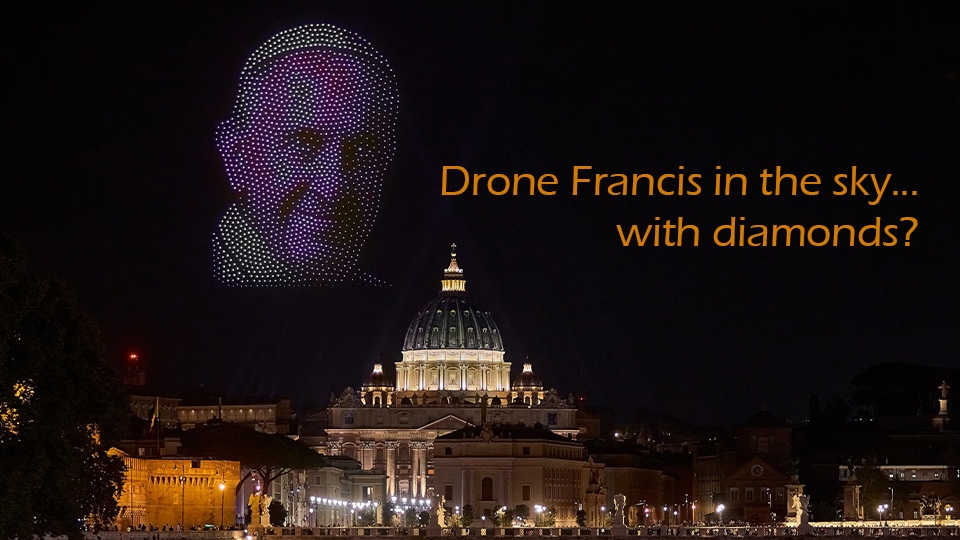

Francis liked to condemn the rigid and backward Traditional Catholics, many of whom may not appreciate the spectacle that Leo XIV and team arranged to help celebrate the legacy of Francis. On what grounds, though, can Traditional Catholics criticize Jelly and “drone Francis” hanging over St. Peter’s?
In his September 12th audience with participants in the “World Meeting on Human Fraternity,” Pope Leo XIV thanked the artists who would help spread the message of Francis’s encyclical on fraternity and social friendship, Fratelli Tutti, with their artistic display a few days later:
“At the heart of the Encyclical Fratelli Tutti, we read: ‘Social friendship and universal fraternity necessarily call for an acknowledgement of the worth of every human person, always and everywhere’ …I would like to thank the artists who, with their creativity, will send this message to the world from the magnificent embrace of Bernini’s colonnade. A special thanks goes to the distinguished Nobel Prize winners present, both for drafting the Declaration on Human Fraternity of 10 June 2023, and for the witness they give in international forums.”
The artistic display featured performers such as Jelly Roll, whose performance won high praise from Country Thang Daily:
“It was more than a cool moment. It was a testament to the most unlikely redemption arc in country music. Jelly Roll’s appearance was part of the Grace for the World concert, which closed out the third World Meeting on Human Fraternity. The lineup was star-studded, with names like Andrea Bocelli, Jennifer Hudson, John Legend, Pharrell Williams, Karol G, and Teddy Swims. Yet it was the tattooed Nashville native with a past riddled in felony charges who grabbed headlines across the globe. And he didn’t just show up. He performed ‘Hard Fought Hallelujah’ with fellow singer Brandon Lake, a song drenched in hope, redemption, and faith. Lake later praised Jelly in the comments, writing, ‘Crushed it! This is what our world needs right now more than ever. Thanks for leading us Jelly!’ The irony wasn’t lost on fans. Here was a man who once thought the system had chained him to a life of crime, now standing free, using his voice to deliver a message of healing to the entire world.”
Yes, it was “more than a cool moment,” and Jelly’s face tattoos, Protestantism, and rowdy performance took nothing away from the overall spiritual flavor of the event, which also featured the face of Francis portrayed in lights over St. Peter’s by thousands of drones. Truly, as Leo XIV had previewed days earlier, Jelly and his fellow artists sent Francis’s message of universal fraternity to the world “from the magnificent embrace of Bernini’s colonnade.” To borrow the words of Country Thang Daily, Jelly and team “crushed it.”
In his relentless pursuit of universal fraternity and appreciating the “worth of every human person, always and everywhere,” Francis liked to condemn the rigid and backward Traditional Catholics, many of whom may not appreciate the spectacle that Leo XIV and team arranged to help celebrate the legacy of Francis.
In his relentless pursuit of universal fraternity and appreciating the “worth of every human person, always and everywhere,” Francis liked to condemn the rigid and backward Traditional Catholics, many of whom may not appreciate the spectacle that Leo XIV and team arranged to help celebrate the legacy of Francis. On what grounds, though, can Traditional Catholics criticize Jelly and “drone Francis” hanging over St. Peter’s? Francis’s Fratelli Tutti — which formed the “theological” foundation for the event — is full of quotes from Vatican II, Paul VI, John Paul II, and Benedict XVI. Francis brought the persecution of Traditional Catholicism to new levels, but the unmistakable reality is that the Council and its implementation have always opposed the Faith as it existed prior to John XXIII. In one way or another, the spirit of Francis will hang over the Vatican until we return to a world in which the unadulterated Catholic Faith reigns again in Rome.
It has been so long since the unadulterated Catholic Faith reigned in Rome that even many Traditional Catholics may no longer know what it would mean for a pope to defend it. To see a perfect expression of it, we need only look to the opening words of St. Pius X’s 1910 apostolic mandate about the Sillon movement, Notre Charge Apostolique:
“Our Apostolic Mandate requires from Us that We watch over the purity of the Faith and the integrity of Catholic discipline. It requires from Us that We protect the faithful from evil and error; especially so when evil and error are presented in dynamic language which, concealing vague notions and ambiguous expressions with emotional and high-sounding words, is likely to set ablaze the hearts of men in pursuit of ideals which, whilst attractive, are nonetheless nefarious. Such were not so long ago the doctrines of the so-called philosophers of the 18th century, the doctrines of the Revolution and Liberalism which have been so often condemned; such are even today the theories of the Sillon which, under the glowing appearance of generosity, are all too often wanting in clarity, logic and truth. These theories do not belong to the Catholic or, for that matter, to the French Spirit.”
This is the epitome of what a pope should believe and express in the face of threats to the Faith. St. Pius X’s words highlight several ideas that have become completely foreign in Rome since the Council:
- The mandate to watch over the purity of the Faith
- The mandate to watch over the integrity of Catholic discipline
- The need to protect the faithful from every evil and error, especially when the errors are presented with ambiguous language
- The need to condemn Liberalism
If St. Pius X had been asked what would happen if the popes and hierarchy stopped doing these things, he surely would have predicted disasters that would rival those that we saw with Francis, and which Leo XIV has not stopped. Indeed, St. Pius X’s Notre Charge Apostolique specifically condemned the “human fraternity” at the root of Francis’s Fratelli Tutti:
“The same applies to the notion of Fraternity which they found on the love of common interest or, beyond all philosophies and religions, on the mere notion of humanity, thus embracing with an equal love and tolerance all human beings and their miseries, whether these are intellectual, moral, or physical and temporal. But Catholic doctrine tells us that the primary duty of charity does not lie in the toleration of false ideas, however sincere they may be, nor in the theoretical or practical indifference towards the errors and vices in which we see our brethren plunged, but in the zeal for their intellectual and moral improvement as well as for their material well-being. Catholic doctrine further tells us that love for our neighbor flows from our love for God, Who is Father to all, and goal of the whole human family; and in Jesus Christ whose members we are, to the point that in doing good to others we are doing good to Jesus Christ Himself. Any other kind of love is sheer illusion, sterile and fleeting. Indeed, we have the human experience of pagan and secular societies of ages past to show that concern for common interests or affinities of nature weigh very little against the passions and wild desires of the heart. No, Venerable Brethren, there is no genuine fraternity outside Christian charity. Through the love of God and His Son Jesus Christ Our Saviour, Christian charity embraces all men, comforts all, and leads all to the same faith and same heavenly happiness. By separating fraternity from Christian charity thus understood, Democracy, far from being a progress, would mean a disastrous step backwards for civilization.”
This is a direct repudiation of what took place at the Vatican during the “World Meeting on Human Fraternity,” but how can we possibly insist on these truths if we are also committed to defending the Vatican II revolution?
If St. Pius X was right, the Vatican II revolution is entirely wrong. The innovators at Vatican II would have had little room for mischief if every Council Father truly believed these words. And spectacles like the World Meeting on Human Fraternity could never take place at the Vatican if the hierarchy believed these words today.
St. Pius X also condemned the false ecumenism that has animated the entire Vatican II revolution:
“This being said, what must be thought of the promiscuity in which young Catholics will be caught up with heterodox and unbelieving folk in a work of this nature? Is it not a thousand-fold more dangerous for them than a neutral association? What are we to think of this appeal to all the heterodox, and to all the unbelievers, to prove the excellence of their convictions in the social sphere in a sort of apologetic contest? Has not this contest lasted for nineteen centuries in conditions less dangerous for the faith of Catholics? And was it not all to the credit of the Catholic Church? What are we to think of this respect for all errors, and of this strange invitation made by a Catholic to all the dissidents to strengthen their convictions through study so that they may have more and more abundant sources of fresh forces? What are we to think of an association in which all religions and even Free-Thought may express themselves openly and in complete freedom? For the Sillonists who, in public lectures and elsewhere, proudly proclaim their personal faith, certainly do not intend to silence others nor do they intend to prevent a Protestant from asserting his Protestantism, and the skeptic from affirming his skepticism.”
If St. Pius X was right, the Vatican II revolution is entirely wrong. The innovators at Vatican II would have had little room for mischief if every Council Father truly believed these words. And spectacles like the World Meeting on Human Fraternity could never take place at the Vatican if the hierarchy believed these words today.
It is an illusion to imagine that we can expunge the spirit of Francis without also ridding the Church of the Spirit of Vatican II. Ultimately we have to choose between what St. Pius X believed and what Francis believed — a compromise is really just a variation of what Francis believed.
Still, some may doubt whether St. Pius X truly understood the issues. For those with these doubts today, though, St. Pius X also left us with a prophetic look at what would happen if the ideas of the Sillon prevailed:
“And now, overwhelmed with the deepest sadness, We ask Ourselves, Venerable Brethren, what has become of the Catholicism of the Sillon? Alas! this organization which formerly afforded such promising expectations, this limpid and impetuous stream, has been harnessed in its course by the modern enemies of the Church, and is now no more than a miserable affluent of the great movement of apostasy being organized in every country for the establishment of a One-World Church which shall have neither dogmas, nor hierarchy, neither discipline for the mind, nor curb for the passions, and which, under the pretext of freedom and human dignity, would bring back to the world (if such a Church could overcome) the reign of legalized cunning and force, and the oppression of the weak, and of all those who toil and suffer. We know only too well the dark workshops in which are elaborated these mischievous doctrines which ought not to seduce clear-thinking minds. The leaders of the Sillon have not been able to guard against these doctrines. The exaltation of their sentiments, the undiscriminating good-will of their hearts, their philosophical mysticism, mixed with a measure of illuminism, have carried them away towards another Gospel which they thought was the true Gospel of Our Savior. To such an extent that they speak of Our Lord Jesus Christ with a familiarity supremely disrespectful, and that – their ideal being akin to that of the Revolution – they fear not to draw between the Gospel and the Revolution blasphemous comparisons for which the excuse cannot be made that they are due to some confused and over-hasty composition.”
This is what we see today, especially with the new Synodal Church which accompanies “all the baptized” — except Traditional Catholics — in their varied religious beliefs. This Synodal Church effectively offers what overwhelmed St. Pius X with sadness: “a One-World Church which shall have neither dogmas, nor hierarchy, neither discipline for the mind, nor curb for the passions, and which, under the pretext of freedom and human dignity, would bring back to the world.”
It is an illusion to imagine that we can expunge the spirit of Francis without also ridding the Church of the Spirit of Vatican II. Ultimately we have to choose between what St. Pius X believed and what Francis believed — a compromise is really just a variation of what Francis believed. In the words of Jelly Roll, the enemies of the Faith think they have won a “Hard Fought Hallelujah” in replacing the spirit of St. Pius X with the spirit of Francis. Until more Catholics decide to insist on the unadulterated Catholic Faith, or God intervenes, the entire world will believe they are right. Immaculate Heart of Mary, pray for us!