

Pope Leo XIV has suppressed two dioceses in China and established a new one. Two main implications. First, the Pontiff has chosen to continue fully in line with Francis’s approach to relations with the Chinese Communist Party. Second, the Pontiff has opted for a sharp change of course compared to what appeared to be his initial governing stance on this sensitive issue.
On July 8, Pope Leo XIV suppressed the two Chinese dioceses of Xuanhua and Xiwanzi. As stated in the official Bulletin of the Holy See, the two dioceses “were erected on 11 April 1946 by Pope Pius XII”. Furthermore, the Pope established the new Diocese of Zhangjiakou, which now incorporates the two former dioceses. Zhangjiakou is now a suffragan Diocese of Beijing.
The Vatican also states in its Bulletin the two reasons that allegedly led Leo to make this decision: the “desire to promote pastoral care” and “to attend more effectively to the spiritual good” of Chinese Catholics, and to align “the territory of the diocese of Zhangjiakou with that of the principal city of Zhangjiakou”. These justifications, however, appear to be flimsy fig leaves meant to cover a much more troubling and sorrowful reality.
Christianity has been spreading rapidly in recent years in China, and the regime is seriously concerned that it could, in the near future, even lead to its collapse. Chinese propaganda refers to this uncontrollable growth of Christian faith with the infamous label “Christian fever”.
Indeed, as is well known, the two suppressed dioceses were not recognized by the Chinese Communist Party. By contrast, the Diocese of Zhangjiakou had been established by the government in 1980, and was affiliated with the so-called Patriotic Church — that is, the association of laypeople, priests, and bishops founded, recognized, and directly controlled by Xi Jinping’s regime.
On the same day, Leo XIV also confirmed Wang Zhengui as Bishop of Zhangjiakou, who was consecrated by Li Shan and Guo Jincai — respectively the president and vice president of the Patriotic Association — on September 10, 2025. Zhengui had already been elected by the Patriotic Association in December 2019 as “director of the local entity of Zhangjiakou”, a sort of diocesan administrator, without any recognition from the Vatican – of course!
Moreover, Zhengui is known for having implemented outright discriminatory policies against Catholics, clearly following the directives of his Maoist superiors. For instance, in 2019, Zhengui announced measures to ban minors from entering churches.
The reasoning is simple: Christianity has been spreading rapidly in recent years in China, and the regime is seriously concerned that it could, in the near future, even lead to its collapse. Chinese propaganda refers to this uncontrollable growth of Christian faith with the infamous label “Christian fever”. Zhengui merely enforced the Party’s directives — namely, prohibiting young people from accessing the sacraments in order to hinder their education according to Catholic principles.
This deeply sorrowful act of governance by Pope Leo XIV points to at least two key aspects. First, Prevost has chosen to place himself in full and deliberate continuity with what was organized and carried out by Francis. Second, he appears to have drastically shifted his own approach to governance compared to the decisions he himself made last June.
One of the most controversial acts of governance carried out by Francis concerns the so-called Secret Agreements between the Holy See and Beijing. The terms of this pact are not officially known, but we can safely say it’s an open secret.
Let’s proceed step by step. The reader is aware that one of the most controversial acts of governance carried out by Francis concerns the so-called Secret Agreements between the Holy See and Beijing. The terms of this pact are not officially known, but we can safely say it’s an open secret. Indeed, if we examine what has happened so far in the so-called Middle Kingdom, it becomes quite clear that the Vatican has effectively delegated the selection of bishops entirely to the leaders of the Chinese Communist Party.
The Holy See appears to retain only a right of veto over the proposed candidate. However, one must ask: how much pressure can the Vatican realistically exert if the Pope chooses to reject a candidate? Moreover, it seems evident that the Maoist authorities will always seek to nominate priests who are most aligned with communist doctrine — a doctrine that is fundamentally incompatible with Catholic social teaching.
The Secret Agreements were initiated by Bergoglio and — more specifically — by his Secretary of State, Cardinal Pietro Parolin, who has been confirmed in that role by Pope Leo XIV as well. It is known that Parolin established his first contacts with Chinese authorities in the early 2000s, when he sought advice and guidance from Giuliano Di Bernardo, former Grand Master of the Grand Orient of Italy, to resolve a delicate matter in China whose details remain unknown to this day. Parolin came into contact with Di Bernardo through the mediation of the then-nuncio to Bulgaria, Gheorghi Eldarov, who is listed among the co-founders of the initiatory and para-Masonic association known as Dignity Order.
First signed on September 22, 2018, these agreements were defined as “provisional”. They were renewed in 2020, 2022, and 2024. The most recent renewal, however, was not biennial but extended to four years, set to expire on October 22, 2028. This extension marks a significant shift from the previous two-year renewals and may well indicate an intention to transform the agreement from provisional to permanent.
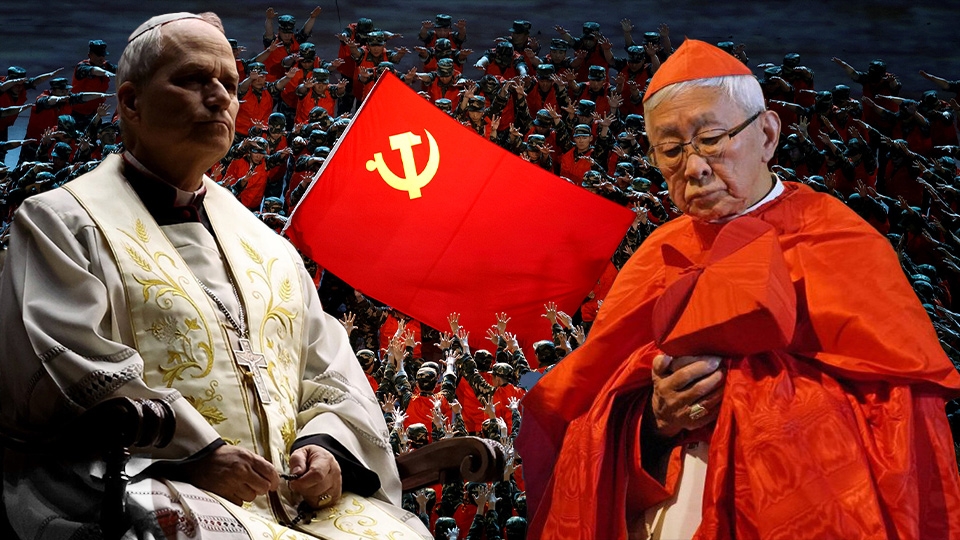
Cardinal Zen, Bishop Emeritus of Hong Kong, personally endured fierce persecution at the hands of the Chinese government—his only “crime” being loyalty to the Catholic Church.
Over the years, numerous commentators have highlighted the serious implications of the Secret Agreements with Beijing. Among the most prominent critics is undoubtedly Cardinal Zen, Bishop Emeritus of Hong Kong, who personally endured fierce persecution at the hands of the Chinese government—his only “crime” being loyalty to the Catholic Church. The Secret Agreements caused Cardinal Zen profound sorrow and disappointment, leaving him with a deep sense of betrayal.
From a theological point of view, the Secret Agreements undermine the Petrine authority. Only the pope has received from God the power to confer canonical mission upon bishops — that is, to share with them his own governing authority. The Secret Agreements grant the Chinese Communist Party full freedom to select episcopal candidates and recognize, if not formally then at least de facto, governing authority to Party officials over their fictitious dioceses, pending their “officialization”, as occurred with the Diocese of Zhangjiakou.
From a political and strategic point of view, the Secret Agreements facilitate the adaptation of the Christian message in China to the values of Chinese socialism. The bishops appointed by the Patriotic Association have been formed according to Marxist ideals and pledge allegiance to the Chinese Constitution. They thus formally adhere to the process of sinicizing Catholicism.
From a moral point of view, the Secret Agreements represent a true and unconditional surrender of the Vatican to the Chinese Communist Party. It is no coincidence that, in recent years, the Vatican has refrained from publicly condemning the severe persecution carried out by the government against priests and faithful of the so-called “underground” Church. The agreement has not led to greater religious freedom nor to genuine ecclesial unity. On the contrary, it has deepened the tensions between the official and underground clergy.
One must indeed ask: what will become of the Chinese Catholic bishops and priests who, up until September 10, consistently refused to recognize the Diocese of Zhangjiakou, created by the government and not approved by the Holy See? What will happen to Bishop Augustine Cui Tai, who until just days ago led the now-suppressed Diocese of Xuanhua, and who has been among the most loyal “underground” bishops to the Vatican? So loyal, in fact, that he has repeatedly faced restrictive measures, including imprisonment. Giorgio Bernardelli commented on Pope Leo’s decision in AsiaNews as follows:
This marks an extremely significant development for the province of Hebei, one of the regions where the Catholic presence has historically been most substantial, but also one that, in recent years, has been most heavily affected by pressure on so-called underground communities—those that have consistently refused to join the official Church organizations in China controlled by the Beijing authorities. […] The approval of Bishop Wang Zhengui’s ordination carries a meaning that goes beyond the mere redrawing of diocesan boundaries to align with administrative divisions, a process already seen in other dioceses. The suppression of the dioceses of Xuanhua and Xiwanzi inevitably sends a message to the underground communities in Hebei, both of which had their own pastoral leadership. […] Less clear, however, is the fate of those priests who, in good conscience, have continued to reject the obligation to register with the official bodies imposed by the Chinese Communist Party—and of the faithful who still look to them for spiritual guidance.”
Moreover, as demonstrated by the establishment of this new diocese, the Vatican is accommodating Beijing’s desire to reduce the number of Catholic dioceses. The reason is simple: fewer dioceses mean fewer bishops to monitor and control.
Let us now turn to the second meaning behind this act of governance by Pope Prevost. As mentioned earlier, he appears to have drastically shifted his approach compared to the decisions made last June, effectively restoring the Bergoglian status quo. Let us briefly recall what happened. On June 5, 2025, Pope Leo XIV appointed Joseph Lin Yuntuan as auxiliary bishop of Fuzhou, in southeastern China. Exactly one week later, on June 11, 2025, the Chinese government accepted the Vatican’s appointment — precisely the opposite of what had occurred until then.
While one might assume that such decisions largely stem from the Secretariat of State and its now well-known diplomatic approach, it is increasingly difficult to believe that Leo XIV is not at least in agreement with these choices. True, this Pope has shown himself to be a cautious figure, inclined to wait and avoid imposing a clear direction too quickly. Yet excessive hesitation, especially in matters of faith and martyrdom, risks becoming a form of tacit consent.
In the end, he is the Roman Pontiff, and it is he alone who bears the divinely entrusted responsibility to confirm his brothers in the faith, to defend the flock, and to safeguard the freedom of Christ’s Church. We must therefore resist the temptation to justify Pope Leo at all costs: the ultimate responsibility, before history and before God, always rests with the Pope.