
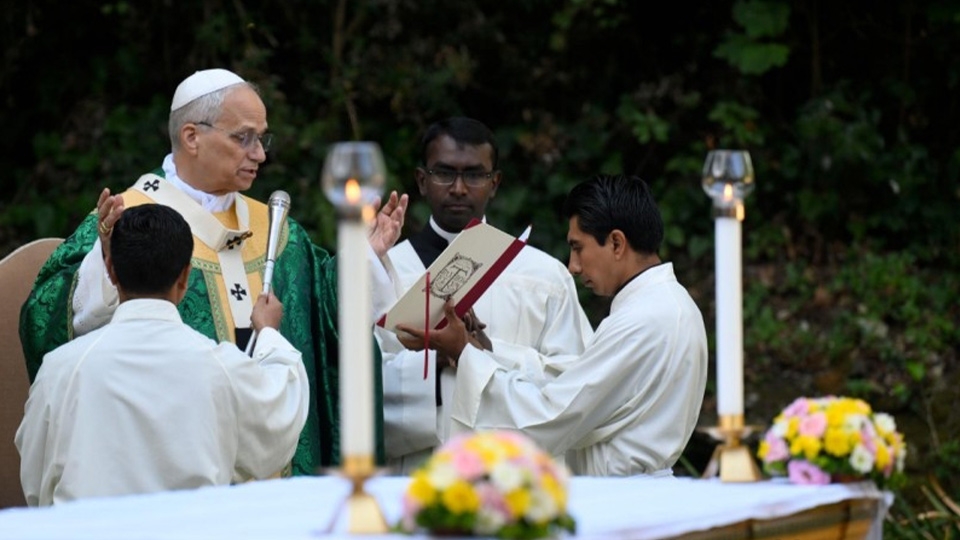

On July 9, 2025, Pope Leo XIV celebrated the first Mass pro custodia creationis, “for the care of Creation.” This is a new set of prayers and biblical readings officially approved by the Supreme Pontiff on June 8 through a decree of the Dicastery for Divine Worship, signed by Cardinal Arthur Roche.
The prayers and readings in question are added to the Masses for Various Needs and Occasions (Missae pro variis necessitatibus vel ad diversa) of the Ordinary Form of the Roman Missal—liturgical formularies intended for celebrating Mass in particular circumstances outside the regular liturgical seasons. This is not, therefore, the institution of a specific liturgical day dedicated to the care of Creation, but rather a flexible tool that allows the Church to pray and respond spiritually to what Pope Leo considers a pressing need of the contemporary world.
The Content of the New Formulary
The new liturgical formulary approved by Pope Leo XIV for the Mass for the Care of Creation contains nothing scandalous in itself. It does not introduce new doctrines, ambiguous elements, or anything contrary to the Catholic Faith, nor does it serve as a direct vehicle for environmentalist ideology. Rather, it draws upon important expressions regarding the relationship between God and creation, as well as humanity’s responsibility toward it. In essence, it is a Mass that speaks of God as Creator and of man as guardian—not as maker or redeemer of the world.
The collect refers to Christ as “the firstborn of all creation” (Col 1:15), emphasizing that the world does not exist autonomously, but in dependence on the Logos. The invocation of the Holy Spirit as spiraculum vitæ recalls Genesis 2:7: the breath of life comes from God, not from the balance of the ecosystem. The post-communion prayer is perhaps the most modern in its formulation, yet it remains cautiously orthodox: the expectation of “new heavens and a new earth” is eschatologically grounded (cf. 2 Pet 3:13), and living “conveniently” with all creatures can easily be understood in a way that does not evoke Greta Thunberg.
While Leo spoke of creation in relation to sin and Redemption, many curial officials formed under the Bergoglian era clamored to preserve the status quo of the previous administration.
As for the choice of biblical readings, the selection of Wisdom 13:1–9 is particularly noteworthy—a sharp critique of the idolatry of nature and a warning to those who contemplate the beauty of creation without being led back to the Creator. Colossians 1:15–20 is one of the loftiest texts of “cosmic Christology”: all things were created through Christ and for Christ. Finally, the proposed Gospel passages—the discourse on Providence (Mt 6:24–34) and the calming of the storm (Mt 8:23–27)—emphasize Christ’s lordship over all creation.
Of course, while not scandalous in itself, this formulary could lend itself to ideological manipulation if used within a pastoral context tainted by gnostic environmentalism, neo-Malthusian views, or anti-human rhetoric. This, however, is not a flaw of the formulary itself, but a risk of abuse. As with many other Masses for Various Needs, the danger lies in the subjective intention of the celebrant, not in the objective liturgical content.
Environmentalism and the Revolution
While Leo spoke of creation in relation to sin and Redemption, many curial officials formed under the Bergoglian era clamored to preserve the status quo of the previous administration. The press conference presenting the document “A Call for Climate Justice and Our Common Home” (July 1, 2025), promoted by episcopal bodies from the Global South, is indicative of the ideological drift that still afflicts a significant portion of the current Vatican Curia.
The text, presented by Cardinals Jaime Spengler, Filipe Neri Ferrão, and Fridolin Ambongo Besungu, focuses exclusively on concepts such as ecological conversion, imminent climate collapse, ecological debt, degrowth, and the urgency of energy transition—while entirely neglecting the foundational elements of the Christian faith: original sin, Redemption, grace, and conversion to Christ. What we are faced with is a naturalistic and secularized vision that empties the faith of its transcendent content and reduces it to an environmental ethic devoid of reference to the supernatural.
He does not speak of man as a cancer of the earth, but as a sinner in need of conversion. His interpretation is profoundly theological: the ecological crisis is a consequence of the moral crisis—not the other way around. The issue, then, is not so much about reducing emissions as it is about reforming hearts.
To grasp the essence of environmentalism as a contemporary cultural phenomenon, we must keep in mind that it represents a necessary stage in the historical revolutionary process that humanity has been undergoing for roughly five centuries. Let us consider for a moment the five phases of the Revolution. I will briefly revisit what I explained here.
“These phases are five because there are five great systems of relationship that every individual establishes with the reality outside of themselves. Starting from the outermost system to the most intimate one, we have religion (relationship between man and God), politics (relationship of right and justice among men), economy (relationship of exchange among men), society (relationship of each man with his neighbor and especially with the family), and humanity (relationship of each man with his own nature). Catholic civilization had built five walls that protected man according to these five systems of relationship. Revolution besieged starting from the outermost wall. The apex points of these five sieges were Protestantism (religion), Jacobinism and Bonapartism (politics), Marxism (economy), Sixty-Eightism (society), and now Transhumanism (anthropology).”
Environmentalism should be understood as an internal and necessary moment within the anthropological phase of the revolutionary process. The new vision of the environment is, in fact, deeply imbued with Gnosticism. The Gnostic sees matter as something intrinsically evil, yet at the same time, something divine. Divinity is identified with the universe itself (pantheism), which encompasses both good and evil (dualism). From this arises the apparent paradox of ecolatry—the deification of the ecosystem.
The environment becomes an impersonal, yet often hostile, god that demands sacrifices to maintain its balance. From this mindset emerges the rhetoric of international organizations: population decline, depopulation, and even—in the most extreme cases—proposals for the voluntary extinction of humanity, which is seen as the planet’s only true cancer. The entire spectrum of environmentalism, from the more moderate to the most radical, converges on the same solution: more State, less freedom. Families, small businesses, and private property are targeted, while new taxes and regulations are imposed in the name of the environment.
As in every phase of the Revolution, environmentalism too is founded on a dialectical conflict (let us not forget that Hegel is the quintessential philosopher of the Revolution): this time, not between social classes, but between man and matter. And once again, it is claimed that what is below must transform what is above. The order of creation—which places man at the summit as a rational being—is overturned by an anti-speciesist vision that rejects all natural hierarchy. It is yet another conceptual and spiritual perversion. Environmentalism, as both ideology and practice, is merely a stage toward the true objective: the real anthropological revolution, namely the redefinition of human nature itself—transhumanism.
The solution to the ecological crisis is neither political nor technological, but religious: only by recognizing the beauty of creation—ontologically corrupted by original sin— and the Creator who sustains it, and Who alone can redeem it, can man rediscover his place in the world and truly care for the Earth.
Does Ecology Have a Place in Theology?
To the question of whether ecology has a place in Catholic theology, the answer is yes—but in a way that is subordinate to and ordered by the theology of Creation, sin, and Redemption. The reflection offered by Pope Leo XIV in his first homily for the Mass for the Care of Creation stands out precisely for this reason: it does not begin with ideology, but with the Mystery of Christ.
In denouncing the “many natural disasters” caused also (though not solely) by “human excesses,” Pope Leo does not fall into the guilt-driven rhetoric of radical environmentalism. He does not speak of man as a cancer of the earth, but as a sinner in need of conversion. His interpretation is profoundly theological: the ecological crisis is a consequence of the moral crisis—not the other way around. The issue, then, is not so much about reducing emissions as it is about reforming hearts.
In commenting on the Gospel of the calming of the storm, the Pontiff appears to firmly reject ecological catastrophism. Humanity is not destined for extinction, but for Redemption. Hope is not to be found in green technologies or climate treaties, but in Jesus Christ, Lord of creation. He is the one who commands the winds and the sea. It is this certainty that grounds a theology of creation: nature is not master over man, but servant—and the Son of God is its Lord. Any worldview that reintroduces a kind of cosmic fatalism is, in itself, already anti-Christian.
When Pope Leo speaks of the “mission to care for creation” as part of the Church’s mission, he never reduces it to a technical or environmental function. Accountability is part of the vocation of the human person renewed in Christ: to bring peace and reconciliation—not simply to plant trees or reduce waste. It is about restoring a relational order broken by sin. It seems, then, that the Pope is speaking of a Christian anthropocentric stewardship, and therefore ultimately a Christocentric one—because it places at the center the redeemed human being, transfigured in the image of the God-Man, Jesus Christ, and not the idolized ecosystem. It is the exact reversal of the ideological premises of modern environmentalism.
No less important is the Pope’s reference to the “destructive power of the princes of this world.” In an age when ecological religion is being used by technocratic and supranational elites to impose new totalitarian paradigms, increased taxation, and restrictions on the natural right to private property, the Pontiff dares to place the Church in a prophetic and almost resistant stance. The Christian ecology that Leo seeks to propose is not complicit with power, but corrective of it.
The keystone of the entire homily lies in the final sentence: “Only a contemplative gaze can change our relationship with created things.” Here the vast distance between the Christian theology of creation and ideological environmentalism becomes clear. The solution to the ecological crisis is neither political nor technological, but religious: only by recognizing the beauty of creation—ontologically corrupted by original sin— and the Creator who sustains it, and Who alone can redeem it, can man rediscover his place in the world and truly care for the Earth. The real problem is not capitalism or global warming, but sin. And the only true conversion is conversion to Christ.
Latest on RTV — MASS DECEPTION: Vatican Push to Cancel Latin Mass Based on Fake News