
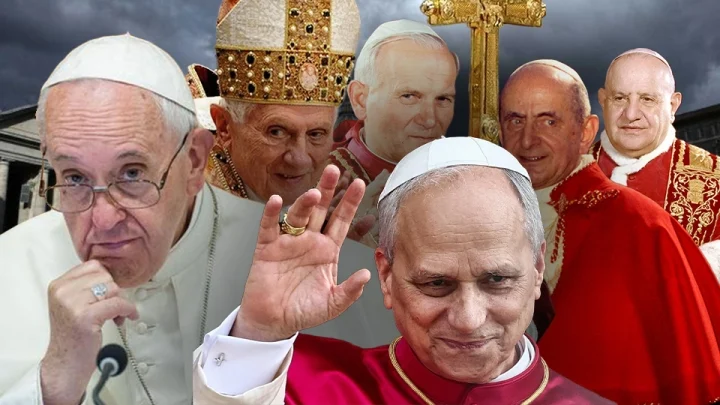

If you look at the history of the Church (and of humanity in general), you can notice that it tends to repeat itself through four types of generations. This interpretative model of general history, which became very popular in the USA thanks to authors like William Strauss and Neil Howe, is very ancient. Far from being a deterministic reading of human events (although some, like the Italian historian Giuseppe Ferrari, have interpreted it that way), I believe it is authentically Christian and profoundly biblical.
The Holy Scripture reasons with the category of human generations and presents sacred history as a succession of four models, which we can recover in the figures of the four patriarchs: Abraham, Isaac, Jacob, and Joseph. I use the adjectives preparatory, active, reactive, and resolutive to indicate the four generational types. Each generation lasts on average 31 years, because that is the duration of human maturity and the time in which men leave—each to a different degree—visible marks in social life (on average from the completion of the thirtieth year to the completion of the seventieth year).
The fourth generation, called resolutive, closes the cycle. It is the moment when tensions subside and the principles born in the preparatory phase become an integral part of collective life. They are no longer the subject of debate or struggle: they are simply accepted, assimilated, lived.
During a preparatory generation, governance resembles that of the previous resolutive phase, conveying a sense of continuity and stability. However, beneath this apparent calm, new ideas begin to sprout—like hidden seeds—destined to become revolutions or reforms, depending on their nature. This is why this generation belongs to philosophers and artists, and can be compared to spring: a season of ferment, rebirth, and deep insights.
The second generation is called active. It is made up of pragmatic individuals, not very inclined to reflection, driven by an impatient desire to turn into action the principles learned from the teachers of the previous generation. Motivated by enthusiasm and optimism, they create new institutions and initiate innovative processes, often without noticing—or without worrying about—the contradictions, even deep ones, that arise. On one hand, they foster a climate of fervor and hope; on the other, they become witnesses, and sometimes architects, of tensions that eventually explode, tearing apart the ‘new world’ they had imagined building.
The third generation, called reactive, grows up observing the contradictions inherited from the active generation, often ignored in the name of progress. When it comes to power, it aims to tone down the excesses and resolve the conflicts, without rejecting the original principles. On the contrary, it seeks to use those very principles—enthusiastically applied by the previous generation—to correct the imbalances and heal the fractures that resulted.
The fourth generation, called resolutive, closes the cycle. It is the moment when tensions subside and the principles born in the preparatory phase become an integral part of collective life. They are no longer the subject of debate or struggle: they are simply accepted, assimilated, lived. People recognize them as their own, without questioning their origins or the path that led them there. One could say that the three previous generations—the preparatory, the active, and the reactive—do nothing but work, often unknowingly, toward the arrival of the fourth.
Leo XIV marks the beginning of the resolutive generation in power within the Church, even though he personally belongs to a reactive generation. For this reason, we could define his figure as a synthesis between Paul VI and John Paul II.
In this sense, the analogy with the seasons is illuminating: spring (preparatory) is the time of sowing and inspiration; summer (active) is the time of action and impetuous growth; autumn (reactive) is the time of reflection and correction. All converge toward winter (resolutive), the season of calm and sedimentation, in which what has been cultivated becomes a stable landscape, shared memory, and natural order.
When the resolutive generation determines governance, it shows recurring traits: a return to tradition, a depersonalization of principles—which no longer belong to individual thinkers or movements, but to the community—and a peaceful realization of what the active generation had fervently tried to build. It is the time of synthesis, of historical maturity, when the ideal becomes institution and utopia turns into custom.
Leo XIV marks the beginning of the resolutive generation in power within the Church, even though he personally belongs to a reactive generation. For this reason, we could define his figure as a synthesis between Paul VI and John Paul II. The current cycle began under Pope Pius XII, placed at the head of a preparatory generation: similar to his predecessor in leading the Church, but also more tolerant toward the innovative ferment that began to emerge underground during his pontificate. Theologians such as Henri de Lubac, Marie-Dominique Chenu, Karl Adam, and Joseph Maréchal laid the foundations on which later neo-modernists would build their works and gain notoriety. Naturally, not only problematic elements are found in every preparatory generation. Thinkers such as Réginald Garrigou-Lagrange, Cornelio Fabro, Marcel Lefebvre, and Romano Guardini also belong to this generation, but – sadly – only the most revolutionary seeds found fertile ground in the following generation.
Leo’s election as pope in 2025 took place after a particularly turbulent historical phase. His predecessor Francis tried to address unresolved tensions, attempting to impose the more or less coherent consequences of the proposals put forward by the active generation.
Among the representatives of this preparatory generation were also Angelo Roncalli and Giovanni Battista Montini, who would later become popes under the names John XXIII and Paul VI. During their reign, the active generation turned into practice what the teachers had taught. Thus, the Second Vatican Council marked the great attempt to transform the Church according to those principles. Alongside the masters—Lubac, Chenu, Congar, Daniélou, Tromp, Lefebvre—sat also the younger ones, with often very different theological sensibilities—Joseph Ratzinger, Karl Rahner, Karol Wojtyła, Hans Küng, Annibale Bugnini, Giuseppe Dossetti, Edward Schillebeeckx, and others.
When Karol Wojtyła (John Paul II) and Joseph Ratzinger (Benedict XVI) ascended to the papal throne, they found themselves reigning over a reactive generation, committed to containing the excessive impulses of the active one that had preceded it. Robert Francis Prevost, a representative of that same reactive generation, personally experienced the tensions and contradictions inherited, partially suffering their effects.
His election as pope in 2025 took place after a particularly turbulent historical phase. His predecessor Francis, also belonging to that same reactive generation, tried to address the unresolved tensions, attempting to impose—almost forcefully and despite resistance from both allies and opponents—the more or less coherent consequences of the proposals put forward by the active generation. However, his attempt did not come to completion: what remains is a set of open and unresolved processes.
It is now up to Pope Prevost to take up that unfinished legacy and bring it to fulfillment, interpreting the expectations and desires of the resolutive generation, now the protagonist on the stage of the Church.
Pope Leo XIV will not resolve the Church’s crisis. We will have to wait for the next Pope, maybe. The next Pope will govern in a manner similar to Leo XIV, but future theologians will sow new ideas—whether revolutionary or reformist remains to be seen—that will later erupt with the next active generation.
Those who believe that Pope Leo XIV can, or even wants to, wipe away all the problems and confusion stirred by the previous administration are seriously mistaken. As we have stated in other contributions, the new American Pontiff will at most try to ‘baptize’ Bergoglio’s controversial themes (synodality, environmentalism, inclusion, female ministry, agreements with China, etc.), but not to remove them, and this in the name of ecclesial unity—which, however, risks being misunderstood as a confederation of sensibilities and thoughts that are, in themselves, irreconcilable. True unity, in fact, as we have also said elsewhere, is founded on truth and is exclusive. Pope Prevost’s unity, on the other hand, is actually cohesion and is inclusive.
Added to this is the strong interdependence Leo XIV feels toward the Roman Curia, currently shaped by Bergoglio’s framework and strongly interested in preserving the status quo of the revolution carried out by the Argentine Pope, who—let it be remembered, because it is too often forgotten—is not the cause of the Church’s crisis, but merely one of its effects.
Pope Leo XIV will not resolve the Church’s crisis. We will have to wait for the next Pope, maybe. Although he belongs to this resolutive generation, he will reign over the Church’s next preparatory generation, which will begin a new cycle. The next Pope will govern in a manner similar to Leo XIV, but future theologians will sow new ideas—whether revolutionary or reformist remains to be seen—that will later erupt with the next active generation. Those who deeply understand the laws of history also know how to prepare, just as a good farmer knows when it is time to sow, harvest, or till the soil.
Latest from RTV — Dancing with the Devil: Archbishop of New York vs. Ozzy Ozbourne