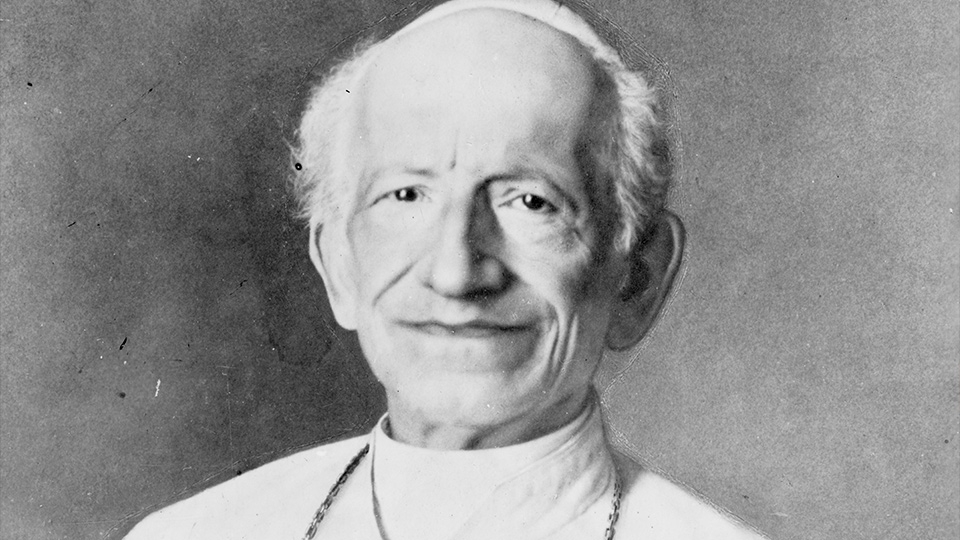

In his 1888 encyclical on the nature of human liberty, Libertas Praestantissimum, Pope Leo XIII explained how Catholic princes in Catholic nations could tolerate evil without approving of it:
“[W]ith the discernment of a true mother, the Church weighs the great burden of human weakness, and well knows the course down which the minds and actions of men are in this our age being borne. For this reason, while not conceding any right to anything save what is true and honest, she does not forbid public authority to tolerate what is at variance with truth and justice, for the sake of avoiding some greater evil, or of obtaining or preserving some greater good. God Himself in His providence, though infinitely good and powerful, permits evil to exist in the world, partly that greater good may not be impeded, and partly that greater evil may not ensue. In the government of States it is not forbidden to imitate the Ruler of the world; and, as the authority of man is powerless to prevent every evil, it has (as St. Augustine says) to overlook and leave unpunished many things which are punished, and rightly, by Divine Providence. But if, in such circumstances, for the sake of the common good (and this is the only legitimate reason), human law may or even should tolerate evil, it may not and should not approve or desire evil for its own sake; for evil of itself, being a privation of good, is opposed to the common welfare which every legislator is bound to desire and defend to the best of his ability.”
Thanks to Vatican II, we no longer have Catholic nations; and the Council’s Declaration of Religious Liberty, Dignitatis Humanae, replaced this concept of “tolerating evil for the sake of the common good” with the mistaken idea that everyone has a “right” to their errors so long as the public order is not disturbed. Nonetheless, it remains the case that the Church’s teaching on this matter has not changed, because it cannot change. And, if the Church permitted Catholic nations to tolerate grave evils (such as houses of prostitution, and the practice of false religions) “for the sake of avoiding some greater evil, or of obtaining or preserving some greater good,” surely we should understand that non-Christian nations will sometimes need to tolerate even greater evils for the same reason.
In his Against the Heresies, Archbishop Marcel Lefebvre helped explain this principle by drawing a parallel to our own spiritual lives:
“One tolerates evil, but one does not approve it. A parallel can be drawn to ourselves: we are sinners, we have evil tendencies, but we are not going to kill ourselves because we cannot tolerate our vices; we must bear with ourselves, to a certain degree, without, however, approving our vices. We bear with them while trying to combat them and reestablish order within ourselves. The same thing is true of societies: they are sick; to want to suppress evil would make social life impossible; one is not going to kill society! The States are thus obliged to tolerate certain things.” (p. 175)
Thus, we try to overcome our own vices just as we try to overcome the vices we see in society. And, just as there are generally more personal sins to overcome in a pagan who has recently converted to the Faith, there are more societal evils in a pluralist nation in 2024 than there were in Catholic nations when Leo XIII wrote his encyclical in 1888. But the principle remains: we must do the best we can in light of the actual realities with which we are faced, always trying to move in the direction of true Catholic goodness. We never let evil have free rein, but we also do not kill ourselves, or society, for the sake of showing God that we will have no compromise with evil.
To illustrate how these principles apply to voting issues, we can consider the prospect of competing ballot measures on abortion, which Nebraska voters will likely face in November. Pursuant to the September 13, 2024 Nebraska Supreme Court ruling, two competing measures can appear on the November ballot:
“One initiative looks to secure the right to abortion in the Nebraska Constitution up to the point of viability, or even later if the woman’s health is at risk. The opposing measure would put the state’s 12-week abortion ban, passed by lawmakers in 2023, into the constitution, with exceptions for rape, incest, and the life of the mother. Amending the state constitution requires that a petition earn more ‘yes’ than ‘no’ votes and reach at least 35% of the total votes cast in the election. If both abortion initiatives clear these hurdles, the petition with the most support will be added to the constitution.”
How should a Nebraska Catholic vote to promote the common good? Abstaining from the vote on the grounds that we cannot compromise with evil by allowing exceptions for an abortion ban would make it more likely that the far worse pro-abortion measure would succeed. Thus, if we apply the principles set forth by Pope Leo XIII to the actual realities facing Nebraska voters, the only way to promote the common good is to vote for the defective measure — which permits abortion in some instances — “for the sake of avoiding some greater evil.” As a result, if a Catholic were to campaign against the defective measure, he or she would actually be working to oppose the common good.
Some may argue that Trump could easily turn on us, and perhaps this is true. But God judges our actions based on our intentions to act in accordance with His laws rather than any unintended and unforeseen results of those actions (which He alone knows).
So what are the actual realities facing us today with the 2024 U.S. presidential election? If we want to serve God by cooperating with His grace to make the best decisions we can to advance the common good, we must consider the following four realities:
- Two Viable Candidates. Absent extraordinary circumstances, only one of two candidates can possibly become president: Kamala Harris or Donald Trump.
- Kamala Harris’s Overtly Anti-Christian Agenda. As discussed in a previous article, Harris has an overtly anti-Christian agenda. She has made it perfectly clear that, as president, she would direct a tremendous portion of her efforts to opposing the common good.
- Trump’s Softening on Social Conservative Positions. We would not be having serious debates on the election were it not for the reality that Trump has softened on some social conservative positions since 2020. Nonetheless, on essentially every issue that relates to the common good, including sanctity of life issues, Trump is significantly better than Harris. And, importantly, Trump’s “20 Core Promises” include the following protections for the common good that Harris opposes: defend freedom of religion; end the weaponization of the government against the American people; and cut federal funding for any school pushing critical race theory, radical gender ideology, and other inappropriate racial or sexual content to our children.
- Growing Censorship and Political Prosecution. In Europe and in the United States, we have seen a rapid increase in censorship and political prosecution, all in support of the globalist, woke, anti-Christian agenda touted by Harris. We have every reason to believe that Harris would employ this tyrannical practice to the utmost of her ability for the sake of permanently burying opposition to her anti-Christian agenda.
Many of the most prevalent disagreements among serious, pro-life, devout Catholic voters relate to neglecting one or more of these realities. Unfortunately, though, we cannot possibly hope to vote for the common good by denying reality. Two examples can help illustrate this:
Sanctity of Life. Some Catholics who oppose Trump’s softening on pro-life matters assert that voting for Trump is voting to kill babies. The implication of that perspective is that withholding our votes from Trump would be a good way to stop, or at least limit, the killing of babies. But this conclusion is undermined by the realities that (a) Harris has an overtly anti-Christian agenda centered on unlimited abortion, (b) Trump is still much more pro-life than Harris, and (c) the next president will be Harris or Trump. Thus, if we look at reality instead of a make-believe world, it is obvious that the only vote to limit abortion is to vote for Trump.
Pro-Life and Conservative Movements. Some Catholics who oppose Trump’s softening on pro-life matters take a more sophisticated view. They concede that a Harris presidency will likely lead to many more abortions over the next four to eight years, but they argue that this is somehow preferable to the impairment of the pro-life and conservative movements that would occur if Trump remains the driving force of the Republican Party, which would presumably be the case if he wins. But this conclusion is undermined by the realities that (a) Harris has an overtly anti-Christian agenda, and (b) there is growing censorship and political prosecution. If Harris gains power, there will indeed be more reason to fight for pro-life positions, but Harris will almost certainly make that fight less possible than ever before. As a probable result, letting Harris win not only leads to more abortion; it effectively means that the pro-life movement will not be able to play a role in politics for the foreseeable future, if it even exists.
We still have an obligation to try to fight for the Catholic positions that Trump and the Republican Party have set aside. But that fight must begin with our fellow Catholics if we hope to have success.
So these examples highlight excellent arguments to not vote for Trump if we were faced with different realities; but with the actual realities we face, they are far less persuasive. Exposing the weakness of these arguments does not prove that we should vote for Trump, or that he would actually be better for the common good. However, it should encourage us to look more closely at actual realties when evaluating arguments about how to vote in the election.
When we combine the four realities stated above, it appears that the most reasonable way to participate in the election with the goal of truly helping to promote the common good is to vote for Trump. This does not mean we think he is better than other candidates who might have run against Biden (now Harris). Rather, it means that of the two viable candidates he is most likely to promote the common good.
The promotion of the common good clearly has supernatural implications. By promoting the common good, it is generally more likely that a Trump presidency would lead to less public sin, and, therefore, less grievous offense against God; it would likely mean greater opportunity for Catholics to openly promote God’s truth, and try to lead souls to the Faith; and it would almost certainly mean a far greater likelihood that Catholics can raise their families without intrusion from the growing globalist hostility. All of this translates into a greater ability of Catholics to establish the reign of Christ the King.
Francis provided an unexpected affirmation of these conclusions with his September 13, 2024 comments on the election:
“They are both against life. The one who throws away the migrants as well as the one who kills children . . . Both are against life.”
So, according to Francis, Harris is bad because she wants to kill babies, and Trump is bad because he wants to stop illegal immigration. But Trump wants to stop illegal immigration because of its unambiguously disastrous consequences for the common good, and so what Francis imagines to be a sin is actually a virtue.
Some may argue that Trump could easily turn on us, and perhaps this is true. But God judges our actions based on our intentions to act in accordance with His laws rather than any unintended and unforeseen results of those actions (which He alone knows). If we come back to the crucial question of which of the two candidates is most likely to promote the common good, there is only one possible right answer to that question at this point: Trump.
Taken altogether, these considerations suffice (for many of us) to entirely justify wholehearted support of Trump’s presidential bid because we believe that he is the candidate most likely to promote the common good. We can reach this conclusion without even considering that Harris would be disastrous for the nation and world in various matters that deal far more with material prosperity and security — we can reach this conclusion, in other words, simply by considering how we think God wants us to vote to promote the common good. As a matter of honest discourse, then, those who recommend withdrawing support from Trump ought to be able to make the case that it is the best path to promote the common good; and, as argued above, that is quite difficult to do without ignoring fundamental realities.
Returning to Pope Leo XIII and the concept of tolerating evil for the sake of preserving and promoting the common good, we must recall that this toleration can never become support for the evil in question, or even indifference to it. We still have an obligation to try to fight for the Catholic positions that Trump and the Republican Party have set aside. But that fight must begin with our fellow Catholics if we hope to have success. It is preposterous to assume that we can tell Trump, or any other politician, to adopt platforms that even our fellow Catholics do not accept. And it is even more preposterous to decide that his failure to adopt platforms that our fellow Catholics reject is a good reason to consign our nation to the living Hell that Kamala wants to establish.
As discussed in a previous article, another Trump presidency could provide us the breathing room to do what we can to try to spread God’s truth and grace throughout the nation and world. When we combine this with the reality that the best actual option to promote the common good in the election is to vote for Trump, it is evident that Catholics can, in good conscience, do all we can to help Trump defeat Harris and the evil she wants to enthrone in America and throughout the world. We can therefore vote for Trump as Catholics with a holy desire to promote the common good, rather than fatalistically surrender to Kamala’s fiendish designs to promote the greatest evils that our nation has ever seen. Our Lady of Sorrows, pray for us!