
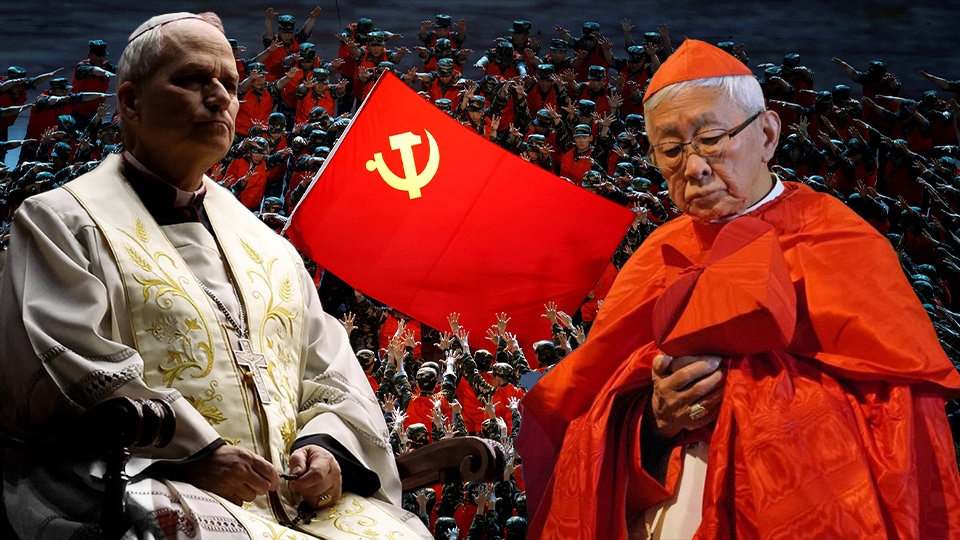

Pope Leo XIV faces a crucial litmus test for international diplomacy and moral leadership as he inherits the Vatican’s controversial bilateral ties with Communist China under the Chinese Communist Party (CCP). The contentious and clandestine 2018 Sino-Vatican deal wasrenewed most recently for another four years in November 2024, permiting the Vatican and Chinese authorities to jointly oversee episcopal appointments in China’s state-sanctioned church.
As the present head of the Roman Catholic Church, Pope Leo XIV has a lot on his plate.
In the context of Asia, the new pontiff faces a crucial litmus test for international diplomacy and moral leadership as he inherits the Vatican’s controversial bilateral ties with Communist China under the Chinese Communist Party (CCP) from his predecessor, the late Pope Francis.
For one, the contentious and clandestine 2018 Sino-Vatican deal that has been renewed three times (as of the time of writing) already has been a thorn in the flesh for many Chinese Catholics faithful (clergy and laity alike) to the Holy See.
This closed-doors deal, renewed most recently for another four years in November 2024, permits the Vatican and Chinese authorities to jointly oversee episcopal appointments in China’s state-sanctioned church.
Although the Vatican has approved the CCP’s latest bishop appointments, calling the nominations a “significant step in the diocese’s communal journey,” Beijing’s recent moves have sought to dent the pope’s exclusive authority to appoint bishops and paves the way for greater CCP meddling in Church affairs.
Although the late Pope Francis and his proponents asserted that the 2018 Sino-Vatican pact was a pragmatic step toward safeguarding China’s estimated 12 million Catholics and bridging the rift between China’s state-approved church and the underground church faithful to Rome, Beijing has been consistently brazen in breaching the deal by nominating bishops without Vatican approval.
Notably, in the interregnum weeks between Pope Francis’s death in April and Leo’s election on May 8 this year, the CCP regime dared to “elect” two new bishops without Vatican approval—an audacious indication to the new pope about Beijing’s plans for the future of Sino-Vatican ties and a signal of greater marginalization of China’s underground Catholics.
Although the Vatican has approved the CCP’s latest bishop appointments, calling the nominations a “significant step in the diocese’s communal journey,” Beijing’s recent moves have sought to dent the pope’s exclusive authority to appoint bishops and paves the way for greater CCP meddling in Church affairs.
Moreover, under the regime of authoritarian rule XI Jinping, anti-Catholic persecution has only taken a toll for the worse with detained or disappearing bishops, closures of underground churches shuttered, as well as draconian restrictions on religious activities.
At least ten Chinese Catholic bishops, all Vatican-approved, are currently in indefinite detention, have disappeared or been forced out of their episcopal posts, or are under open-ended investigation by security police. To evade Western sanctions, the Chinese Communist Party uses less bloody and more hidden methods of coercion against these bishops than the show trials and physical torture of the Mao era.
In October 2024 (when Pope Francis was still alive), Nina Shea of The Hudson Institute stated in an article that since the 2018 Sino-Vatican deal, “at least ten Chinese Catholic bishops, all Vatican-approved, are currently in indefinite detention, have disappeared or been forced out of their episcopal posts, or are under open-ended investigation by security police. To evade Western sanctions, the Chinese Communist Party uses less bloody and more hidden methods of coercion against these bishops than the show trials and physical torture of the Mao era.”
Highlighting the suffering faced by some Chinese bishops under the CCP regime, Shea added:
“Baoding’s Bishop James Su Zhimin suffers the longest continuous secret detention: 27 years so far, after he led a large procession to a Marian shrine. The CCP had previously imprisoned and severely tortured him. Wenzhou’s Bishop Peter Shao Zhumin is in secret detention, following an arrest last January. He has been placed in secret detention without due process six times since 2018. Bishop Augustine Cui Tai of Xuanhua diocese was last arrested in April 2021 and placed in secret, indefinite detention for the fourth time since the agreement was signed. This continues a cruel 30-year pattern against him.Having spent much of the past 30 years in detention, Zhengding diocese’s Bishop Julius Jia Zhiguo was placed under house arrest in 2018. In 2020, police transferred him from the house to a hotel, where his diocese believes he remains. Police recently dismantled the orphanage he ran for 30 years. There, in defiance of state ‘Sinicization’ laws, he allowed children to pray. In May 2021, local police closed the seminary of Xinxiang’s Bishop Joseph Zhang Weizhu and placed him in indefinite detention at an unknown location. He was arrested soon after having cancer surgery. Shanghai’s Bishop Joseph Xing Wenzhi, at age 48 and having served as a bishop for six years, went missing in 2011. Last year, in a tacit acknowledgement that he is being persecuted, the Vatican expressed hope for a ‘just and wise solution’ to his case as well as to that of Bishop Thaddeus Ma Daqin, his successor, who has been detained at a seminary since 2012. In violation of the 2018 agreement, last year the government installed Bishop Shen Bin, who also heads a bishops’ council considered illegitimate by the Vatican, to replace them. The Vatican protested but eventually approved the Shen transfer for ‘the sake of Church unity.’ Bishop Melchior Shi Hongzhen of Tianjin has been detained for the past 15 years in his parish church compound. He spends his days reading in his study, except when the government has allowed him out to hold last rites. In August, the Vatican reported that China will ‘officially recognize’ the 95-year-old bishop and declared this ‘a positive fruit of the dialogue.’ It’s a bitter fruit, considering his advanced age. The gesture aims to influence public opinion. It is on par with Beijing’s cynical practice of releasing prisoners of conscience once they are on their deathbeds.”
Yet despite long standing suffering faced by both underground Chinese Catholic clergy and laity, it appears that Pope Leo XIV is likely adopting the late Pope Francis’ approach in Sino-Vatican ties.
The ultimate mission of the Catholic Church is to labor for the salvation of souls, and not to kowtow to the whims of the CCP regime nor further emboldening it. If Pope Leo XIV chooses upholding Catholic principles over political compromise with the CCP, he would, with God’s grace, elevate the Church’s moral standing and credibility both within and beyond China.
Tony Yang penned in an article published by the Global Taiwan Institute, stating:
“The early signals from the new pontificate are troubling for Taiwan. Despite weeks of lobbying by Taipei to secure an invitation for President Lai Ching-te to attend Leo’s papal installation on May 18, it was former Vice President Chen Chien-jen who ultimately represented Taiwan at the ceremony. While neither the Vatican nor Taiwan confirmed whether Lai received an invitation, the diplomatic slight echoes a familiar pattern of the Holy See’s careful calibration to avoid offending Beijing. This papal brush-off represents more than ceremonial protocol—it reveals the Vatican’s continued pursuit of warmer ties with China at Taiwan’s expense. The Holy See has declined to station an ambassador in Taiwan since 1971 and notably refused to join Taiwan’s other diplomatic allies in their annual effort to secure observer status for the island at the World Health Assembly. These symbolic snubs, as Vatican observers note, are intended to signal to Beijing that the Holy See remains open to switching diplomatic recognition from Taipei to Beijing.”
Elaborating, Yang continued:
“In early June 2025, Leo XIV named Bishop Joseph Lin Yuntuan as auxiliary bishop of Fuzhou under the terms of the 2018 Vatican-Beijing agreement, which allows Chinese authorities a role in the selection of bishops. This move signals Leo XIV’s intention to continue Pope Francis’s controversial policy, which has been criticized by some Catholic conservatives as a concession to Beijing’s demands and a potential betrayal of the underground Catholic community in China.”
Admittedly, Pope Leo XIV’s vital role as both a global spiritual leader and an American citizen puts him at the heart of a religious and political tussle between Catholicism and Maoist-style communism.
However, for the interests of the worldwide Catholic Church, our new pontiff must showcase moral fortitude by refusing to further compromise with the CCP.
Instead of continuing to acquiesce to Beijing’s intrusive demands on the Catholic Church, Pope Leo XIV should more forcefully denounce the CCP’s persecution of underground Chinese Catholics and insist on prioritizing Catholic moral authority over political pragmatism and Ostpolitik. Cardinal Joseph Zen of Hong Kong previously declared that too much compromise with the CCP would undermine the Church’s moral authority and “witness from within”.
After all, the ultimate mission of the Catholic Church is to labor for the salvation of souls, and not to kowtow to the whims of the CCP regime nor further emboldening it. If Pope Leo XIV chooses upholding Catholic principles over political compromise with the CCP, he would, with God’s grace, elevate the Church’s moral standing and credibility both within and beyond China.
Meanwhile, faithful Catholics can do their part in praying for the Catholic Church in China. As Cardinal Zen said in 2020:
“I love China. China is not the Communist Party. The Party is not eternal, we hope to be one day, soon, free from the tyranny of Communism. We believe in God and in the intercession of Our Lady. May all the good people preserve their faith and the bad people be convicted!”
Blessed Virgin Mary, Our Lady of China, pray for us.