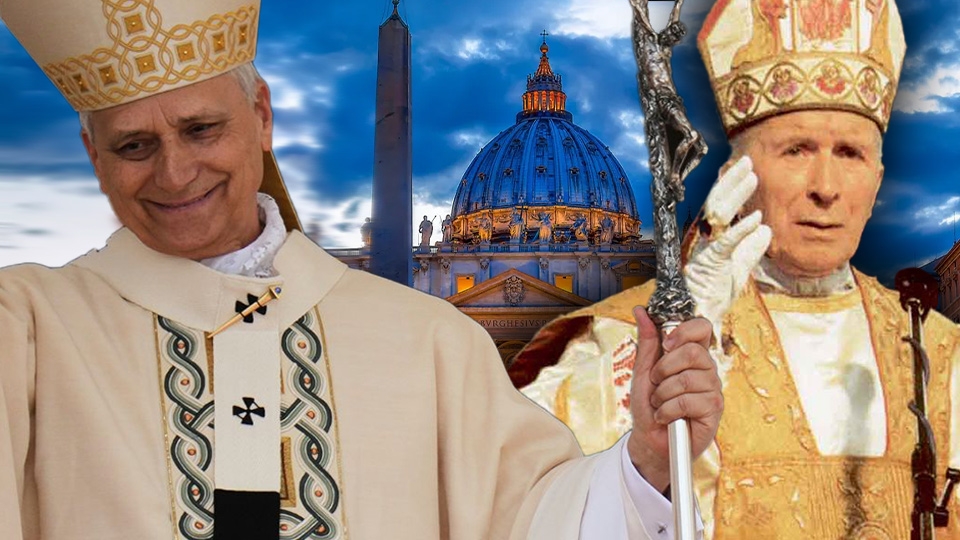

The existence of the Synodal Church is an entirely sufficient demonstration that there is a grave crisis in the Church. And it is not merely the existence of the Synodal Church that signals the grave state of necessity — one could say that an even more alarming sign is that only a small minority of shepherds have been willing to speak out against the wicked Synodal Church.
These five bishops have all spoken out against Synodality, and they are coming in person to address this year’s Catholic Identity Conference.
Stand with them and thank them for their witness — register for the CIC today!
As Rorate Caeli reported, two priests of the Society of St. Pius X (SSPX) recently published an “Open Letter to Cardinal Arborelius in Response to the Statements of 15 August 2025,” in which they defended the SSPX against the same types of anti-SSPX arguments that have been made for decades. While the arguments themselves have not changed significantly over time, the realities undermining the legitimacy of those arguments have become so obvious now that one wonders how an actual Catholic could honestly maintain the anti-SSPX positions asserted by Cardinal Arborelius. Nonetheless, one portion of the SSPX response provides a welcome occasion to reflect on one of the most important considerations in the Church and world today: the “existence of a state of grave spiritual necessity caused by the current crisis in the Church.”
What Are the Conditions for a State of Necessity?
The SSPX response introduced the concept of a state of grave spiritual necessity as follows:
“The Priestly Fraternity of St. Pius X considers the carrying out of those of its pastoral activities that lack the approval of church authorities to be justified by the existence of a state of grave spiritual necessity caused by the current crisis in the Church. For their salvation and sanctification, souls are in need of the true, unadulterated Catholic Faith and the sacraments of the Catholic Church celebrated in the dignified, awe-inspiring and uplifting rites of the traditional Missal, Ritual and Pontifical that truly lead hearts and minds to the realm of the supernatural and the things of God, as they have done for centuries for so many of the Church’s most loved and venerated Saints. Every member of the Church has the right to receive from it the doctrine and the sacraments necessary for salvation. This includes the right to be warned against errors that put the faith in danger as well as the right to be taught the fulness of the Catholic faith.”
Because every Catholic has the right to receive the unadulterated Catholic Faith and the sacraments from the Church, a state of necessity would exist in those situations in which the Church’s ostensible shepherds denied souls these essential goods. However, the state of necessity obviously does not grant permission for the SSPX or any other party to defy the Church’s laws without restraint. To understand the principles that must govern the state of necessity, we can look to Our Lord’s words from the Gospel of St. Luke:
“And it came to pass, when Jesus went into the house of one of the chief of the Pharisees, on the sabbath day, to eat bread, that they watched him. And behold, there was a certain man before him that had the dropsy. And Jesus answering, spoke to the lawyers and Pharisees, saying: Is it lawful to heal on the sabbath day? But they held their peace. But he taking him, healed him, and sent him away. And answering them, he said: Which of you shall have an ass or an ox fall into a pit, and will not immediately draw him out, on the sabbath day?” (Luke 14:1-5)
Jesus used the example of an ox falling into a pit to describe a state of necessity that permitted an otherwise forbidden action on the sabbath day. Importantly, though, it should be clear that the need to violate one law on the sabbath did not grant permission to violate (a) the law in question any more than was required to rescue the ox, or (b) any other laws that did not stand in the way of drawing the ox out of the pit. One could not, for example, use the need to rescue the ox in the pit to do other unlawful tasks on the sabbath: the actions permitted were only those necessary to address the state of necessity.
Those who remain in the Church often practice a cafeteria-Catholicism that gives them little chance of pleasing God and saving their souls. In response to this, only a small number of bishops register any concern.
It should also be evident that only those who are willing and able to rectify the emergency can avail themselves of the dispensation from following the law that would otherwise apply. The fact that someone was permitted to draw the ox out of the ditch on the sabbath day would not have permitted those who were incapable of assisting with the task to violate the law.
The SSPX response to Cardinal Arborelius explained how these principles operate in connection with the supreme law of the Church:
“The supreme Law of the Church is the salvation of souls. The Law of the Church, just like any other just law, allows for exceptions in exceptional circumstances. Civil law forbids breaking windows, but it is not wrong to break a window in order to save an infant from a burning building. It is similarly not wrong to help feed the starving flock even if it can only be done at the cost of the disapproval of Church authorities, whose approval would have been required in normal circumstances. . . . If the normal hierarchy (pastor, bishop, etc.) do not fulfill their duty, the faithful find themselves in a state of necessity that allows them to have recourse to any Catholic priest. Because of the necessity, this priest then receives directly from the Church what is called supplied jurisdiction, in order to minister to the faithful. We have always maintained that in the current crisis, supplied jurisdiction empowers traditional priests to baptize, hear the confessions of, marry, etc., Catholics who otherwise would not depend on them.”
Thus, when the salvation of souls is seriously threatened by extraordinary situations, true shepherds may take otherwise forbidden steps so long as they are necessary to rectify the threat to souls.
Does a State of Necessity Exist Today?
The SSPX response to Cardinal Arborelius outlined the state of necessity in the Church today:
“In the Church of today, many errors previously condemned by the Church’s magisterium are being allowed to spread practically unchecked, with an immense number of contemporary theologians and even bishops and cardinals openly denying or questioning the dogmas of the Catholic Church. The liturgical reforms have led to a loss of respect for the sacred, as the new forms largely fail to lift the soul to God and rather bring what should be considered sacred and approached with respect and awe down to the level of the mundane and everyday. The practice of receiving Holy Communion in the hand and standing not only occasions many sacrileges, but is also at least partly responsible for the loss of faith of many Catholics in Christ’s Real Presence in the Blessed Sacrament.”
As a result of these conditions, many souls who would otherwise convert to the Catholic Church remain outside, and many others who were born into the Church apostatize. Those who remain in the Church often practice a cafeteria-Catholicism that gives them little chance of pleasing God and saving their souls. In response to this, only a small number of bishops register any concern. All of this is a tremendous scandal that makes it appear as though the gates of hell have prevailed against the Church.
Although the SSPX response to Cardinal Arborelius did not mention it, one could also add that the existence of the Synodal Church is an entirely sufficient demonstration that there is a grave crisis in the Church. As discussed in a previous article, this new Synodal Church is a counterchurch and ape church, which Archbishop Sheen described with great accuracy in 1948:
“In the midst of all his seeming love for humanity and his glib talk of freedom and equality, he will have one great secret which he will tell to no one: he will not believe in God. Because his religion will be a brotherhood without the fatherhood of God, he will deceive even the elect. He will set up a counterchurch which will be the ape of the Church, because he, the Devil, is the ape of God. It will have all the notes and characteristics of the Church, but in reverse and emptied of its divine content. It will be a mystical body of the Antichrist that will in all externals resemble the mystical body of Christ.” (Sheen, Communism and the Conscience of the West, p. 24)
It is not merely the existence of the Synodal Church that signals the grave state of necessity — one could say that an even more alarming sign is that only a small minority of shepherds have been willing to speak out against the wicked Synodal Church. Thus, anyone with eyes to see can recognize that we face on unparalleled state of necessity in the Catholic Church.
The SSPX’s work serves as a check to the progress of the Vatican II revolution. Indeed, the Vatican has granted many accommodations to Catholic tradition over the years — especially the approval of other Traditional Catholic communities — with the clear purpose of providing alternatives to the SSPX that Rome can better control.
It also seems relatively certain that the state of necessity in the Church would be far more grave were it not for the fact that the SSPX has been working to counteract the crisis for decades. In addition to providing for the needs of the faithful who rely upon it, the SSPX’s work serves as a check to the progress of the Vatican II revolution. Indeed, the Vatican has granted many accommodations to Catholic tradition over the years — especially the approval of other Traditional Catholic communities — with the clear purpose of providing alternatives to the SSPX that Rome can better control. Although this consideration did not factor into the SSPX’s determination of how to act in the state of necessity, the unintended benefits to the entire Church would appear to be a Providential sign that the SSPX’s work has indeed been proper to address the grave state of necessity.
Would the State of Necessity Exist if Pope Leo XIV Begins to Fight for Orthodoxy?
The SSPX response to Cardinal Arborelius did not mention Pope Leo XIV, let alone discuss what might happen if Leo XIV ends up fighting in earnest for orthodoxy. Nonetheless, the response does allow us to see that the SSPX would presumably see a persistence of the state of necessity for so long as the authorities of the Church did not fully restore the unadulterated Catholic Faith and repudiate all of the errors opposed to it:
“The fact that some errors are condemned, (parts of) Catholic truth is preached and the traditional liturgy is allowed to be celebrated in some places especially provided, often in an unstable manner, for faithful who have a ‘personal preference’ or happen to be ‘attached to the vetus ordo,’ as it is often expressed, clearly does not change the fact that the state of grave spiritual necessity remains. For the defence of the liturgical and doctrinal Tradition of the Church is nothing more nor less than the defence of the integrity of the Catholic Faith, which is the common good of the Church; by this very fact it entails the fight against modern errors which challenge fundamental truths of the Faith and thus endanger the common good of the Church. When this common good of the Catholic Faith is considered by the authorities as the object of a simple personal attachment, a state of necessity exists.”
Thus, although we and the SSPX pray for Pope Leo XIV, and would do everything in our power to assist him, the state of necessity will persist until he or a successor truly restores the Faith. Moreover, it is clear that the most important work that the SSPX can do in helping to bring an end to the state of necessity in the Church is to remain a faithful witness to the need to restore the faith in its complete integrity. This is also the greatest service that the SSPX can render to Leo XIV. Immaculate Heart of Mary, pray for us!