
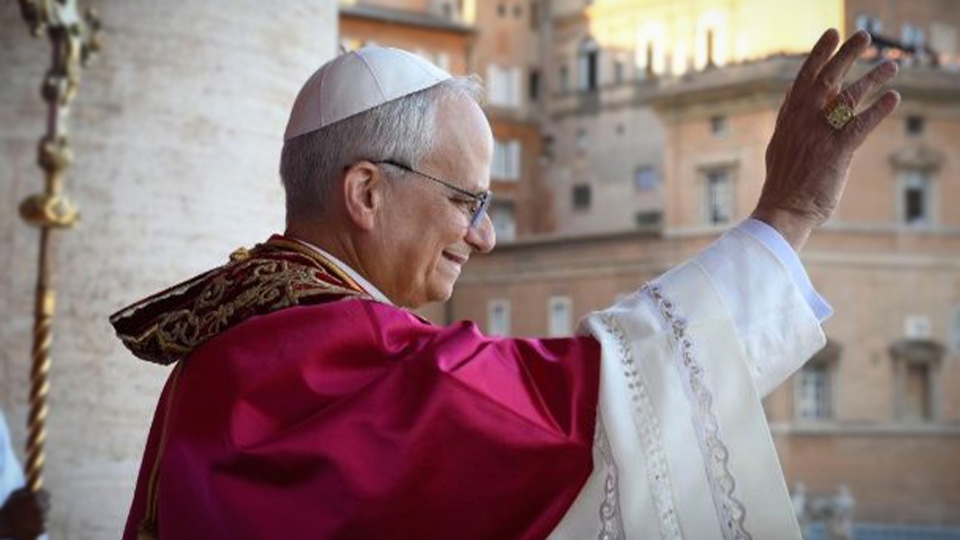

Upon the pontiff’s arrival, Istanbul, previously known as Constantinople, an erstwhile jewel of Christendom, now serves as a sad reminder of Christian unity lost (since the Great Schism of 1054 when the pope back then, also by the name of Leo—Leo IX—excommunicated Patriarch Michael Cerularius), as well as Christian unity hoped for by many Catholics.
Notably, Pope Leo XIV’s gestures and statements during this visit were occasionally heartening, yet at times revealed an unsettling equivocation that mirrors the current and unfortunate within the post-conciliar Church today: fidelity to traditional Catholic teachings and the faddish itch towards ecumenical accommodation at the expense of Catholic Truth.
Remarkably, the Pope’s refusal to participate in a joint prayer in Istanbul’s Blue Mosque, unlike his predecessors Pope Benedict XVI and Pope Francis, was prudent and immensely symbolic.
Firstly, the Holy Father’s laudable decision to visit Istanbul as the Vicar of Christ—not merely as a “global moral leader,” was palpable in his solemn demeanor throughout his visit (ah, could a nostalgic return to more dignified papal appearances be nigh?). Remarkably, the Pope’s refusal to participate in a joint prayer in Istanbul’s Blue Mosque, unlike his predecessors Pope Benedict XVI and Pope Francis, was prudent and immensely symbolic. After all, the Blue Mosque was the very location where, almost two decades years earlier, Pope Benedict XVI had “prayed silently” in what was depicted at the time as a “moment of reflection,” but which many faithful Catholics perceived as a confusing public act by a Supreme Pontiff, obfuscating the difference between the worship of the one true and Trinitarian God and the merely natural notion of God within Islam.
By declining to join any kind of interreligious ceremony in this setting, Pope Leo XIV commendably held his own and drew a clear line, as if alluding to Pope Pius XI’s encyclical “Mortalium Animos” which cautioned against the dangers of religious indifferentism disguised as “unity”. At least in this regard, Pope Leo XIV seemed to refuse the all-too-prevalent temptation of the post-conciliar church – to sacrifice the uniqueness of the Bride of Christ, the Catholic Church, on the altar of superficial fraternity.
Nonetheless, despite Pope Leo XIV’s praiseworthy restraint from displaying any form of interreligious unity in prayer at the Blue Mosque, the joint declaration between Pope Leo XIV and the Ecumenical Patriarch Barthlomew I, raised eyebrows among faithful Catholics. An excerpt of the joint declaration reads:
“We believe that authentic interreligious dialogue, far from being a cause of syncretism and confusion, is essential for the coexistence of peoples of different traditions and cultures. Mindful of the 60th anniversary of the declaration ‘Nostra Aetate’, we exhort all men and women of good will to work together to build a more just and supportive world, and to care for creation, which is entrusted to us by God. Only in this way can the human family overcome indifference, desire for domination, greed for profit and xenophobia.”
In context for the uninitiated, the ecumenical movement, as framed since the Second Vatican Council, has generally regarded “Christian unity” as a goal attainable by mere human dialogue, instead of a supernatural gift and aspiration premised upon filial submission to the authority of the pope as the Successor of Saint Peter. When unity is portrayed only as “respect for each Church’s unique traditions” rather than “reunion through the conversion of schismatics and heretics” to the one true Catholic Church founded by Our Lord Jesus Christ, the consequence is confusion at best and doctrinal compromise and eternal damnation at worst. Hence, while Pope Leo XIV’s reference to “Christian unity” might have been intended charitably, the phrasing reeks of the equivocal statements of Vatican 2’s decree of ecumenism, namely, “Unitatis Redintegratio”.
That the pope could visit Istanbul and not recount the true essence of “Christian unity”; the latter being a supernatural submission to Catholic truth and doctrine, was indeed a tragedy.
Yet the reality of the matter is that the Orthodox churches, despite all their reverent liturgies and immense piety, lack the fullness of truth guaranteed by the Roman See. To speak of unity without an explicit reference to and firm insistence on communion with the Successor of Saint Peter risks giving the false impression that existing differences between the Roman Catholic Church and the Orthodox ones are only cultural, not doctrinal. In contrast, pre-Vatican popes like Pius XI, always reinforced the reality that that true Christian union necessitates submission to the Chair of Saint Peter, for “in this one Church of Christ no man can be or remain who does not accept, recognize, and obey the authority and supremacy of Peter and his legitimate successors”, as “Mortalium Animos” indicates. Such is the true Catholic understanding of unity—one unfortunately diluted and compromised in many post-Vatican 2 narratives about ecumenism.
Additionally, one major collateral damage of post-conciliar ecumenism has been the latter’s propensity to muddle “dialogue” with evangelization, thus risking theological relativism. Exchanging in “dialogue” should not be for the purpose of merely “exchanging viewpoints”, but to charitably welcome non-Catholics to repent and convert to Catholicism, the sole religion that contains the entire deposit of Divine Revelation.
Alas, the costs of such vagueness and spiritual pluralism are far too high! Generations have grown up indifferent or even hostile to the one True Church founded by Our Lord Jesus Christ and countless souls have been lost (presumably) because of moral and religious indifference! In view of this, Pope Leo XIV’s words speaking of “mutual understanding” with the Orthodox in Istanbul, fell short of authoritative precision and gravity.
After all, doesn’t the very city of Istanbul (a unique blend of East and West), epitomize the spectacle of “Christian unity” forfeited centuries ago (after AD 1054) and after the Islamic conquest in the 15th century?
Nevertheless, to voice only consternation at Pope Leo XIV’s actions would be throwing the baby out of the bathwater. Admittedly, at times, the pontiff displayed signs of faith, including mentioning the Divinity of Our Lord Jesus Christ and His “Lordship over history” during his sermon at Istanbul’s Cathedral.
That the pope could visit Istanbul and not recount the true essence of “Christian unity”; the latter being a supernatural submission to Catholic truth and doctrine, was indeed a tragedy, though an unsurprising one, considering post-conciliar languor at proclaiming Catholic doctrine in face of non-believers.
Catholics can only bemoan a sorely missed opportunity – that the Vicar of Christ, instead of reinstating the Roman Catholic Church’s unique claims, based on the papal office that was instituted by Jesus Christ Himself, chose to merely “dialogue” with the Orthodox during his recent Istanbul trip, at the expense of missionary zeal and doctrinal clarity.
Nevertheless, to voice only consternation at Pope Leo XIV’s actions would be throwing the baby out of the bathwater. Admittedly, at times, the pontiff displayed signs of faith, including mentioning the Divinity of Our Lord Jesus Christ and His “Lordship over history” during his sermon at Istanbul’s Cathedral. Over at the cathedral, the pope’s choice of words, most likely derived from pre-conciliar liturgical theology, seemed to point towards the golden yesteryears when the Roman Catholic Church stood firmly against numerous heresies like Arianism.
Finally, it is noteworthy that Pope Leo XIV’s move to celebrate the Holy Sacrifice of the Mass ad orientem (albeit using the Novus Ordo Missae), also did not unnoticed. These gestures, minor as they may appear to a casual observer, remind Catholics that the Church’s eventual triumph over Her enemies hinges upon Her return to older and more ancient forms and rites that produced legions of saints, trophies of martyrs, and bands of virgins. God willing, may the pontiff also realize and live such a reality out in his personal and public papal ministry.
Maria, Mater Ecclesiae, ora pro nobis.
Latest from RTV — Michael Matt on Sedevacantism, EWTN & the ADL, and the Neo-Trad Attack on Women
