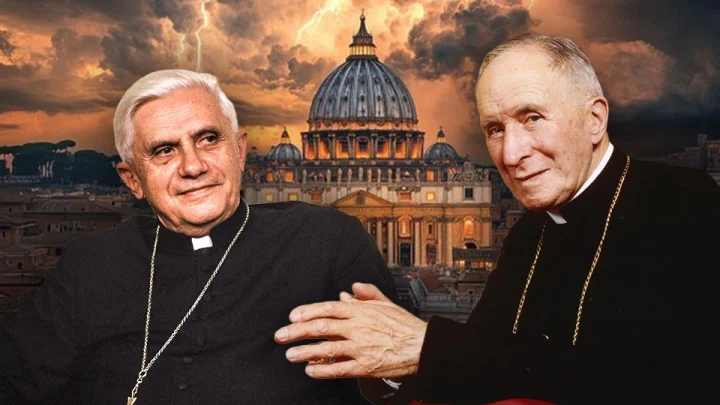

As one would expect, Cardinal Joseph Ratzinger had much to say about Archbishop Marcel Lefebvre’s 1988 episcopal consecrations. Astoundingly, though, the conference considered below that Cardinal Ratzinger gave two weeks after the consecrations constitutes an elaborate and clear admission that Archbishop Lefebvre was essentially correct about the concerns he had leading up to the consecrations. Even more importantly for us today, if we put Cardinal Ratzinger’s message within the context of everything that has happened since 1988, it is reasonable to believe that it is one of the most insightful statements about the ongoing crisis in the Catholic Church.
Before evaluating Cardinal Ratzinger’s conference, it is useful to recall the words of Archbishop Lefebvre from his sermon for the episcopal consecrations on June 30, 1988. Here, he insisted that he and his Society of St. Pius X (SSPX) had no intention of schism and were carrying out the consecrations as the greatest service they could render Rome:
“We are not schismatics! If an excommunication was pronounced against the bishops of China, who separated themselves from Rome and put themselves under the Chinese government, one very easily understands why Pope Pius XII excommunicated them. There is no question of us separating ourselves from Rome, nor of putting ourselves under a foreign government, nor of establishing a sort of parallel church as the Bishops of Palmar de Troya have done in Spain. They have even elected a pope, formed a college of cardinals . . . It is out of the question for us to do such things. Far from us be this miserable thought of separating ourselves from Rome! On the contrary, it is in order to manifest our attachment to Rome that we are performing this ceremony. It is in order to manifest our attachment to the Eternal Rome, to the pope, and to all those who have preceded these last popes who, unfortunately since the Second Vatican Council, have thought it their duty to adhere to grievous errors which are demolishing the Church and the Catholic priesthood.”
Essentially everything about the SSPX’s position remains the same today, even though the crisis has worsened immeasurably. As Fr. Davide Pagliarani and the SSPX prepare to consecrate additional bishops, they do so with a sincere conviction that this step is absolutely necessary for the good of souls and the Church.
Cardinal Ratzinger was the Prefect of the Congregation for the Doctrine of the Faith, and so he was certainly competent to judge that Rome had been much more severe with Archbishop Lefebvre and the SSPX than with the progressive movement.
Of course Cardinal Ratzinger did not share this viewpoint, so his July 13, 1988 conference to bishops in Santiago, Chile undeniably condemns the allegedly “schismatic” act, largely on grounds that Archbishop Lefebvre was too unwilling to reach a satisfactory compromise with Rome. However, Ratzinger began with a defense of how Rome had handled the process with the SSPX leading up to the consecrations:
“In recent months we have put a lot of work into the case of Lefebvre, with the sincere intention of creating for his movement a space within the Church that would be sufficient for it to live. The Holy See has been criticized for this. It is said that it has yielded to blackmail; that it has not defended the Second Vatican Council with sufficient energy; that, while it has treated progressive movements with great severity, it has displayed an exaggerated sympathy with the traditionalist rebellion. The development of events is enough to disprove these assertions. The mythical harshness of the Vatican in the face of the deviations of the progressives is shown to be mere empty words.” (from Fr. Francois Laisney’s Archbishop Lefebvre and the Vatican, p. 216)
Cardinal Ratzinger was the Prefect of the Congregation for the Doctrine of the Faith, and so he was certainly competent to judge that Rome had been much more severe with Archbishop Lefebvre and the SSPX than with the progressive movement. Ratzinger even displayed some anger at the hypocrisy of the progressives who had been disobedient to Rome for decades:
“There is a glaring contradiction in the fact that it is just the people who have let no occasion slip to allow the world to know of their disobedience to the Pope, and to the magisterial declarations of the last 20 years, who think they have the right to judge that this attitude [to Lefebvre] is too mild and who wish that an absolute obedience to Vatican II had been insisted upon. In a similar way they would claim that the Vatican has conceded a right to dissent to Lefebvre which has been obstinately denied to the promoters of a progressive tendency.” (p. 217)
According to Ratzinger, the progressives who insisted that Lefebvre needed to obey Vatican II had themselves been thoroughly disobedient to Rome for twenty years. And yet Rome was somehow unwilling or unable to control these progressives, even though it should have been crystal clear that such unchecked rebellion would cause tremendous harm to the Church. Of course this attitude of neglect was entirely foreign to the pre-Vatican II popes who had consistently worked to protect the Church against heresies. Because Archbishop Lefebvre adhered to what Pius XII and his predecessors had taught, he knew that those in authority had an absolute duty to oppose the errors threatening the Faith.
It is obvious that those who say that we must adhere to what the Church had always taught are correct because, according to Cardinal Ratzinger, Vatican II defined no dogma at all and was merely a pastoral council.
Moreover, Ratzinger acknowledged that part of the problem was that many Catholics treated Vatican II as though it had eclipsed everything the Church had always taught:
“The Second Vatican Council has not been treated as a part of the entire living Tradition of the Church, but as an end of Tradition, a new start from zero. The truth is that this particular Council defined no dogma at all, and deliberately chose to remain on a modest level, as a merely pastoral council; and yet many treat it as though it had made itself into a sort of super-dogma which takes away the importance of all the rest.” (pp. 220-221)
Based on these words, who is in error? Those who insist that we must follow new teachings of Vatican II or those who adhere to what the Church has always taught? It is obvious that those who say that we must adhere to what the Church had always taught are correct because, according to Cardinal Ratzinger, Vatican II defined no dogma at all and was merely a pastoral council. As we shall consider below, Ratzinger’s matured views on this at the end of his papacy are especially revealing.
Cardinal Ratzinger continued his conference by describing various harms that flowed from the progressives spreading their errors without check:
“That which was previously considered most holy — the form in which the liturgy was handed down — suddenly appears as the most forbidden of all things, the one thing that can be safely prohibited. It is intolerable to criticize decisions which have been taken since the Council; on the other hand, if men make question of ancient rules, or even of the great truths of the Faith — for instance, the corporal virginity of Mary, the bodily Resurrection of Jesus, the immortality of the soul — nobody complains or only does so with the greatest moderation.” (p. 221)
These words would have fit well in Archbishop Lefebvre’s sermon from a few weeks earlier and yet, strangely, they are the thoughts of the Prefect of the Congregation for the Doctrine of the Faith. If Ratzinger saw these problems, why didn’t he use the power of his office to condemn them instead of Lefebvre? Ratzinger continued:
“All of this leads a great number of people to ask themselves if the Church of today is really the same as that of yesterday, or if they have changed it for something else without telling people.” (p. 221)
These are the same questions that Archbishop Lefebvre had been asking for almost two decades by that point. Why was Ratzinger pondering them as though he was merely some curious spectator instead of one of the most influential men in the Vatican? Ratzinger continued:
“In the spiritual movements of the post-conciliar era, there is not the slightest doubt that frequently there has been an obliviousness, or even a suppression, of the issue of truth: here perhaps we confront the crucial problem for theology and for pastoral work today. The ‘truth’ is thought to be a claim that is too exalted, a ‘triumphalism’ that cannot be permitted any longer. You see this attitude plainly in the crisis that troubles the missionary ideal and missionary practice. If we do not point to the truth in announcing our faith, and if this truth is no longer essential for the salvation of Man, then the missions lose their meaning. In effect the conclusion has been drawn, and it is being drawn today, that in the future we need only seek that Christians should be good Christians, Moslems good Moslems, Hindus good Hindus, and so forth. If it comes to that, how are we to know when one is a ‘good’ Christian or a ‘good’ Moslem?” (pp. 221-222)
Cardinal Ratzinger was clearly saying that Rome needed to change to restore the true Catholic Faith if the supposed schism was to end. In other words, the real problem was not Archbishop Lefebvre or the SSPX but Rome and the progressives it had enabled to tear down the Faith.
Again, these are precisely the problems that prompted Archbishop Lefebvre to forego retirement for the sake of educating priests. And, if we are honest, we can readily acknowledge that if I were to have attributed these words to Archbishop Lefebvre rather than their true source, Cardinal Ratzinger, a large segment of those opposing the SSPX would attack these ideas as the sensationalist ramblings of a schismatic. Ratzinger continued:
“The idea that all religions are — if you talk seriously — only symbols of what ultimately is the Incomprehensible, is rapidly gaining ground in theology, and has already deeply penetrated into liturgical practice. When things get to this point, faith as such is left behind, because faith really consists in the fact that I am committing myself to the truth so far as it is known. So in this matter also there is every motive to return to the right path.” (p. 222)
Thus, according to Cardinal Ratzinger, Archbishop Lefebvre’s concerns about the crisis in the Church were essentially correct. As monumental as all of this is, the final sentence from the conference is the one that deserves the most attention:
“If once again we succeed in pointing out and living the fullness of the Catholic religion with regard to these points, we may hope that the schism of Lefebvre will not be of long duration.” (p. 222)
Who is the “we” in this sentence? It is Rome and those bishops who were not excommunicated — Cardinal Ratzinger was clearly saying that Rome needed to change to restore the true Catholic Faith if the supposed schism was to end. In other words, the real problem was not Archbishop Lefebvre or the SSPX but Rome and the progressives it had enabled to tear down the Faith.
Did Ratzinger ever succeed in reversing the damage? One indication that the crisis actually grew tremendously worse during his watch comes from the well-known words that Benedict XVI said nearly twenty-five years later, before resigning the papacy in 2013:
“We know that this Council of the media was accessible to everyone. Therefore, this was the dominant one, the more effective one, and it created so many disasters, so many problems, so much suffering: seminaries closed, convents closed, banal liturgy . . . and the real Council had difficulty establishing itself and taking shape; the virtual Council was stronger than the real Council.”
During this entire time between 1988 and 2013 — as Prefect of the Congregation for the Doctrine of the Faith, and then as pope — Ratzinger had power to condemn the errors plaguing the Church and insist that Catholics disregard the “Council of the media” and follow the “real Council.” Nonetheless, all of the disasters he mentioned were still continuing in 2013.
Ratzinger was right in 1988: it is up to Rome to “succeed in pointing out and living the fullness of the Catholic religion” if there is to be a time at which the SSPX can surrender its obligation to continue its work by consecrating bishops.
What about today? Who can honestly deny that the crisis has become exponentially worse since Benedict XVI stepped aside in 2013? When we simply consider the various diabolical scandals that have become household terms — including Amoris Laetitia, Pachamama, Fiducia Supplicans, the Synodal Church, and Mater Populi Fidelis — we have our answer.
As tragic as this is, it is clear that matters would likely be far worse if Archbishop Lefebvre had simply given up. Although, to use Cardinal Ratzinger’s expression, Rome was not able to create a space for the SSPX, it was compelled to allow the former Ecclesia Dei communities (such as the Fraternity of St. Peter and Institute of Christ the King) to exist as alternatives to the SSPX. Consequently, Rome has been checked in how far it could push anti-Catholic innovations — if Rome were to push the innovations too far or too soon, more Catholics would seek safe harbor with the SSPX. If the SSPX had died off because it had no bishops, then Rome would have absolutely no need to accommodate the former Ecclesia Dei communities.
Ratzinger was right in 1988: it is up to Rome to “succeed in pointing out and living the fullness of the Catholic religion” if there is to be a time at which the SSPX can surrender its obligation to continue its work by consecrating bishops. We are not there yet, so Fr. Pagliarani and the SSPX must consecrate bishops. Immaculate Heart of Mary, pray for us!
In the name of the Father, and of the Son, and of the Holy Ghost. Amen.