
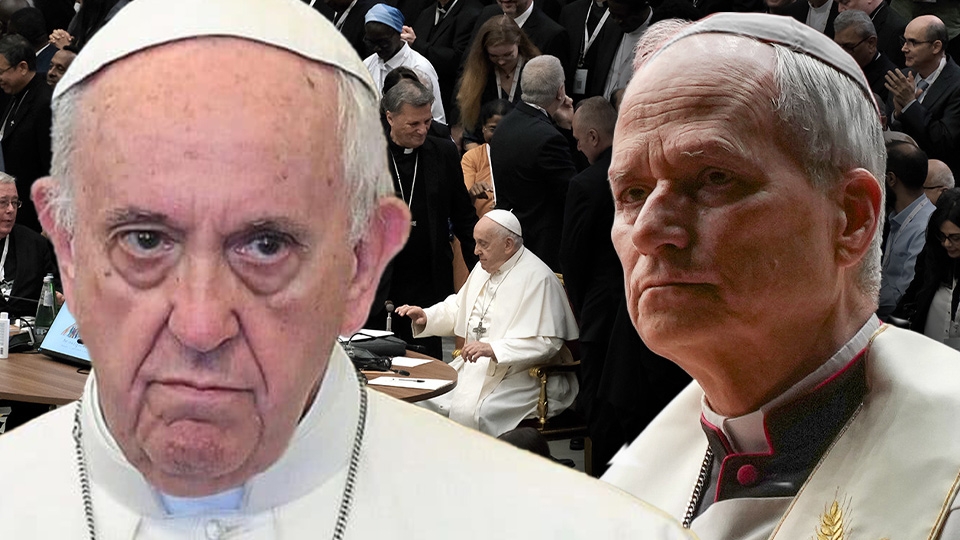

The respective demise and election of Popes Francis and Leo XIV saw the secular mainstream Western media leading the global charge to peer inside the Catholic Church, whose workings on such occasions rivet world attention. While revealing much about the Church, these attempts at understanding often fall fundamentally short in grasping the heart of what drives her.
The Catholic Church proclaims herself the city on a hill, the light of the world. With members in practically every country, she exercises extraordinary soft power, including diplomatic power, amongst mostly secular nation-states recognising her headquarters as coterminous with a highly unusual sovereign state of her own. If world news erupts periodically with her scandals as it does for no other religion, nor is any other religion accorded her degree of (qualifiedly) favourable attention. That access has given especially left-leaning or left-influenced media a sense of entitlement over where the Church is headed.
The media’s fascination is motivated partly by a search for truth in an age of perpetually eroding certainties. However, it frequently mingles with a desire to remake the Church in the image of the world. In the Christian sense, “the world” refers not to the society inhabiting our planet (although this discussion also uses the word in that sense), but rather the temporal, imperfect and sometimes necessary, sometimes baser aspects of human existence, which might operate counter to the values of Christ who founded the Church, and will one day pass away.
A misconception common amongst Catholics (and secular leftists) is that any behaviour or belief maintained by a Catholic, no matter how anti-Catholic it be, can legitimately be considered to express Catholicism if the label of Catholic is just applied to it.
The Church, no doubt, contributes to notions of her own worldliness. Since its beginning Christianity has interfaced with worldly powers, at times in conflict or competition and at others in cooperation. The Church herself contains internal administrative structures to function as an institution counting 1.4 billion members.
Yet, the Catholic Church has no equivalent. Catholics term her an organisation or institution so as to operate within the world. Nonetheless, she is most profoundly a divine organism—the mystical body of Christ, whom the Church professes to be God historically incarnated as man. This is no mere metaphor, but a supernatural reality. Every Catholic is a member of this body, like parts of a human body. It is an article of Catholic faith that this body, the Church, is eternal and indestructible, so that when history and the created order end, the Catholic Church continues to triumph as the very society of heaven, the abode of God. The Church, therefore, is simultaneously an indefectible supernatural entity (spiritual) and a human institution (visible) in need of perfecting, both mirroring and yearning towards the logic of Christ, the perfect God who became man in his frailty, and who is man in all things but sin.
Objections to those claims of singularity, divinity and indestructibility might consider how, despite the personal failings of Catholics and the Church’s institutional failings at various historical points, she endures and keeps gaining adherents. Two millennia old and rooted in biblical Israel, the Catholic Church is the world’s longest continuing institution, defying limitations that should have left her in the dust of history.
These are obsessions of the secular left unable to comprehend the Church’s refusal to budge on sexual issues… Thus, many eyeing the Church critically for what are rightly scandals of sex abuse also discuss her stance towards the sexual revolution as a shortcoming.
The Church’s indestructibility is the divine guarantee that she will always exist for the salvation of souls for the life hereafter. That indestructibility is not an invitation to divert the Church nor her teachings from the deposit of faith, handed down from Christ and the apostles, to suit the values of anyone or any historical age. For although the Church will endure, it is taught that only the souls remaining faithful to her will not perish.
Catholic claims about the Church are hard for non-believers to take at face value, but the Church cannot be shoehorned into the humanistic political and institutional categories of world news and current affairs. These are indeed their dominant modes of discussing her, notwithstanding how she is properly understood through countless words including good, evil, sin, absolution, redemption, salvation, damnation, heaven, purgatory and hell which obtain full meaning within Catholic discourse alone. Once integral to European life, Catholic notions are today highly discomfiting to the Western media-dominated global public square, from which their removal or attenuation of meaning results in the Church being viewed through inadequate secular notions like liberalism, centrism or conservatism and the worldly objectives they propose.
Undue familiarity assumed by secular reporting and commentary often distortedly represent the Church as the great religiously-flavoured, political clout-wielding humanitarian agency. This would designate her primary purpose as dealing with politically- and economically-induced traumas such as war or exploitation by multinational corporations. An exemplar is the 2024 CBS News exclusive interview Pope Francis: The First with Norah O’Donnell, Francis’ first extended wide-ranging interview with an American broadcast network. A troubling exchange on many counts, the interview desacralises its prize interviewee by skirting Christ’s most pressing message of spiritual salvation—the principal remit of Catholicism, for which the pope is Vicar (Christ vicarious) and chief apostle. Interviewer O’Donnell preoccupies herself instead with the pontiff’s opinions and recountings of world and moral issues as they pertain to social uplift; issues whose relevance he omits to relate to the Church’s core mission.
Fundamentally, what leftist observers cannot fathom is the problem overwhelming the Church: the de facto downgrading of her core value of holiness, in her confused engagement with the modern world since the Second Vatican Council.
Accompanying such a representational framework are usually assessments of the Church’s readiness or lack thereof for endorsing features of the sexual revolution like contraception, abortion, in-vitro fertilisation, surrogacy, non-marital sex, non-heterosexual lifestyles, transgenderism, and with their unacknowledged desecration of human sexuality and life, euthanasia. Alongside, the possibility of women in clerical roles is contemplated, as if all these are sine qua non for the Church’s engagement with the contemporary world.
These are obsessions of the secular left (and those Catholics ideologically captured by it) unable to comprehend the Church’s refusal to budge on sexual issues while championing the marginalised in other domains. They miss the nexus between the seeming contradictions, which is the Church’s central purpose in calling individuals to repentance from sin, baptised discipleship and salvation in Christ.
Thus, many eyeing the Church critically for what are rightly scandals of sex abuse also discuss her stance towards sexual revolution as a shortcoming. Put aside erroneous messaging by Catholics about the acceptability of contraception, or the Church’s purported blessing of gay relationships. The Church in her Magisterium or teaching authority maintains that the radical interventions to sexual conduct, the human body and personal and public morality promoted by the sexual revolution are sinful, and will ultimately destroy both individuals and societies. Concomitantly, when the Church confronts abusive political or economic regimes, she challenges sinful behaviour at the political and societal levels.
If mainstream Catholic media has itself ever projected an image of devotion to Francis, one must consider his shocking impact upon the mystical body.
It is as unclear to secular observers that female clerical ordination would contradict the theological principle of the priest in persona Christi—as standing in for Christ at each Mass, which is the unbloody re-presentation of Christ’s sacrifice on the cross and the Church’s central act of worship. Christ is the New Testament fulfilment of both the priest, and the male lamb that is the victim of atonement for sin required by Old Testament covenantal sacrifice to God. This necessitates a male priest as Christ’s stand-in at the New Testament Mass. Christ as divine bridegroom further necessitates a male priest in the same sacrifice of the Mass, which is the marital act of God to his bride the Church.
Fundamentally, what leftist observers cannot fathom is the problem overwhelming the Church: the de facto downgrading of her core value of holiness, in her confused engagement with the modern world since the Second Vatican Council. Holiness refers to being set apart for God, to whom the Church belongs. The holiness deficiency underlies the sex scandals, the shift towards the Church’s peripheral social mission at the expense of her central one of spiritual salvation, and the burgeoning temptations to worldliness in morality and liturgy.
Not by coincidence did this deficiency reach a nadir under Pope Francis. His pronouncements favouring Catholicism were continually qualified by his other statements and actions strongly suggesting his welcome of its dilution. The declaration Fiducia Supplicans is one of two most conspicuous examples from over a decade of undermining Catholic doctrine, morality and tradition. Its stated “possibility of blessing couples in irregular situations and same-sex couples without officially validating their status or changing in any way the Church’s perennial teaching on marriage” is a fig leaf for attempting to endorse exactly what it professes not to endorse—non-marital sex and homosexual “couplehood”. The second example, his statement that “All religions are paths to God” would by its adoption logically dispense with the necessity of sacrificially demanding heroic sanctification that is Catholicism itself.
For those dismissing the preceding view as conservative, like how leftist coverage provides token statements about conservative Catholic opposition to aspects of Francis’ pontificate to indicate its “balanced” consideration of him, it needs pointing out that so-called conservative objections (also including what Catholics call traditionalism) are the Catholic views. Based upon submission to the deposit of faith which Francis was frequently calling into question, the objections are what one should expect of anyone with their Catholic wits about them. Opposition concerning his pontificate, already detailed elsewhere by Catholics alarmed about the Church’s secularising trajectory of which that pontificate was most painful evidence, arises from the Catholic belief that the Church exists for the salvation of souls and not the pleasuring of worldly interests.
The pontificate of Pope Francis has approximated what one secular scholar of interreligious studies has termed dialogue-washing—attempts to employ the device of dialogue (in Francis’ case, inter-, intra- and extra-religious) to promote a positive view of a transgressive regime.
What of the Catholics thrilled by Francis, as evinced by the tributes and crowds in Rome captured by the media upon his passing?
There is more to their support for him than meets the eye. Long before his passing, numerous Catholics had already relied to a fair extent on secular media for news about their own faith. Many accept unquestioningly the liberalism that may influence it, bolstered by guest commentators often espousing secularism beneath Catholic veneer. Multitudes, therefore, are beautifully unaware of Francis’ glaring omission of Christ’s call to repentance and salvation that habitually characterised his seemingly open-ended welcome to the marginalised (concurrent with his sidelining of more traditional constituents of his flock) and non-binding personal opinions made public.
Even many adherents to conventional Catholic morality who have consumed the liberal hagiographies (or their conveniently inoffensive bits), either from genuine ignorance of Francis’ doings and their significance, or wanting to give the benefit of the doubt, believe them to suffice for Catholic faith. Indeed, some dubbed popesplainers worked to convince others how virtually every disturbing pronouncement and act of his was reconcilable with Catholic faith and good faith. Others tried to discredit negative talk of him for fear of challenging a pope, thus mistaking papal infallibility for papal impeccability.
This is better read as the extent of Catholicism’s crisis than as unproblematic Catholic approval of Francis. Since Vatican II, most Catholics have become so accustomed to creeping worldliness transforming the institutional Church that they would be hard-pressed to recognise it as such. Widespread collapse of real catechesis has bred poor knowledge of the faith. A misconception common amongst Catholics (and secular leftists) is that any behaviour or belief maintained by a Catholic, no matter how anti-Catholic it be, can legitimately be considered to express Catholicism if the label of Catholic is just applied to it. At best a lapse of ignorance in the simple or well-intentioned, this is at its worst in those wilfully wanting to change Catholic doctrine to suit post-Christian norms. The misconception directly contradicts actual Catholic understanding that truth—and the Catholic faith that professes it—is objective, intact and knowable, versus the Protestant default to truth as being personalised, fragmentary and necessarily self-conflicting as it would be if everyone decided that their own version of truth was what mattered.
If mainstream Catholic media has itself ever projected an image of devotion to Francis, one must consider his shocking impact upon the mystical body. The pope’s attempts at doctrinal and moral innovation, rejection of tradition and even ostensible downplaying of the importance of the papal office (the rock upon which Christ founded the Church) were papally unbecoming and ironically, implemented with autocratic ruthlessness against his loyal opposition amongst the clergy. This fostered a Church torn between reverence for the divinely-instituted papacy and dismay at the incumbent, with every response from glee to opposition, including ardent enthusiasm, qualified charity, head-burying denial and sheer obliviousness even within clerical circles. The unaccustomed harshness of his pontificate necessitated varieties of damage control, and having to carry the cross of Francis’ vagaries in the old-fashioned hope of Catholic resurrection after worldly crucifixion.
These complexities went unobserved by the left-leaning press portraying his pontificate as a springtime of openness to the world. However, the said pontificate has approximated what one secular scholar of interreligious studies has termed dialogue-washing—attempts to employ the device of dialogue (in Francis’ case, inter-, intra- and extra-religious) to promote a positive view of a transgressive regime.
Despite what presently appears as the Leonine pontificate’s return towards Catholic form, this struggle between two visions persists. One is Catholic (of the Church as the sign of divine ability to transform fallen humanity), and the other worldly (desirous of a “Catholic” rubber stamp for post-Christian morals). As ever, the Catholic Church belongs to Christ. She is his bride, for his perfecting, and this bride is not for sale.
Rachel Lucy Choo was a staffer in a strategic and security affairs think tank with academic and public policy interest in the Catholic Church. The views in this article are her own, and she thanks JAJ and Alvin Yap for their collaboration.
