
Cardinal Robert F. Prevost has been elected Pope on the fourth ballot — A swift outcome, as many had anticipated, though not for him. What should we expect? It was said that there would not be another South American pope, yet here we are: a Peruvian, if not by birth, then certainly by formation and adoption. He appears to be a kind pope, a diplomat. Three guiding principles define him: unity within the Church, peace in the world, and social justice. However, he also carries significant vulnerabilities that could be exploited by those hostile to Christ.
On Thursday, May 8, 2025, the cardinals elected Robert F. Prevost as Pope, an Augustinian monk who had served as Prefect of the Dicastery for Bishops under Pope Francis since April 12, 2023. He chose the name Leo, a choice deeply rooted in Catholic tradition.
May 8 holds strong symbolic significance for Catholics, as it is the Feast of Our Lady of the Rosary in Pompei, and also commemorates Saint Michael’s apparition on Mount Gargano in Italy, in the distant year 490 AD. Moreover, the 2025 Conclave began on May 7, coinciding with the traditional movable feast of Saint Joseph’s universal patronage over the Church. These three celebrations all relate to the Church’s triumph over its adversaries.
Prevost’s name had not been among the most widely expected candidates, making his election a true surprise for many. Initially, most anticipated the immediate election of Pietro Parolin, or, in the case of a prolonged conclave, a shift toward a cardinal with similar capabilities to the former Secretary of State but with a less politically complex image, such as the Patriarch of Jerusalem, Pierbattista Pizzaballa.
Ratzinger was the natural successor to John Paul II. Prevost, while also being a plausible “natural” successor to Francis, fits more the profile of a convergence pope. This means that, despite starting from diverse or even conflicting positions, the cardinal electors saw in the American cardinal the perfect candidate, capable of uniting the different currents within the Church.
Is Prevost a compromise pope, as some have suggested? It seems highly unlikely, in my opinion, especially given the speed with which he was elected. The cardinals secured at least two-thirds of the votes by the fourth ballot, indicating that Prevost was not a last-minute choice, emerging after failed attempts to mediate between opposing factions.
For example, Karol Wojtyla was a compromise candidate, elected after eight ballots to break the deadlock between the conservative Giuseppe Siri and the more liberal Giovanni Benelli. In contrast, Ratzinger was elected—just like Prevost—after four ballots.
Ratzinger was the natural successor to John Paul II. Prevost, while also being a plausible “natural” successor to Francis, fits more the profile of a convergence pope. This means that, despite starting from diverse or even conflicting positions, the cardinal electors saw in the American cardinal the perfect candidate, capable of uniting the different currents within the Church. His name and the resulting broad agreement likely emerged as early as the General Congregations preceding the conclave.
Before the conclave and during its proceedings, there was frequent discussion about how the time had finally come to elect an Italian pope, partly to restore credibility to the Roman Curia, which had been significantly weakened by Pope Francis’ centralized governance. It was also widely predicted that, after the experience of the Argentine pontiff, it would be highly unlikely to see another South American pope. Both forecasts turned out to be inaccurate, or at least only partially correct. Prevost is not Italian, but he holds Peruvian citizenship, making him South American, if not by birth, then certainly by formation and adoption.
In the mindset of an average American priest trained after the Second Vatican Council, the name Leo essentially signifies two things: pacifism and social doctrine.
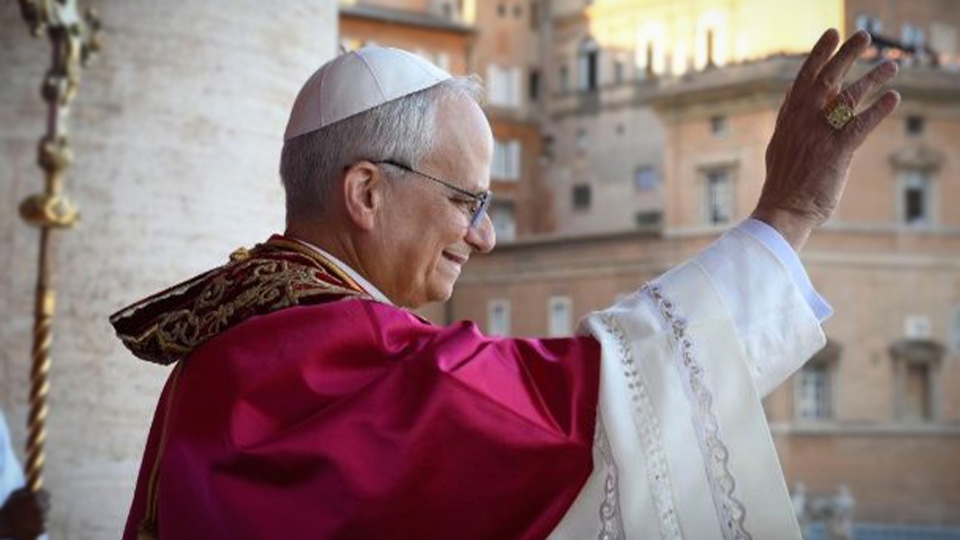
Prevost appeared wearing traditional papal vestments—a pectoral cross (a reliquary-style cross typical of preconciliar bishops), Pope’s stole, and red mozzetta—thus reviving a Roman aesthetic tradition that Francis seemed to have abruptly interrupted, if not entirely discarded. The name chosen by Prevost, i.e. Leo, strongly evokes Catholic Tradition. Many conservative and traditionalist Catholics, struck by these two elements, have in recent hours expressed sudden enthusiasm. In situations like these, it is natural for emotion to take precedence over rational analysis.
While it is true that Leo is a highly traditional papal name, we must avoid the mistake of interpreting it from the perspective of an average progressive using our own way of thinking. Instead, we should strive to reason within the framework of the individual in question. Prevost, after all, has until now been regarded as moderately progressive, as will be explored further. In the mindset of an average American priest trained after the Second Vatican Council, the name Leo essentially signifies two things: pacifism and social doctrine. Saint Leo the Great was the pope who halted Attila, the barbarian destroyer. Leo XIII was the pope believed to have inaugurated the Church’s social doctrine, although the foundations had already been laid by Boniface VIII with Unam Sanctam.
Minutes regarding the acceptance of the Roman Pontiff and the name he has assumed, drafted by the Master of Pontifical Liturgical Celebrations in his capacity as notary.
Why was Prevost elected?
Peace and justice, meaning social doctrine, will very likely be two of three central themes of the pontificate of Leo XIV. This was evident from the very first words he spoke from the Balcony: “Peace be with you! (…) This is the peace of the risen Christ, a disarmed and disarming peace, humble and persevering (…) God loves you all, and evil will not prevail. We are all in God’s hands. Therefore, without fear, united, hand in hand with God and with one another, let us move forward (…) They have chosen me to be Peter’s successor and to walk with you as a united Church, always seeking peace, and justice.”
A particularly positive aspect of Pope Leo XIV’s inaugural speech is that, while he does reference Francis—such as the need to “build bridges” of dialogue in today’s world—he nonetheless frames these concepts in a more orthodox sense, saying: “Christ goes before us. The world needs his light. Humanity needs Him as the bridge to be reached by God and his love.” Almost as if to say: bridges are good, but ultimately there is only one true bridge, and that is Jesus Christ. Another striking element is his emphasis on the Church’s missionary dimension: “I also want to thank all my brother cardinals who have chosen me to be Peter’s successor and to walk together as a united Church to proclaim the Gospel, to be missionaries.” And again: “We must seek together how to be a missionary Church” and “Let us pray together for this new mission, for the whole Church, for world peace, and let us ask for this special grace from Mary, our mother.”
While the cardinal electors sought a pope in 2025 who could mediate for justice and peace in the world, they were equally searching for someone capable of mediating for unity within the Church.
Peace and justice, then. These were two of the primary needs perceived by the College of Cardinal Electors for the new Pontificate. A pope capable of mediation, one who is more diplomatic than pastoral, in response to the grave conflicts already underway and those that may erupt in the near future. A pope capable, like Saint Leo the Great, of halting the many Attilas—or at least those perceived as such—who seek to invade and ignite wars: not only Putin against Ukraine and Xi Jinping against Taiwan, or Netanyahu against Palestine, but also Trump. In fact, despite being American and a registered member of the Republican Party, Prevost has always positioned himself (at least so far) as an opponent of the tycoon president. Similarly to Pope Francis and Pietro Parolin.
When J.D. Vance, the U.S. Vice President, sparked controversy by invoking the Thomistic doctrine of the ordo amoris, then-Cardinal Prevost strongly criticized him on social media, writing on X: “J.D. Vance is wrong—Jesus does not ask us to rank our love for others.” Justice, moreover, entails continuing the focus on issues already central to Francis’ papacy, such as ecology, immigration, and poors.
However, whether Pope Leo will precisely follow in Bergoglio’s footsteps remains to be seen.
While the cardinal electors sought a pope in 2025 who could mediate for justice and peace in the world, they were equally searching for someone capable of mediating for unity within the Church. Unity, in fact, is the third major theme that strongly emerges in Pope Leo’s inaugural address. The Church must return to a state of unity after years of deep divisions, ideological and theological disputes, and even economic conflicts that have taken shape under Bergoglio’s tenure.
During the dignified Mass pro Ecclesia concluding the Conclave in the Sistine Chapel on Friday, May 9, at 11:00 AM, the newly elected pontiff repeatedly emphasized concepts that Catholics had become less accustomed to hearing, such as sanctity and the journey toward sanctity.
Prevost is undeniably a reserved figure. Those who have interacted with him, whether in Peru or at the Vatican in recent years, describe him as a kind, quiet, reflective individual who is open to listening to all viewpoints.
Inside the Conclave
So, what happened during the Conclave? If Prevost’s election was not accidental, as its rapidity suggests, and if the majority of the electing cardinals were appointed by Francis, is it possible to identify a strategic plan behind this papal election?
For now, three scenarios can be considered. The first suggests that Prevost was Pietro Parolin’s Plan B. In recent days, much attention has been given to Parolin’s ambition to ascend to the Papal Throne and his attempts to secure the necessary quorum by gathering votes from both conservatives and progressives. This was in response to the pressure from the most progressive factions supporting Tolentino de Mendonça and Jean-Marc Aveline, the most conservative ones pushing for Péter Erdő, and the more moderate ones advocating for Pierbattista Pizzaballa.
However, little consideration has been given to the possibility that Parolin may have had an alternative strategy, a way to secure the election of someone similar to himself—another revolutionary of deceleration—should his own name become too compromised, which is precisely what happened. If this was Parolin’s expectation, given that he was present and smiling on the Balcony of St. Peter’s alongside Cardinal Vinko Puljić, then he might see Prevost, his peer, as malleable or at least sympathetic to his ecclesiastical policies.
After securing broad support from the Americans, the decisive votes for Prevost’s election are said to have come from Asian and African cardinals—the very ones that Parolin failed to win over, despite rumors of a deal with another early frontrunner, the Filipino Cardinal Tagle.
Nonetheless, it is worth remembering that Wojtyla was also expected to be a weak and easily influenced pope by many of his electors, yet he proved to be a strong leader who decisively shaped the Church’s historical course, regardless of the judgment one may have of his pontificate. In other words, once a man reaches the Primacy, there is no guarantee that he will conform to the expectations of those who promoted him.
The second scenario, on the other hand, could see Prevost as the result of a convergence of cross-sectional votes, achieved through the discreet orchestration of influential figures, such as the Italian cardinal Giuseppe Versaldi. Versaldi, created cardinal by Benedict XVI and serving as Prefect of the Congregation for Catholic Education under Francis from 2015 to 2022, represents a typical figure within the Roman Curial government.
Over the past few years, Versaldi is believed to have built a network of support and credibility around Prevost. Operating with discretion, he helped to make him known and respected within the Italian episcopate, ensuring his authority in the Sacred Palaces and promoting him as a viable alternative to Pietro Parolin—more spiritual and reliable, yet still diplomatic.
Prevost is undeniably a reserved figure. Those who have interacted with him, whether in Peru or at the Vatican in recent years, describe him as a kind, quiet, reflective individual who is open to listening to all viewpoints. A diplomatic pope, as was expected after twelve years of Francis, marked by a centralized and ideologically driven pastoral approach.
In either case, the coming years—or even months—could see a positive strengthening of the Curia.
A third scenario has also emerged in recent hours, suggesting that the true pope-maker may have been Cardinal Timothy Dolan of New York. He is believed to have played a key role, just as he did in the previous Conclave when he helped shape the candidacy of Jorge Mario Bergoglio, though he later became disappointed with the outcome.
According to some media reports, Dolan worked to mend the divisions within the American Church. On one side were staunch anti-Trump figures like McElroy and Wilton Gregory, while on the other were conservatives like Di Nardo and Dolan himself. They ultimately recognized that the time had come to act as a united team.
Cardinal Dolan, unsurprisingly, remarked that the future pope would be “a blend of the last three.” And with Prevost’s election, he can certainly claim to have been right. The real maneuvering is said to have taken place at the North American Pontifical College.
He is likely opposed to the blessing of same-sex couples, as liberalized by Fiducia supplicans. His stance on liturgy, particularly regarding the ban on the Tridentine Mass through Traditionis custodes, remains unknown.
Confident in himself, Dolan tweeted and flashed his usual smiles, all while tallying the votes for Prevost—a candidate with an ideally marketable profile: American by birth but a missionary in Peru, solid in doctrine, curial in experience as the former prefect of the Congregation for Bishops, and fluent in Italian, English, and Spanish.
After securing broad support from the Americans, the decisive votes for Prevost’s election are said to have come from Asian and African cardinals—the very ones that Parolin failed to win over, despite rumors of a deal with another early frontrunner, the Filipino Cardinal Tagle. The African and Asian cardinals were reportedly undecided at the start of the Congregations, and in the end, their votes in the Conclave leaned toward the West, or at least toward a particular vision of the West.
It is also possible that Prevost was supported by members of the Curia, due to the substantial donation that, according to various sources, President Trump is rumored to have made—a reported gift of 14 million dollars to the Vatican on the occasion of Pope Francis’ funeral.
This sum was supposedly welcomed by the Holy See, given the estimated 70-million-euro deficit left by Bergoglio. Some viewed the donation as an act of generosity, while others raised questions about potential ulterior motives, especially considering Trump’s closeness to Cardinal Timothy Dolan, a key figure in the Conclave, whom Trump himself once praised: “I have no preferences, but I must say we have a cardinal from New York, Timothy Dolan, and he is very good. We’ll see what happens.”
Similarly, his position on the secret Sino-Vatican agreements, brokered primarily by Parolin and renewed multiple times under Francis, is unclear.
Who was Prevost before the Pontificate
Robert F. Prevost has always kept away from the spotlight and cameras throughout his life, even during his tenure as a bishop and a Curial cardinal. This is an encouraging sign after twelve years of media-driven protagonism, which at times has been embarrassing, inappropriate, and even harmful to the faithful.
However, little is known about his positions on various topics. So far, Prevost has consistently aligned himself with Francis’ views, particularly on ecology, immigration, and poverty. He has expressed support for the practice introduced by Bergoglio of granting Communion to divorced and civilly remarried Catholics. He is clearly in favor of the synodalization of the Church, as highlighted in his inaugural address—a matter of significant concern.
He is likely opposed to the blessing of same-sex couples, as liberalized by Fiducia supplicans. His stance on liturgy, particularly regarding the ban on the Tridentine Mass through Traditionis custodes, remains unknown.
Similarly, his position on the secret Sino-Vatican agreements, brokered primarily by Parolin and renewed multiple times under Francis, is unclear. Finally, it is still uncertain whether he is among the prelates who advocate for modifications or even the abolition of Paul VI’s Humanae Vitae.
Nevertheless, his career has progressed rapidly. He entered the Order of St. Augustine in 1977 and took solemn vows in 1981. With a background in mathematics, theology, and canon law, he was ordained a priest in 1982. Three years later, he joined the Augustinian mission in Peru, where he served as chancellor of the Territorial Prælature of Chulucanas. After a brief period in the United States from 1987 to 1988 as vocational director and mission director, he returned to Peru, where he led the Augustinian seminary in Trujillo for ten years, teaching canon law and holding several pastoral and administrative positions.
In 1999, he was elected provincial prior of the Augustinians in Chicago, and in 2001, he became the prior general of the Order, a position he held until 2013. In 2014, Pope Francis appointed him apostolic administrator of the Diocese of Chiclayo, elevating him to bishop the following year. He later assumed leadership roles in the Peruvian Bishops’ Conference from 2018 to 2023, contributing to the country’s political stability.
In January 2023, Pope Francis appointed him prefect of the Dicastery for Bishops. This is one of the most important and sensitive curial offices, likely rivaling only the Secretariat of State and the Dicastery for the Doctrine of the Faith in significance. It is the prefect of this Dicastery who oversees the selection of bishops worldwide. In September of the same year, he was created cardinal.
There is one last crucial aspect to consider about Robert F. Prevost, an issue of great concern. After years in which the Church has been shaken by sexual abuse scandals, the new Pope brings with him serious accusations of covering up abuse. Sources indicate that these allegations concern his tenure as Bishop of Chiclayo from 2006 to 2010, during which he allegedly protected two Peruvian priests accused of abuse. Prevost’s accountability is also questioned regarding his time as Provincial of the Augustinians in Chicago, a case involving his friend and sponsor, the Cardinal of Chicago, Blase Joseph Cupich.
It remains uncertain whether these accusations are founded or if they are merely attempts to discredit influential prelates.
Regardless, enemies of the Church, both internal and external, could potentially use these issues to keep his pontificate under continuous pressure. As is often the case, major media outlets will likely avoid discussing the matter until Pope Leo XIV provokes a powerful figure or angers dissatisfied factions within the Church. This scenario is reminiscent of what transpired during Benedict XVI’s pontificate.