
In our everyday lives, it is possible to evaluate many things without explicitly thinking about how God sees them. For example, when considering the best type of vehicle, the most reliable appliances, or the healthiest foods, we seldom ask ourselves what God thinks about them unless there is something overtly offensive about one of the options. However, this is not the case with respect to our evaluations about religion because religion has everything to do with God — if we lose sight of how God sees questions about our religious beliefs, then we have become blind to the most important consideration. Appreciating this reality and its implications is especially important today, as Rome’s attacks on Traditional Catholicism in general, and the Society of St. Pius X (SSPX) specifically, appear to reflect a complete disregard for God and His will.
To evaluate whether this is in fact the case, we cannot merely look at the events taking place today. Instead, we must begin by considering the warnings that God had given to the Catholic Church through the pre-Vatican II popes. From that foundation, it is not difficult to grasp the essential elements of what has taken place for the past sixty years since the close of the Council.
Religion must first be judged according to how God sees it—not according to modern opinion.
Pre-Vatican II Warnings. The pre-Vatican II popes consistently warned Catholics that the Church’s enemies sought to undermine the true Catholic Faith. They also clearly identified specific theological errors that those enemies would use as their weapons to attack the Church, including Liberalism and Modernism. If Catholics accept these errors, the popes told us, great calamities would follow for the Church and the world. These warnings were a gift from God to the entire Church. That gift remains today, even though it is scorned by almost the entire hierarchy.
The last pope to firmly warn the Church against the errors that plague it today was Pius XII, in his 1950 encyclical on “false opinions threatening to undermine the foundations of Catholic doctrine,” Humani Generis. Just judging by the topic of Pius XII’s encyclical, it should be relatively clear that God did not want Catholics to accept the false opinions that would undermine Catholic doctrine. Because God does not change with the times — and can neither deceive nor be deceived — those warnings were not limited solely to the time of Pius XII and his predecessors.
Thus, the warnings in Humani Generis remain true today, particularly those related to changing Catholic doctrine to appeal to non-Catholics. Every idea in this lengthy passage from Humani Generis relates to the current crisis in the Church:
“In theology, some want to reduce to a minimum the meaning of dogmas; and to free dogma itself from terminology long established in the Church and from philosophical concepts held by Catholic teachers, to bring about a return in the explanation of Catholic doctrine to the way of speaking used in Holy Scripture and by the Fathers of the Church. They cherish the hope that when dogma is stripped of the elements which they hold to be extrinsic to divine revelation, it will compare advantageously with the dogmatic opinions of those who are separated from the unity of the Church and that in this way they will gradually arrive at a mutual assimilation of Catholic dogma with the tenets of the dissidents. Moreover, they assert that when Catholic doctrine has been reduced to this condition, a way will be found to satisfy modern needs, that will permit of dogma being expressed also by the concepts of modern philosophy, whether of immanentism or idealism or existentialism or any other system. Some more audacious affirm that this can and must be done, because they hold that the mysteries of faith are never expressed by truly adequate concepts but only by approximate and ever-changeable notions, in which the truth is to some extent expressed, but is necessarily distorted. Wherefore they do not consider it absurd, but altogether necessary, that theology should substitute new concepts in place of the old ones in keeping with the various philosophies which in the course of time it uses as its instruments, so that it should give human expression to divine truths in various ways which are even somewhat opposed, but still equivalent, as they say. They add that the history of dogmas consists in the reporting of the various forms in which revealed truth has been clothed, forms that have succeeded one another in accordance with the different teachings and opinions that have arisen over the course of the centuries.”
Thus, the Church cannot minimize or alter Catholic teaching for the sake of appealing to non-Catholics. Moreover, appealing to the notion that truth changes with time exacerbates the problem rather than avoiding it. God would not have guided Pius XII or the other pre-Vatican II popes to repeatedly issue these warnings unless they were absolutely necessary to protect the foundations of Catholic doctrine. Ignoring those warnings would therefore invite catastrophe.
Multi-Faceted Offenses Against God. John XXIII opened Vatican II by announcing that the Church was abandoning the practice of condemning errors, even though they still threatened the Church:
“The Church has always opposed these errors. Frequently she has condemned them with the greatest severity. Nowadays, however, the spouse of Christ prefers to make use of the medicine of mercy rather than that of severity. She considers that she meets the needs of the present day by demonstrating the validity of her teaching rather than by condemnations. Not, certainly, that there is a lack of fallacious teaching, opinions, and dangerous concepts to be guarded against and dissipated.”
In addition to abandoning one of the Church’s primary defenses against its enemies, John XXIII invited certain powerful theologians whose work had been under suspicion of heresy, including Fathers Yves Congar, Henri de Lubac, and Karl Rahner. The late Fr. Dominique Bourmaud described these theologians as the three musketeers:
“Many things unite these three men. They all had a long history as university professors; all were under theological scrutiny for modernist ideas under Pius XII; all were somehow disciplined or exiled from their positions. All were then miraculously reinstalled as Council periti on the eve of the Council. Their teaching ideas were broadly known as ‘the new theology’ and they came to influence the principles of conciliar teaching. They all became the experts of subsequent popes and therefore were granted many praises and honors by the post-conciliar Church.”
Pius XII had condemned the ideas of these important theologians in Humani Generis — their ideas were the ones threatening to undermine the foundations of Catholic doctrine. And so John XXIII’s appointment of these men as important figures at Vatican II was first and foremost a rejection of the protections that God had given to the Church through Pius XII and his predecessors. God does not bless and reward deliberate rejection of His will, so John XXIII’s rejection of Humani Generis was not especially propitious.
The pre-Vatican II popes warned that Liberalism and Modernism would undermine the Catholic Faith.
Finally, John XXIII made it clear from the beginning of the Council that the primary purpose was to foster Christian unity. Almost every initiative of Vatican II related in some way to seeking unity with non-Catholics (including non-Christians, as we see with Nostra Aetate). According to the passage from Humani Generis above, though, this pursuit of Christian unity was one of the most dangerous battlegrounds in the Church. Time would tell whether John XXIII’s gamble would bear fruit for God or for the Church’s enemies.
Archbishop Lefebvre’s Assessment. Through numerous interventions at the Council, Archbishop Lefebvre demonstrated that he was among the small number of Council Fathers who both saw the dangers and had the courage to stand up to defend the Church against them. Here, for example, is the conclusion of his September 9, 1965 intervention related to the Pastoral Constitution on the Church in the Modern World, Gaudium et Spes:
“This pastoral Constitution is not pastoral, nor does it emanate from the Catholic Church. It does not feed Christian men with the Apostolic truth of the Gospels and, moreover, the Church has never spoken in this manner. We cannot listen to this voice, because it is not the voice of the bride of Christ. This voice is not that of the Spirit of Christ. The voice of Christ, our Shepherd, we know. This voice we do not know. The clothing is that of the sheep. The voice is not the voice of the shepherd, but perhaps the wolf.” (Archbishop Lefebvre, I Accuse the Council!, p. 61)
He was not speaking of semantics, or hermeneutics, or technical ways to see some connection between something that a Church Father had once said — he was speaking about how God saw the document. And this is how he evaluated the entire Council. Along these lines, the 1977 book featuring Archbishop Lefebvre’s conversations with José Hanu, Vatican Encounter, included one of his most vital observations about the Council:
“Well, surely at the moment when I rose against certain directions the Council was taking, I did not foresee the consequences very clearly. But history teaches us that the moment we acknowledge false principles, we are opening a Pandora’s box of unforeseen consequences.” (p. 65)
Archbishop Lefebvre recognized that accepting false principles would open a Pandora’s box of unforeseen consequences because it constituted a rejection of God’s truth. As he had learned from the popes, the Church’s enemies use these false principles as weapons to undermine the Catholic Faith. As such, accepting these dangerous errors amounted to a rejection of the gifts that God has given to the Church. He knew he had no right to go along with such an unfathomable offense against God.
Archbishop Lefebvre’s 1974 Declaration. Rome’s opposition to Archbishop Lefebvre began before 1974, but the famous 1974 Declaration amounted to a declaration of war against the Vatican II revolution. If Archbishop Lefebvre had simply wanted the Traditional Latin Mass, there would have been room for cooperation with Rome’s attacks on the Faith. But Archbishop Lefebvre’s 1974 Declaration made it clear that he wanted something more than the Traditional Latin Mass:
“This Reformation, born of Liberalism and Modernism, is poisoned through and through; it derives from heresy and ends in heresy, even if all its acts are not formally heretical. It is therefore impossible for any conscientious and faithful Catholic to espouse this Reformation or to submit to it in any way whatsoever. The only attitude of faithfulness to the Church and Catholic doctrine, in view of our salvation, is a categorical refusal to accept this Reformation. That is why, without any spirit of rebellion, bitterness, or resentment, we pursue our work of forming priests, with the timeless Magisterium as our guide. We are persuaded that we can render no greater service to the Holy Catholic Church, to the Sovereign Pontiff, and to posterity. That is why we hold fast to all that has been believed and practiced in the faith, morals, liturgy, teaching of the catechism, formation of the priest, and institution of the Church, by the Church of all time; to all these things as codified in those books which saw day before the Modernist influence of the Council. This we shall do until such time that the true light of Tradition dissipates the darkness obscuring the sky of Eternal Rome. By doing this, with the grace of God and the help of the Blessed Virgin Mary, and that of St. Joseph and St. Pius X, we are assured of remaining faithful to the Roman Catholic Church and to all the successors of Peter, and of being the fideles dispensatores mysteriorum Domini Nostri Jesu Christi in Spiritu Sancto. Amen.”
Archbishop Lefebvre did not know why God had permitted the crisis in the Church or how He would resolve it, but he was absolutely convinced that the pre-Vatican II popes were correct. If it was wrong to support Liberalism and Modernism in the time of Pius XII, it was not suddenly permissible to support it in the time of Paul VI. So he chose his side in the battle.
Archbishop Lefebvre refused to abandon what previous popes taught because truth does not change.
This 1974 Declaration had monumental implications immediately after it became public, but for present purposes it is worth noting that it serves a position that can be judged by how well it holds up over time. To see how well it has fared, we can look to the relative fruits of the SSPX and the Vatican over the past fifty years.
Fruits of Abandoning God. Our Lord gave us a test for discerning between true and false prophets:
“Enter ye in at the narrow gate: for wide is the gate, and broad is the way that leadeth to destruction, and many there are who go in thereat. How narrow is the gate, and strait is the way that leadeth to life: and few there are that find it! Beware of false prophets, who come to you in the clothing of sheep, but inwardly they are ravening wolves. By their fruits you shall know them. Do men gather grapes of thorns, or figs of thistles? Even so every good tree bringeth forth good fruit, and the evil tree bringeth forth evil fruit. A good tree cannot bring forth evil fruit, neither can an evil tree bring forth good fruit. Every tree that bringeth not forth good fruit, shall be cut down, and shall be cast into the fire. Wherefore by their fruits you shall know them.” (Matthew 7: 13-20)
It is worth observing that Our Lord’s test for judging true and false prophets follows His words about choosing the narrow gate. Looking back at the ideas above, it is easy to detect that the pre-Vatican II popes had insisted that we must enter through the narrow gate, while the false ecumenism of Vatican II has been all about entering through the wide gate (and damning those who insist on the narrow gate). So even before we get to the actual test based on fruits, we already have a way to see that Archbishop Lefebvre was correct in adhering to the holy wisdom that God had given to the Church through the pre-Vatican II popes.
Turning to the test, we are told to judge by fruits, and we can simply consider a few that the Vatican has produced in recent decades:
- It has spent decades fostering apostasy, sacrilege, blasphemy, and cafeteria-Catholicism, but has exerted far more effort addressing secular projects such as environmental protection and open borders than it has addressing the evils that it has fostered.
- It has allowed heresy to flow freely throughout the Church, such that many of the bishops and cardinals promote blatant heresies.
- It has routinely promoted false religions, placing them on the same level as the Catholic Faith.
- It has permitted countless offensive variations of the Novus Ordo Mass but continues to barter access to the Traditional Latin Mass in exchange for silence about the errors that have spread throughout the Church since Vatican II.
- It has created a new Synodal Church, in which religious truths are discerned through a process of “listening” to all baptized souls to reach a consensus. Even “representatives of other religions, public institutions, civil society organisations and society at large” can assist the Synodal Church in its discernment process (Final Document, 127).
- It has arguably become the most powerful promoter of the homosexual agenda in the world.
- It published a document that intentionally insulted the Mother of God by denying her the titles that some of the Church’s best theologians had promoted: Co-Redemptrix and Mediatrix of All Graces.
Without judging the souls of any who have perpetrated these evils, we nonetheless need to judge their fruits because that is the test that Our Lord gave us. Setting aside the fall of Adam and Eve, in how many instances in salvation history do we see greater offenses against God from those to whom He has given so many gifts and so much responsibility? It is difficult to avoid the conclusion that we are witnessing one of the greatest monstrosities in salvation history. Again, that does not mean we judge the souls of those in the Vatican, but it seems that this reality really ought to factor into our decisions about whether God wants us to render blind obedience to Rome today.
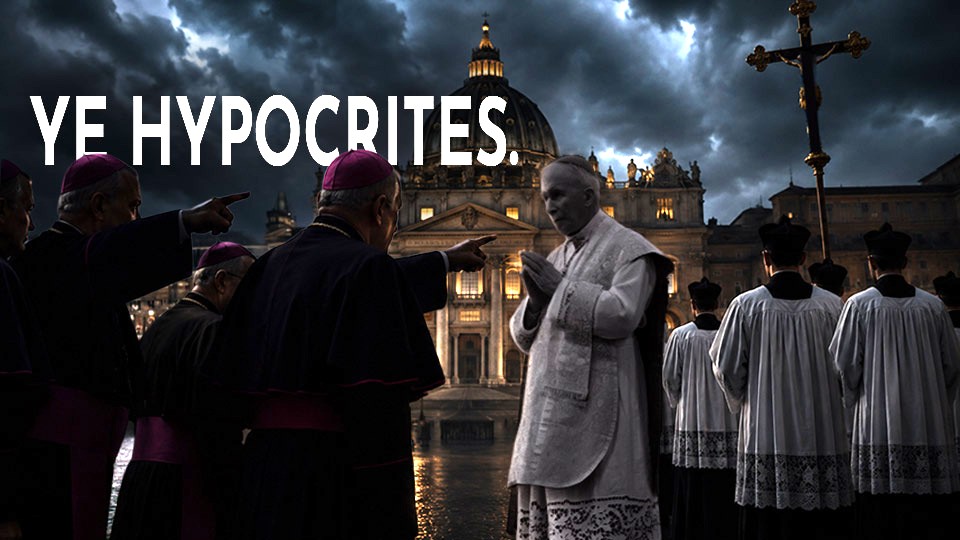
Rome’s punishment of the SSPX has become a witness to the cost of remaining faithful to immutable Catholic truth.
What, though, are the fruits of the SSPX? One is that the 1974 Declaration has become more and more important with each passing milestone of the Vatican II revolution, and the leadership of the SSPX still adheres to it today. Another fruit is that the SSPX continues to grow and attract souls despite active persecution from Rome — other Traditional Catholic communities also bear good fruits, but they generally do so without the same level of persecution from Rome.
And there is another fruit that has recently blossomed. Although it seems somewhat bitter, especially to those viewing from outside of the SSPX perspective, it is a fruit that appears especially precious today:
At this time in which the Vatican promotes the wide gate of the Synodal Church, rejects God’s truths, and embraces sins crying to Heaven for vengeance, it has bestowed upon the SSPX the tremendous honor of declaring that the SSPX must be severely punished for its adherence to immutable Catholic truths given to the Church by God. The SSPX’s willingness to endure a “white martyrdom” rather than jeopardize the Faith provides rare witness to the need to serve God rather than go along with the Vatican II revolution.
The SSPX members and faithful are at peace with this seemingly bitter fruit because it is an honor to suffer for God. For those who do not see it this way, though, it is worth considering: how is it that the Vatican is today wrong about essentially everything but is somehow right in its persecution of those who would die rather than willingly offend God? From the vantage point of many Traditional Catholics, the Vatican is as wrong on this as they are on the Synod on Synodality, Fiducia Supplicans, Amoris Laetitia, Traditionis Custodes, and every other effort to empty the religion of God. Our Lady of Perpetual Help, pray for us!