

Facing the prejudices and morals of a twilight world, we must always remember that the call to holiness is not optional. Actually, it is imperative. From one end of Holy Scripture to the other, this call resounds insistently, continually addressing us with the same exhortation that we read and reread both in the Old Testament and in the Gospels:
“Be you therefore perfect, as also your heavenly Father is perfect” (Matthew 5:48)
This call is directly connected to one of the most important details revealed in the text of Genesis: man is created according to God’s “image and likeness” (Genesis 1:26–27). This necessarily implies that we must “mirror”—however imperfectly, since we are but creatures—the qualities of God, Who is holy, as we read in the famous “thrice holy” of the prophet Isaiah 6:3:
“Holy, holy, holy, the Lord God of hosts, all the earth is full of his glory” (“Sanctus, sanctus, sanctus Dominus, Deus exercituum; plena est omnis terra gloria ejus” – Isaiah 6:3).
This is why the call to holiness addressed to Christians is synonymous with the call to restore and perfect our likeness to God. And this likeness means to be holy. If we take this seriously, we should never be content to read the lives of the saints merely as pious stories from long-vanished times. They do not belong to the same category as tales of princes and princesses, dragons, unicorns, and dwarfs. On the contrary, they are exhortative histories meant to encourage us—despite our own weaknesses and flaws—to aspire to holiness.
During a meeting with candidates for the priesthood on the Saturday of Embertide of Lent, February 22, 1578, Saint Charles delivered an unforgettable sermon. Saint Charles seems to frighten them, presenting insistently the dangers of assuming such an extraordinary calling unworthily.
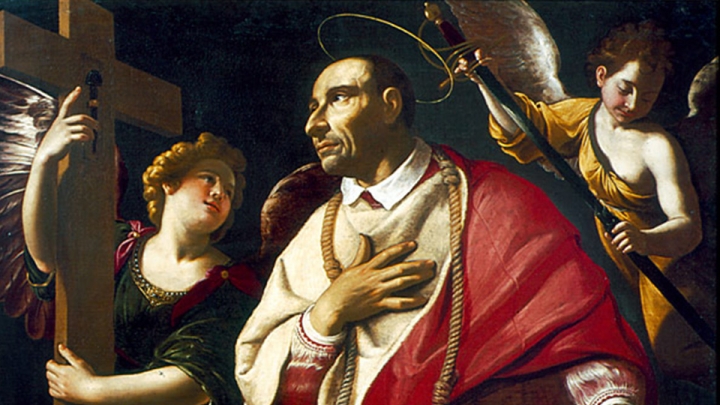
The feast of Saint Charles Borromeo (1538–1584) offers such an occasion. Since he was a Church hierarch—a Cardinal and Archbishop of Milan—we can easily deduce that he was an exemplary shepherd. The heroism shown by this aristocratic prelate, who chose to remain among the dying during the terrible bubonic plague of 1574–1576, earned him imperishable fame. But these facts are too well known to need further presentation. What is far less known is his activity as a reformer of the Church in general, and of the clergy in particular.
During a meeting with candidates for the priesthood on the Saturday of Embertide of Lent, February 22, 1578, Saint Charles delivered an unforgettable sermon. Translated in one of the very few English editions of his writings—Selected Orations, Homilies and Writings[i]—this sermon can truly shock those unaccustomed to the strictness of great saints from various ages. The impression the text leaves is unexpected. Instead of seeming to encourage future priests, Saint Charles seems, on the contrary, to frighten them, presenting insistently the dangers of assuming such an extraordinary calling unworthily.
From the earliest apostolic times through the sermons of saints such as John Chrysostom, Francis de Sales, and up to Alphonsus Maria de Liguori and John Mary Vianney, the emphasis has always been placed on the importance of the divine calling and on following it without deviation. Undoubtedly, if for today’s laity taking seriously the divine vocation that God has eternally appointed for each person is of utmost importance, for those who wish to assume the holy priesthood it is crucial. Fully aware of both the value and the dangers of such a heavenly dignity, Saint Charles Borromeo builds his sermon upon this key verse from the Old Testament:
“The priests also that come to the Lord, let them be sanctified, lest he strike them” (Exodus 19:22)
It is enough to read and meditate on this verse carefully to tremble. Indeed, no vocation, no craft, no profession can be higher than the Holy Priesthood. Called to be a perfect alter Christus, the priest fulfills the most important function established by our Lord Jesus Christ Himself on this earth. It is easy to understand, therefore, that, in direct proportion to the importance of the priestly office, the warnings given to those who approach it unworthily—or carelessly—are the most severe. It is precisely these warnings that Saint Charles intends to comment upon at length:
“In that command there are two words especially worthy of our consideration, the first one a word of honor and incredible glory, and the other a symbol of the most frightful calamity and hardship. These words are sanctificentur (let them be sanctified) and percutiat (lest he strike them). If I were to expound their force and strength to you even superficially, I would consider that I had done my duty by you, since I am obliged to rouse your souls in every way to the contemplation of such a sublime and profound mystery.”
The rhetoric and art of construction shown in this sermon by Saint Charles are exemplary. One can imagine the serious, thoughtful faces and profound reflections of those listening to him. The principle that underlies all his meditations is as simple as it is powerful. Being absolutely and perfectly holy and pure, God demands that those who serve at the altar approach Him—present in the Holy Sacrament of the Eucharist—fulfilling the same requirement of the purity of holiness:
“What wonder is it, therefore, if those who approach Him must be sanctified, so the eyes of his most pure majesty are not offended by anything stained or sordid?”
He genuinely desired that anyone who felt unworthy after hearing his sermon would withdraw, thus avoiding future catastrophe.
Please note the immediate implication of this rhetorical question: any deviation from the demand for holiness implicitly offends the Creator. This, then, is the essence of Saint Charles’s thought! God is either served as He Himself requires and expects from His ministers, or grave offenses are committed against His majesty—and the consequences of such offenses are emphasized repeatedly. It is worth noting here that Saint Charles sincerely wished to persuade those listening to him on that day in 1578 to discern carefully and make the right decision. In other words, he genuinely desired that anyone who felt unworthy after hearing his sermon would withdraw, thus avoiding future catastrophe:
“In the very same way, priests and other ministers of God will be struck down if they dare to approach the Lord impurely. Therefore if someone has come here not sanctified, or without having rightly cleared out the secret places of grave sin in his conscience, I now ask him to withdraw, and beg him to choose instead to blush for a short time rather than be struck by the angry right hand of the Lord and consumed by eternal fires.”
In the same spirit, much of his discourse presents God’s punishments through concrete examples taken from the Holy Scriptures. For example, the calamities sent by God upon the Egyptians who opposed Moses are summarized and described with precision. To move beyond the pagan world of the Old Testament, Saint Charles reflects on the terrible example of Oza from the Second Book of Kings (2 Samuel):
“And when they came to the floor of Nachon, Oza put forth his hand to the ark of God, and took hold of it: because the oxen kicked and made it lean aside. And the indignation of the Lord was enkindled against Oza, and he struck him for his rashness: and he died there before the ark of God.” (II Kings 6:6–7)
Saint Charles’s commentary on this episode centers on the identification between the Ark of God and the Holy Altar. If this is so, the consequence is crystal clear: if Oza was not spared for touching the Ark without having the right to do so, God will punish far more severely those who serve the Holy Mass unworthily:
“But if Oza himself, inspired by his good zeal and carrying the ark of the covenant because of his office, was so harshly struck down for touching with his hand that ark which prefigured our altar, then how liable to damnation will they be who, not sanctified and not truly prepared, dare to touch the altar of God, which is far more noble and excellent, prefigured as it was by that ark?”
If we were to summarize the key points of Saint Charles Borromeo’s sermon, we could note several features common to all saints. First, a living knowledge of the Bible. Then, a very serious consideration of the examples that God offers us in His sacred texts. At the same time, the demand for likeness to God—for all the baptized in general, and especially for the ministers of the holy altars—is an absolute axiom. In practice, the call to holiness and its fulfillment is the axis of Saint Charles’s thought. Last but not least, the terrible consequences of failing to honor the demands of this calling are described with great precision. All of this can always serve as a true rule—or “guide”—for any bishop, priest, or even simple layperson who sincerely asks the question:
“What does it mean to be a Christian—that is, a disciple of the Savior Christ?”
