

Over the years, I have repeatedly noticed the interest aroused by subjects related to the “world beyond.” Despite the accelerated secularization of the modern society, matters concerning the afterlife continue to be a topic of conversation and also a major literary and cinematic theme. At the same time, however, we immediately recognize one of the specific traits of such interest: superstition. This is especially visible in those stories where the moral dimension is excluded. In other words, it does not matter how the person confronting the unseen lived their life. The near-death experiences are most often described in sensationalist terms devoid of moral connotations. Clearly, this is not the Christian perspective.
The ‘unseen world’ and post-lapsarian blindness
The Credo teaches us about the existence of the unseen world in the article that states God is the creator “of all things Visible and Invisible.” The Roman Catechism explains the following:
“Whatever exists in the universe, whatever we confess to have been created by God, either falls under the senses and is included in the word visible, or is an object of mental perception and intelligence and is expressed by the word invisible.”
Regarding the existence of the physical, material world, known through the senses, we encounter no difficulty. We all easily ascertain its existence in our common experience. If we ask what its profound nature is, how the continuity of everything around us is explained, and other such questions, we must step onto the ground of philosophical and metaphysical speculation. The natural sciences also try to answer such questions, but most often remain only at the level of empirical descriptions and investigations under the paradigm of naturalist-mechanistic causality.
When it comes to the existence of the unseen world, things become much more complicated. The reason is that we do not have unmediated knowledge of it. Just like with God, angels, and souls, most Christians never have direct experience of such beings that populate the “world beyond.” Although the Catechism speaks of the invisible world as an “object of mental perception and intelligence,” we cannot compare the object of such perception with the impact of the direct, sensory knowledge of the world accessible to the senses. In fact, it is as if we are blind to the unseen world: through faith, we accept its existence even though, concretely, we never see it during this fleeting life. This explains the blindness spoken of by, among others, Saint Hildegard of Bingen, who says that through original sin, humans lost the capacity for direct knowledge of the intelligible world. In a word, we are blind.
Sometimes the trials can be so powerful that they can lead to the complete denial of the unseen world – especially if a life lived in habitual sins needs to be excused and “protected” from the prospect of a judgment that involves punishments for evil deeds.
What we can learn from the history of religions
Over millennia, this inaccessibility of the unseen world has represented one of the greatest challenges known to human culture. If we look in the history books of religions, we see the extraordinary efforts of members of certain civilizations to make the invisible world visible. The Egyptian pyramids, known to everyone, are such examples of megalithic constructions intended to establish a connection between “heaven” and “earth” with the purpose of transferring the pharaoh’s soul to the “higher” world. To give tangibility to the world of the gods, they identified the beings populating it with the stars. Therefore, astral religions were numerous in antiquity. However, all these have experienced periods of crisis and complete decay, especially when the existence of the unseen world was seriously questioned.
For the members of Jewish civilization and culture, the challenges were the same. Many times, the people of Israel abandoned the religion of the living God to walk the paths of idolatry. The reasons were always similar to those invoked by the Jews when they rebelled against Moses in the wilderness: the meat of the Egyptians in slavery was better, more “concrete,” than the hunger and thirst endured on the path of exile to the promised land. In short, the pleasures of this life seem more real – because they are immediate – than the promised joys of the future life. This is one of the most difficult temptations encountered in the lives of the faithful.
Sometimes the trials can be so powerful that they can lead to the complete denial of the unseen world – especially if a life lived in habitual sins needs to be excused and “protected” from the prospect of a judgment that involves punishments for evil deeds. Then, the faith in the unseen world of the Creed is eclipsed. Things can degrade to such an extent that entire cultures – like the modern one – can abandon any reference to God and His invisible realm. Similarly, in the ancient world, we discover traces of similar crises that usually led to large-scale civilizational catastrophes. For us, Christians, it is enough to think about the prolonged wandering through the wilderness of the chosen people. Moses himself was punished with the prohibition of entering the land of Canaan (Deuteronomy 32:52) – which he saw from a distance, from Mount Nebo (Deuteronomy 34:1-4).
All these are related, directly or indirectly, to the accessibility of the unseen world. We doubt and, above all, suffer from “amnesia” because we do not see. Knowing all too well the limits of people fallen under the curse of original sin, God took care to ensure that we never forget the existence of the unseen world. The same discipline of the history of religions records countless experiences of journeys to the unseen world or, conversely, visits to our world by beings from “beyond.” For the ancients, these beings were genuine “extraterrestrials” (i.e., from beyond our earth). While in most cases we are dealing with deceptions and manifestations of a rich imagination that provided content for fireside stories, some experiences reported by classical authors, such as that of Er in Plato’s dialogue Politeia (i.e., The Republic), bear signs of verisimilitude. These are part of the library of those unusual stories meant to keep our attention awake.
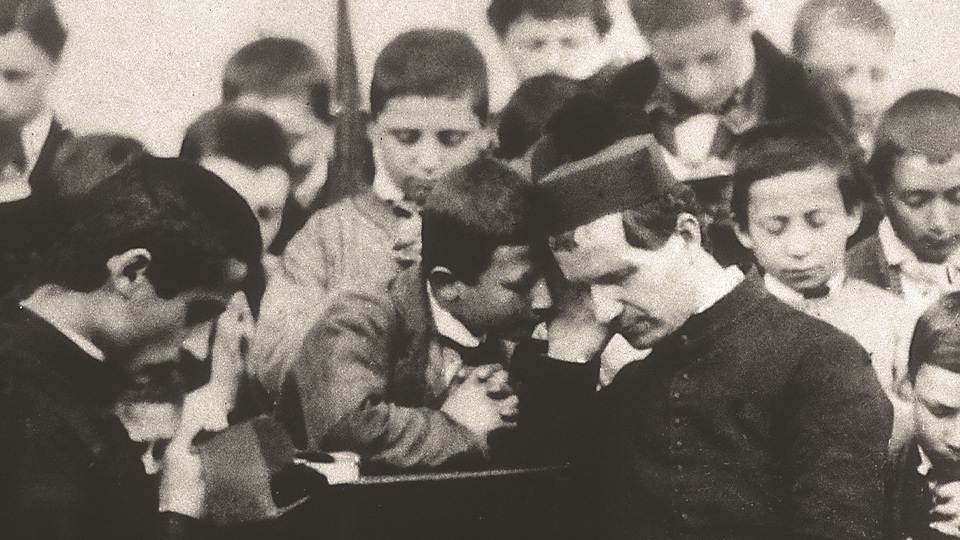
Not only ancient pagans were witnesses and storytellers of such extraordinary accounts. Much closer to us, in the 19th century, we encounter such an experience in the annals of the order created by one of the most beloved Catholic saints, John Bosco (1815–1888). And what matters most for all of us is the fact that we are certainly dealing with a true story. Here are the facts.
Alongside the vision of hell experienced by the three visionary children of Fatima, the following event in the life of Saint John Bosco shows us that the afterlife is as real as can be.
In the middle of the night
A living example of holiness for young John was his good friend, Luigi Comollo (1817–1839). An exemplary Christian, Luigi shone with virtues and charity. Saint John Bosco remembered how patiently he endured the jokes and mockery of his classmates. Let us not think that bullying was invented in the 21st century! However, Luigi Comollo, with the patience of an angel, bore it all without repaying evil with evil. He never had even a single thought of revenge. Fascinated by such a personality, John always sought his company, aware that only by being close to a saint could he also be enkindled with love for God and neighbor. Their conversations often lasted for hours. The two discussed in detail how they could reach the Kingdom of God through the practice of virtues.
During one such conversation, following a reading from the lives of the saints, they concluded that it would be a great comfort for them if, when one of them died, he could inform the other, who remained in the world, that he had been saved. This thought frequently reappeared in their subsequent discussions. Under its influence, they established a sort of pact: whoever died first should come back to inform the other about his fate. Looking back at the pact with Luigi Comollo, Saint John Bosco would later acknowledge how superficial he had been. Here, in his own words, is described the terrible experience:
“Comollo died on 2 April 1839. Next evening he was solemnly buried in Saint Philip’s Church. Those who knew about our bargain waited anxiously to see what would happen. I was even more anxious because I hoped for a great comfort to lighten my desolation. That night, after I went to bed in the big dormitory which I shared with some twenty other seminarians, I was restless. I was convinced that this was to be the night when our promise would be fulfilled. About 23:30 a deep rumble was heard in the corridor. It sounded as if a heavy wagon drawn by many horses were coming up to the dormitory door. It got louder and louder, like thunder, and the whole dormitory shook. The clerics tumbled out of bed in terror and huddled together for comfort. Then, above the violent and thundering noise, the voice of Comollo was heard clearly. Three times he repeated very distinctly: ‘Bosco, I am saved.’ All heard the noise; some recognised the voice without understanding the meaning; others understood it as well as I did, as is proved by the length of time the event was talked about in the seminary. It was the first time in my life I remember being afraid. The fear and terror were so bad that I fell ill and was at death’s door. I would never recommend anyone to enter into such a contract. God is omnipotent; God is merciful. As a rule he does not take heed of such pacts. Sometimes, however, in his infinite mercy he does allow things to come to fulfillment as he did in the case I have just described.”[i]
Alongside the vision of hell experienced by the three visionary children of Fatima, this event in the life of Saint John Bosco shows us that the afterlife is as real as can be. I know there are skeptics who attribute his experience to chance or hallucinations. It seems that there are always those who tend to dismiss the mere possibility of such supernatural events. In the absence of faith, such occurrences seem like inventions or, at best, obscure paranormal experiences. For those who believe, however, they are – just as for John Bosco – small lights from Divine Providence to strengthen our weak faith.
Saint John indicates in his commentary that God cannot be bound by a pact between two young people, even if they are saints, to reveal the afterlife directly to them. Yet, in His infinite mercy, He sometimes allows such things to occur for the benefit and growth in faith of the “little ones.” Personally, I am convinced that the experience recounted above is real. Just as real as the existence of the unseen world and of God. However, John Bosco’s testimony can strengthen this conviction, while also adding a moving story to the collection of unforgettable histories.
Sancte Ioannes Bosco, ora pro nobis!
[i] Saint John Bosco, Memoirs of the Oratory of Saint Francis de Sales from 1815 to 1855 (Chapter 22: Louis Comollo’s Death ): http://www.salesianym.com/uploads/3/0/0/6/30065457/st._john_bosco_-_memoirs_of_the_oratory.pdf [Accessed: 22 July 2024].
