
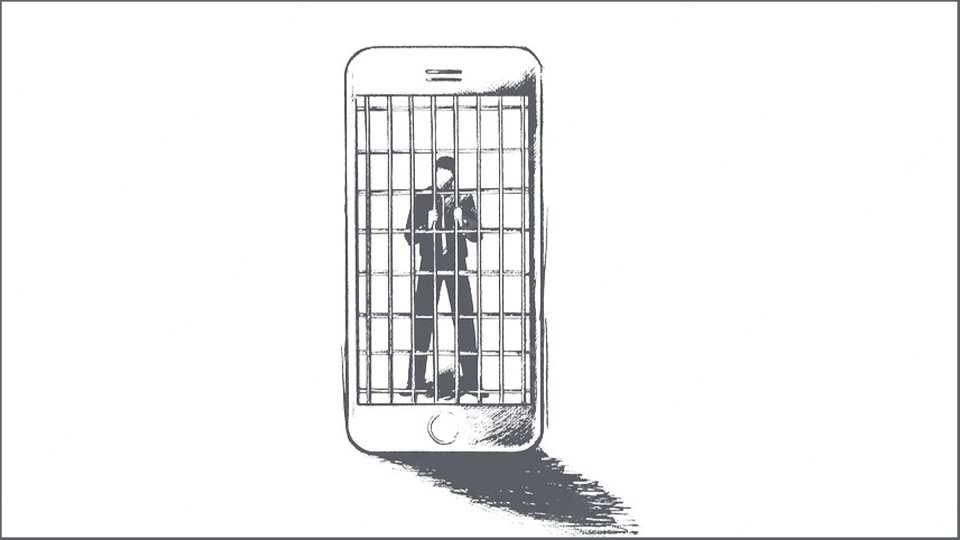

To keep this introduction short, I’ll start with a categorical statement: there is no complete protection from the “temptations” of the digital world.
A few years ago, I read the following question on an online forum: “Can you search for images using a search engine like Google without ever being accidentally exposed to erotic images?” The answer was negative. Experience—both mine and that of others I know—has shown that persistent use of image searches is always accompanied by traps: some have found erotic images on their screens even when searching for the name of a saint. And that despite using security filters. Sure, someone might say these are just accidents. Yes, they are accidents, but how much can such an accident cost a soul? I’ll underline my initial statement: there is no real and complete protection when using these tools.
The Illusory Protection
Most of the time, the main concern seems to be the protection of children. Many companies offer solutions for this, and the operating systems and pre-installed applications on our various devices (PCs, tablets, laptops, smartphones, etc.) include such features. But are these truly effective?
For the sake of argument, let’s assume for a moment that it is technically possible to protect children who use the internet. That filters and applications at our disposal allow us perfect control over the content the youngest members of our families can access. And that the “guardians” (not of the galaxy, but of our children) use these tools perfectly to protect the little ones. Here comes the revealing question: but who protects the guardians? Are they flawless? Why is it always assumed that adults are immune to the digital temptations delivered via cable in the form of trillions of pixels displaying all that a fallen world can offer—while one of the most renowned companies in this field bears the logo of a bitten apple, a symbol of the forbidden fruit?
My Polish and Ukrainian ancestors were driven by World War II to Romania. Thus, I was born and raised under Nicolae Ceaușescu’s communist dictatorship, which was overthrown only in 1989.
The trick behind the advertising for filters and applications promoted as “parental controls” is similar to the infamous category of “adult films.” Seriously? Are adults somehow immune to the devastation caused by pornography, making it permissible for those over 18 or 21 years old? Isn’t this a lie that seeks only to expand the territory of immoral and illicit pleasures little by little? The real answer is the following one: what is prohibited by the seventh commandment “Thou shalt not commit adultery” applies to everyone—children and parents. If children are threatened by such temptations, adults are equally—if not more—threatened. We are all subject to the rule of concupiscence, which, despite Holy Baptism, is not removed from our souls. Passions and vices constantly threaten us until we leave this world. Keeping such axioms in mind, derived from the dogma of original sin, we immediately realize that not only our children but also we, their parents, are in danger when exposed to immoral and sinful content. Let us now return to the idea of protection in using the internet in particular, and digital tools in general.
I am not inviting you to give up on them. But I want you to understand one thing clearly: any lock—or safe, if you prefer—created by man can be broken by man. Specifically, I’ve encountered dozens of cases where a well-meaning father’s installed protection was immediately hacked by an intelligent son. Generally, most children (especially teenagers) possess skills superior to those of their parents. Some are simply gifted.
A good German friend, a hardware engineer, was deluded for a while by the ultra-sophisticated protection systems he had implemented for his home computers. His children’s access was strictly limited, and the content well-filtered. He was satisfied—until the day he discovered that his youngest son knew how to bypass all the digital and hardware barriers created by his father without leaving (almost) any traces of his actions. The father admitted to me that he still doesn’t understand how his son managed to achieve this.
Sure, you might say the kid was a genius. Knowing him, I can confirm he has above-average engineering abilities. However, most parents do not have the skills of my German friend. Most of us use simple applications created by others in a fairly rudimentary manner. To convince yourself, ask how many of you or your acquaintances use Linux distributions and know how to install programs on Linux (via command lines in a console). I assure you, very few. And I’m not talking about “rocket science,” just something slightly more advanced. If the applications we use are at this beginner-to-intermediate level, it’s obvious that our children don’t need skills like those of my German friend’s son to hack them. I repeat: bypassing the filters and barriers set up by parents is actually quite easy.
Before freedom was restored, even food was rationed. Eggs, oil, sugar, flour, and other staples were distributed on ration cards, as during wartime. People stood in long lines for the chance to buy meat. There were also invisible lines: the waiting lists for installing a landline phone were incredibly long.
The True Heart of the Matter: Digital Addiction
Now, I will reveal something subtler than everything previously discussed: the root of the problem, which, as usual, lies not outside us but within. The key word here is “passion” (or “vice”). Think of it as when someone loves chocolate so much that he is willing to lie or steal to get an extra piece. This behavior exemplifies what we call “passion” or “addiction.” We easily recognize it in alcoholics, drug addicts, or those obsessed with sex. But do we recognize the same vice in those who constantly consume digital content, particularly images?
What all these digital tools do—starting with television screens—is “help” us become addicted to the images made up of pixels. Before becoming addicted to specific content, whether licit or illicit, we first become addicted to the medium itself. Images offer us visual experiences far more appealing than the often dull or unpleasant realities of our lives. The content displayed on screens is crafted by companies that aim, at all costs, to captivate our gaze, dominate our imagination, and occupy our memory.
To be absolutely clear, I will state categorically: the new idolatry is not like the ancient kind; it is the idolatry of images. We are immersed in a tsunami of voyeuristic culture, unique in history. In our culture only what appears on a screen has value. We are so deeply conditioned by this attitude that we fail to notice its presence. It is the shadow that follows us everywhere. This explains why certain ads in France once displayed a single message: “Vu à la télé” (“Seen on TV”). The message implied that a product was worth desiring and buying simply because it had been seen on television. As someone once quipped, mocking Descartes: “I watch television, therefore I am.” By the same logic, we could say, “I consume images, therefore I exist.”
I know young people and adults who are literally inseparable from their smartphones. They eat with them, go to the bathroom with them, stare at them while walking, and fall asleep and wake up with them. Never before has there been such a pervasive and powerful form of addiction. What can this lead to, slowly but surely, if not dependency on a specific type of content and, ultimately, on illicit content? Statistics about the spread of digital pornography clearly illustrate this trend. Michael J. Matt remarked during a conference in London that anyone with a smartphone carries an entire “red-light district” in his pocket. The numerous sexual scandals—including those involving Catholic priests and bishops—underscore that absolutely no one is immune to these temptations. But at their core lies an issue I will now address: the need to avoid occasions of sin.
The internet is a source overflowing with such occasions of sin. Distant occasions are nearly constant: it is impossible to browse commercial websites without encountering advertisements designed to ignite desires.
The Sin of Scandal and Avoiding Occasions of Sin
In traditional moral theology, one of the most extensively discussed topics is that of occasions of sin. Why did great saints and Doctors of the Church, such as Alphonsus Maria de Liguori, devote so much attention to this issue? Primarily because this is what holy priests and bishops do: they continuously contemplate how to save souls. Additionally, they addressed this subject because good confessions and authentic Christian lives are impossible without a firm decision to avoid occasions of sin. This is an absolute axiom in both Sacred Scripture and the teachings of all Saints and Doctors of the Church. But what is an occasion of sin? The Catholic Encyclopedia defines it as follows:
“Occasions of sin are external circumstances—whether of things or persons—which, either because of their special nature or because of the frailty common to humanity or peculiar to some individual, incite or entice one to sin.”i
Simply put, an occasion of sin is a context in which most people are likely to fall into sin. For example, erotic images constitute such an occasion—because their content inherently incites a desire for sexual acts outside the bonds of monogamous heterosexual marriage. Even if the sin is not physically committed, the desire is stimulated, and the majority of people (especially men) cannot resist such temptations.
The internet is a source overflowing with such occasions of sin. Distant occasions are nearly constant: it is impossible to browse commercial websites without encountering advertisements designed to ignite desires. In an economy driven not by necessity but by wants and cravings, such stimulation is the engine of marketing. And if one of marketing’s axioms is that “sex sells,” its consequence is the omnipresence of immodesty and nudity. Of course, advertisements are not always immediate occasions of sin. However, becoming accustomed to frequently seeing scantily clad women or provocative images can lead to desires that, in the presence of an immediate occasion, may erupt into spiritual disasters.
Immediate occasions—such as explicit images—are also common. Sometimes, even searching for innocent images yields shocking results. When such an accident occurs purely by chance (assuming the pornographic image is promptly dismissed), it may not constitute mortal sin. But even when someone habitually searches the internet for innocent images, can such a person be sure that he isn’t secretly harboring a desire to ‘accidentally’ stumble upon something else? Anyway, in the case of those who systematically and explicitly search for pornographic images, this behavior reflects a grave vice that requires firm decisions, good confessions, and a spiritual life centered on avoiding occasions of sin.
In a culture where everything is permitted, and God’s law is excluded, what circulates on the internet is often toxic. Compared to the vast volume of content promoting dominant sins, the amount of information related to Sacred Tradition is negligible. Part of the problem is that the sin of scandal has become a marketing tool. Directors, actors, singers, and many others in the entertainment industry shamelessly use scandal to attract attention and boost their ratings. Marketing firms eagerly exploit these means to satisfy their clients. This is why Christians must exercise extreme prudence when engaging with today’s world. If this caution is always necessary, how much more so when, by using the internet—or television—we allow the entire world to flood into our homes?
I often wonder when I might install and use a landline phone like my parents had. When that day comes, I assure you I will give up my smartphone—permanently, I hope.
A Provisional Conclusion
If we have sidelined the television (or even heroically removed it entirely from our homes), the ideal solution for controlling the internet is the same: use it minimally (only for necessary work) or, if possible, eliminate it completely from our family lives. As radical as it sounds, this is achievable. “But how can we live without smartphones and stay informed about our children every second?” The response I can give to such predictable questions is a nostalgic recollection.
My Polish and Ukrainian ancestors were driven by World War II to Romania. Thus, I was born and raised under Nicolae Ceaușescu’s communist dictatorship, which was overthrown only in 1989. Before freedom was restored, even food was rationed. Eggs, oil, sugar, flour, and other staples were distributed on ration cards, as during wartime. People stood in long lines for the chance to buy meat. There were also invisible lines: the waiting lists for installing a landline phone were incredibly long.
My parents waited four (!) years to receive a phone number. When they finally got one, they threw a party. Many other families in our neighborhood were still waiting for approval. The phone itself was one of those rotary models that clicked with each turn of the dial. Admittedly, it had a certain charming antiquity. It was the shared phone for the entire family: each of us gave the number to our acquaintances, who could call if they also had a phone. There was a real etiquette for phone use: how to address others, appropriate times to call, and how to ask for a specific person. The essence was this: you could only use the phone while at home. The idea of a video phone or mobile phone was known to us only from science fiction films and novels. But even the landline phone could be intrusive because of its ringing; some people installed switches or plugs to silence it when they wanted peace. Communication by phone was a rare event, not the norm. I never saw anyone sleep with a landline phone in his bed.
This experience left such an impression on me that, even 40 years later, I still remember our first family phone number: 17564. Today, when I use a smartphone—because it’s the only way to buy plane and train tickets—I often wonder when I might install and use a landline phone like my parents had. When that day comes, I assure you I will give up my smartphone—permanently, I hope.
i The whole article can be read at the following address: https://www.newadvent.org/cathen/11196a.htm
