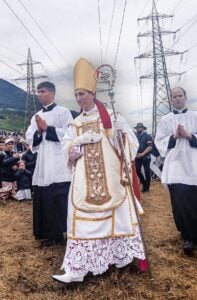
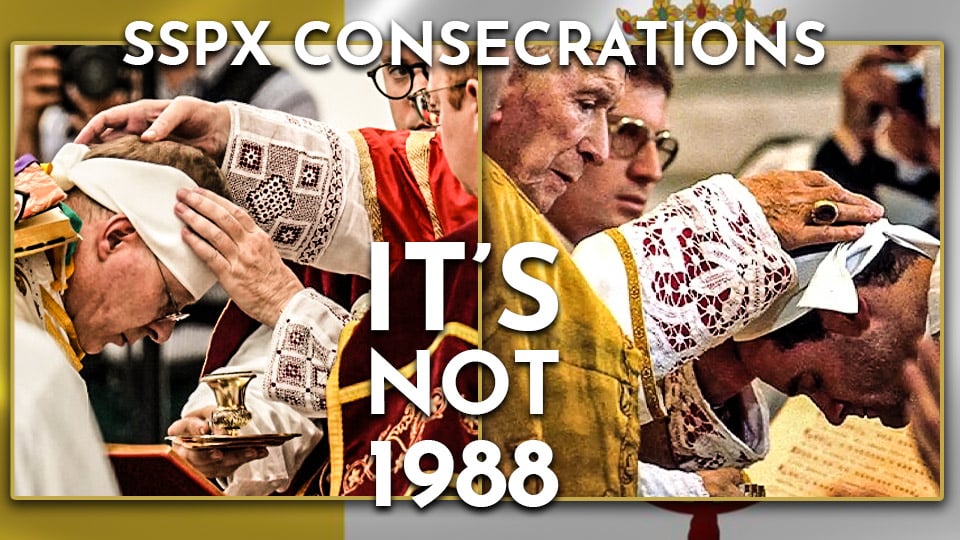

Even those who are familiar with the Society of St. Pius X (SSPX) may wonder at the serene confidence it displayed in pursuit of the episcopal consecrations without Rome’s approval. Rorate Caeli, for example, made the following observation on the day of the consecrations:
“In 1988, there was true agonizing by Archbishop Lefebvre and a wide portion of the SSPX’s priests, seminarians, and faithful, and most of the ‘friendly communities’ (monasteries, convents). The 2026 consecrations were marked by a ‘We don’t care’ attitude, and surrounded by a festive atmosphere. This is the beginning of something different. This isn’t 1988 anymore. We hope and pray for peace and unity.”
Even though we may dispute the characterization of the SSPX’s attitude as one of not caring, Rorate Caeli raised a point that may be more significant than it seems at first glance. Why has the SSPX seemed so calm and confident in the face of such a monumental decision? Why has the SSPX refused to budge from its course when faced with so much criticism and such grave threats from the Vatican? There are very good reasons for this confidence, and we can begin considering them with what Rorate Caeli characterized as Archbishop Marcel Lefebvre’s agony in making the decision to proceed in 1988.
If the Society is of God, it will continue; if it is not of God, it will die.
In his biography of Archbishop Lefebvre, the late Bishop Bernard Tissier de Mallerais quoted the Archbishop’s words from a 1985 retreat at Écône:
“If we must act, Providence will direct circumstances such that our decision will be clear and conformed to the faithfuls’ sensus fidei, the sense of the Faith.” (p. 543)
All throughout the writings from and about Archbishop Lefebvre, we see so many echoes of this absolute reliance on God’s Providence. We should always have this great trust in God’s Providence, but it seems more necessary now than in ordinary times. The crisis in the Catholic Church has been created and perpetuated in large part because those in positions of power have disregarded God’s Providence, seeking instead to satisfy the desires of the sinful world. As such, for those who truly seek to address the evils of this crisis, it is entirely fitting and even necessary to have a great dependence on Providence.
Elsewhere in the biography, Bishop Tissier wrote of Archbishop Lefebvre’s efforts to discern God’s will:
“For years the Archbishop had prayed to the Holy Ghost to enlighten him, and to the Blessed Virgin to guide him. Every night in March 1987, when he could not sleep, he got up to pray. He often exclaimed: ‘Oh! If only the Blessed Virgin could appear to me to tell me what I must do.’ But he had to fall back on his own reason enlightened by faith.” (p. 557)
He truly sought to do the will of God and, as Bishop Tissier recorded, he would not have proceeded if he thought that he was sinning (p. 560). On the day before the 1988 consecrations, he had this to say to his friend, Jean Guitton:
“The Archbishop rose above the insults and pleas . . . . In the afternoon he received his friend Guitton and listened to him, as friendly as ever but unbending. ‘I admire your calm,’ said Guitton. ‘The thing that makes me calm,’ replied the Archbishop, ‘is that I feel that I am doing the will of God. That is more important than anything. And then, what will be, will be. Since I intend to do the will of God and not separate myself from the Church of Peter, I am at peace.” (p. 562)
And so he proceeded calmly and confidently. Meanwhile, those who opposed the SSPX apparently found an exception to Vatican II’s call for religious liberty and ecumenical outreach. These adherents to Vatican II’s novelties who welcomed non-Catholics so freely were quick to fiercely denounce the SSPX’s members and faithful for following their well-formed consciences. These denunciations certainly grew louder and more animated after Fr. Pagliarani announced the SSPX’s plans to consecrate bishops, but they have never really died down since 1988.
There is far greater need and demand for the SSPX today than in 1988.
The testimony of Archbishop Lefebvre’s youngest sister, Mrs. Guy Toulemonde (née Marie-Thérèse Lefebvre), helps us understand how the SSPX has remained confident in God’s will despite these treats and insults from Vatican and so many others:
“He wanted to do God’s will; he wanted to do what God expected of him. That is absolutely certain. I remember that one day, while he was facing great difficulties with Rome, I asked him: ‘But listen, when you are gone, what will happen? Will there be someone to take your place? What will become of the Society?’ He replied: ‘Nothing special, it is quite simple. If the Society is of God, it will continue; and if it is not of God, it will die. That is all. It will be whatever the Good Lord wills. As for me, it does not trouble me in the slightest.’ And, indeed, I am convinced that this was truly his desire: that the Society should do what God wants it to do, and that he himself should do likewise.”
So the Archbishop applied this simple test, which must still apply today: if the SSPX is doing God’s will, it will continue; if it is not doing God’s will, it will not. To apply this test to the current situation, we can compare how the SSPX and the Vatican have changed since 1988:
SSPX: Since 1988, the SSPX had never been “regularized” by Rome, but Benedict XVI withdrew the 1988 excommunications, and the SSPX has won over many critics, such as Bishop Athanasius Schneider. Today the SSPX has over 700 priests, several hundred religious, and so many faithful that the SSPX cannot fully meet their requests for Masses even though many of the priests routinely offer two or more Masses on Sundays. The SSPX has not only continued but has thrived.
The Vatican: Since 1988, matters have grown significantly worse. Whereas John Paul II’s 1986 Prayer Meeting at Assisi was arguably the most scandalous indicator of the crisis when Archbishop Lefebvre consecrated bishops, it would probably not make the top-ten list of scandals that we have seen since Benedict XVI abandoned the papacy. With Francis and now Leo, we have seen the following scandals: Amoris Laetitia, Pachamama, the COVID abandonment of the faithful, the Synod on Synodality, the Abu Dhabi Declaration, Fiducia Supplicans, and countless manifestations of interfaith madness, such as Leo XIV’s welcoming of “Most Reverend and Most Honorable Dame Sarah Mullally, Archbishop of Canterbury.”
For those willing and able to properly evaluate evident reality, this comparison shows us that there is far greater need and demand for the SSPX today than in 1988. Given that Archbishop Lefebvre and the SSPX calmly and confidently proceeded with episcopal consecrations in 1988, there was even more justification for doing so in 2026.
Given that Archbishop Lefebvre and the SSPX calmly and confidently proceeded with episcopal consecrations in 1988, there was even more justification for doing so in 2026.
This being the case, it should come as no real surprise that the SSPX did not hesitate or demonstrate anxiety in the face of Rome’s refusal to grant permission for the 2026 episcopal consecrations. God’s will was clear to them. And, as Fr. Pagliarani expressed with such holy wisdom in his sermon for the consecrations, the SSPX will never lack anything so long as it seeks to do God’s will:
“In 1988, those who condemned the Fraternity predicted its dissolution. Providence had another plan. Why did Providence have another plan? Your presence here today demonstrates it. God has not abandoned us, and God will not abandon us. All these years have shown it, and these consecrations show it again. But why can’t God abandon us? The answer is very simple. God has only one idea, one desire, one will: to save souls. If anyone applies literally the principle that the supreme law is the salvation of souls, it is God Himself. It is His law, and He applies it literally, always. That is why, against all imagination and human foresight, to save souls, He sent His Son. He asked His Son to become incarnate and die on the Cross. For what? Because the supreme law, the law of God, is the salvation of souls. That is why God has not abandoned us and will not abandon us; He will always provide us with means proportionate to our needs. While the work of Redemption may encounter obstacles from men, it will never encounter obstacles from God. But the more we suffer, the more we struggle, the more we try to be faithful to Him, the more He is with us. He reveals it to us. We sometimes falter, we may have doubts, we may experience discouragement. But Our Lord’s promises are all infallible; He always keeps them. And today, He gives us proof of that. If we continue to seek God’s will, the good of souls, whatever the cost, we will never lack anything.”
This is the confidence of one who humbly trusts in God and His loving Providence. It has nothing in common with the blasphemous arrogance of those who seek to change the Catholic religion to conform to the world and placate the Church’s enemies. Nor does it have anything in common with the milquetoast posture of those who disagree with the scandals from Rome but think it is best to “go along to get along.”
In 1988, those who condemned the SSPX predicted its dissolution. Providence had another plan.
The SSPX also has another source of great confidence: its true devotion to the Blessed Virgin Mary and the Rosary. As we know, the SSPX firmly opposed Cardinal Víctor Manuel “Tucho” Fernández’s Mater Populi Fidelis, in which his Dicastery for the Doctrine of the Faith rejected two traditional titles for Our Lady: Mediatrix of All Graces and Co-Redemptrix. Indeed, the SSPX recognized the great need to make reparation for this offense:
“Profoundly outraged and eager to make public reparation for such an offense, the priests of the Society of Saint Pius X invite all affiliated priests and the faithful to join them in prayer on Sunday, 16 November. At every public Mass celebrated that day, an intention of reparation will be added for the offense and scandal committed. After each Mass, the Litany of the Blessed Virgin and the Stabat Mater will be sung or recited.”
Tucho’s gratuitous insult to Our Lady — which Leo XIV never corrected — was almost like a sign from Heaven that the SSPX should not abandon its path to hold pointless dialogue with the Vatican. Fittingly, the SSPX’s prayer for future bishops began on May 8, 2026, the Feast of Our Lady Mediatrix of all Graces, and opened with this petition:
“Almighty and Eternal God, Who willest that all men should come to salvation and to the knowledge of the truth, Thou Whose Spirit sanctifieth and governeth the whole Body of the Church, we humbly beseech Thee, through the intercession of Our Lady Mediatrix of All Graces, to provide for the needs of Thy Church by pouring out upon Thy elect the abundance of Thy grace.”

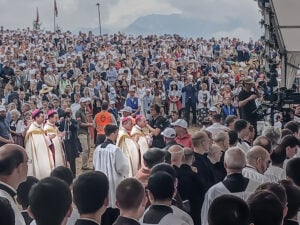
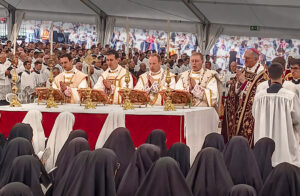
This confidence in God and the intercession of Our Lady Mediatrix of All Graces was also on display in a more subtle way during the consecrations, as the threatened storms finally hit Écône before the distribution of Communion. Not wanting to distribute Communion outside during the storm, the SSPX decided to pause the ceremony and sing the Glorious Mysteries of the Rosary in Latin while waiting for the storm to pass. This is analogous to how the SSPX has handled trials throughout its entire existence. Storms and trials will come day by day, but there is no reason to flee and grow anxious so long as we confidently have recourse to Our Lord and His Mother. Our Lady Mediatrix of All Graces, pray for us!