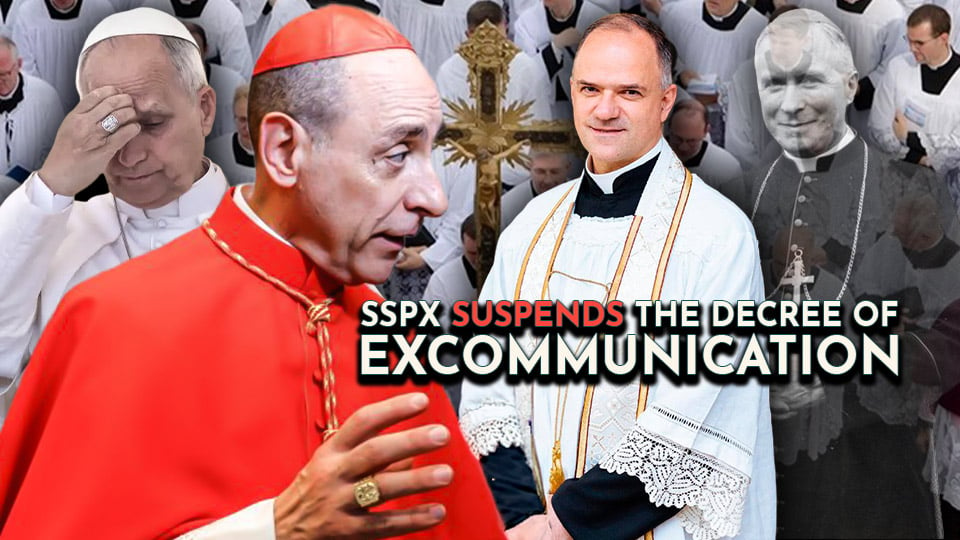

On July 13, 2026, the General House of the Society of St. Pius X (SSPX) announced that it had submitted a preliminary recourse to the Dicastery of the Doctrine of the Faith to appeal the penalties issued by that Dicastery following the episcopal consecrations without papal approval:
“The Society of Saint Pius X announces that, in response to the decree issued on 2 July 2026 by the Dicastery for the Doctrine of the Faith, it submitted on 11 July a preliminary recourse to the same Dicastery, in accordance with canons 1734 and following of the Code of Canon Law.
This request, which constitutes the mandatory preliminary step before the possible introduction of a hierarchical recourse, has the effect of suspending the execution of the decree, in accordance with canon 1353 of the Code of Canon Law. By this recourse, the Society intends to exercise the right which the Church recognizes to any person who considers himself harmed by an administrative act to seek its correction, in a spirit of respect for ecclesiastical authority and of faithful attachment to justice, truth and the good of the Church. The Society of Saint Pius X entrusts this request to the competent authorities and commends this undertaking to the prayers of all the faithful.”
While most of us would be surprised if Rome ultimately agrees with the SSPX position and revokes (or scales back) the purported penalties, this news tends to support an idea that the SSPX has maintained all along: it is not schismatic. Schismatics do not appeal to Rome to insist that they have been unfairly accused of schism — if the SSPX was schismatic, then they would probably be insisting that the pope was no longer head of the true Church.
The SSPX’s appeal now tests whether Rome truly believes the principles of synodality it has preached for decades.
Time will tell how Rome responds, but it is worth recalling a few principles that Leo XIV ought to consider if he intends to follow the teachings he espouses: ecumenism, religious liberty, and synodality. The SSPX does not appreciate these principles as much as Rome would like, but we may soon find out that Rome does not appreciate them either if the SSPX appeal is rejected. Therefore, it is worth briefly considering how these principles could apply to the SSPX.
Ecumenism. John Paul II’s 1995 encyclical on ecumenism, Ut Unum Sint, is perhaps the most important document on ecumenism and begins with the following:
“The call for Christian unity made by the Second Vatican Ecumenical Council with such impassioned commitment is finding an ever greater echo in the hearts of believers, especially as the Year 2000 approaches, a year which Christians will celebrate as a sacred Jubilee, the commemoration of the Incarnation of the Son of God, who became man in order to save humanity. The courageous witness of so many martyrs of our century, including members of Churches and Ecclesial Communities not in full communion with the Catholic Church, gives new vigour to the Council’s call and reminds us of our duty to listen to and put into practice its exhortation. These brothers and sisters of ours, united in the selfless offering of their lives for the Kingdom of God, are the most powerful proof that every factor of division can be transcended and overcome in the total gift of self for the sake of the Gospel.”
Christian unity is so important after Vatican II that Rome has repeatedly taken extraordinary steps to assure non-Catholic Christians that we are all brothers in Christ. In this opening passage from Ut Unum Sint, John Paul II even suggested that non-Catholics who died for their Christian religions are martyrs who offered their lives for the Kingdom of God.
Leo XIV took this a step further in his January 25, 2026 message on Christian unity:
“We are one! We already are! Let us recognize it, experience it and make it visible!”
How can a man who makes such a statement also insist on cutting off the SSPX when they insist that they have no desire to separate themselves from Rome? Yes, the SSPX disobeyed the pope, but with no intention of schism and only because they truly believed it was necessary, as provided for in Canon Law.
If Pope Leo XIV embraces ecumenism, religious liberty, and synodality, the question becomes whether those principles also apply to faithful Catholics attached to Tradition.
Religious Liberty. The most important document on religious liberty remains Vatican II’s declaration on religious freedom, Dignitatis Humanae, which states the following:
“This Vatican Council declares that the human person has a right to religious freedom. This freedom means that all men are to be immune from coercion on the part of individuals or of social groups and of any human power, in such wise that no one is to be forced to act in a manner contrary to his own beliefs, whether privately or publicly, whether alone or in association with others, within due limits. The council further declares that the right to religious freedom has its foundation in the very dignity of the human person as this dignity is known through the revealed word of God and by reason itself. This right of the human person to religious freedom is to be recognized in the constitutional law whereby society is governed and thus it is to become a civil right. It is in accordance with their dignity as persons-that is, beings endowed with reason and free will and therefore privileged to bear personal responsibility-that all men should be at once impelled by nature and also bound by a moral obligation to seek the truth, especially religious truth. They are also bound to adhere to the truth, once it is known, and to order their whole lives in accord with the demands of truth. However, men cannot discharge these obligations in a manner in keeping with their own nature unless they enjoy immunity from external coercion as well as psychological freedom. Therefore the right to religious freedom has its foundation not in the subjective disposition of the person, but in his very nature. In consequence, the right to this immunity continues to exist even in those who do not live up to their obligation of seeking the truth and adhering to it and the exercise of this right is not to be impeded, provided that just public order be observed.”
While some may argue that this was initially directed at the way in which states treat their citizens, the reality is that it has been broadly used to support the freedom of men of good will to follow their consciences in religious matters. Rightly and wrongly, for example, some Catholics appealed to these ideas to support their rejection of Paul VI’s 1968 encyclical on birth control, Humanae Vitae. Regardless, if ever there was a legitimate appeal to religious liberty in the context of Church discipline, it would be the case of the SSPX today. The SSPX simply wants to follow the clear teachings of the Catholic Church. The fact that it disagrees with the Vatican II teaching on religious liberty would be a stunningly spurious reason to deprive them of the religious freedom they seek to follow what the Church has always taught.
The Vatican’s response may become one of the defining moments of Pope Leo XIV’s pontificate.
Synodality. The most “authoritative” document on synodality is the Final Document of the October 2024 session of the Synod on Synodality, which states the following:
“For a Synodal Church: Communion, Participation, Mission there is a call to joy and to the renewal of the Church in following the Lord, in committing to service of His mission, and in searching for ways to be faithful. This call is based upon a shared baptismal identity. It is rooted in the diversity of contexts in which the Church is present and finds unity in the one Father, one Lord, and one Spirit. It challenges all the Baptised, without exception: ‘The whole People of God is an agent of the proclamation of the Gospel. Every baptised person is called to be a protagonist of mission since we are all missionary disciples’ (ITC 53). For this reason, the synodal journey directs us towards a full and visible unity of Christians, as the presence of delegates of other Christian traditions testifies. Unity ferments within the holy Church of God, prophetically so, for the entire world.”
So the Synodal Church unites all baptized Christians. However, all those associated with the SSPX who have been declared schismatic and excommunicated happen to be baptized Christians. As such, the punishment of the SSPX happens to be contrary to the fundamental beliefs of the Synodal Church.
Moreover, the Final Document speaks of an “abuse of conscience” which must be overcome in the Synodal Church:
“[The Synodal process] will also help to overcome clericalism, understood as the use of power to one’s own advantage and the distortion of the authority of the Church that is at the service of the People of God. This expresses itself above all in forms of abuse, be they sexual or economic, the abuse of conscience and of power, by ministers of the Church.”
If Leo XIV wants to avoid the abuse of consciences, it seems that he should not abuse the consciences of SSPX clerics and laity by forcing them to act against their consciences, especially when they make great sacrifices to adhere to what they sincerely believe the Church has always taught.
So while the SSPX does not believe in Rome’s versions of ecumenism, religious liberty, and synodality, it seems that Rome should. Otherwise, why punish the SSPX for not believing it? And if Rome really believes what it preaches, it will surely grant the SSPX appeal. May God grant Leo XIV the grace to reject ecumenism, religious liberty, and synodality so that he can recognize that the SSPX is not schismatic; or else may he truly embrace ecumenism, religious liberty, and synodality so that he can recognize that the SSPX is not schismatic. Immaculate Heart of Mary, pray for us!