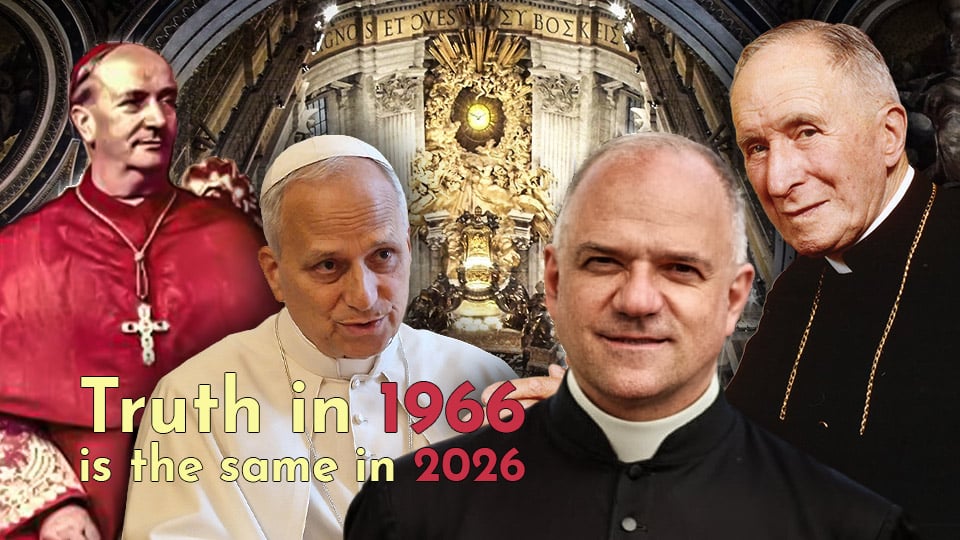

In his 1976 interview with Dutch journalist José Hanu, Archbishop Marcel Lefebvre spoke of his 1966 response to a letter from Cardinal Ottaviani, who was then the Prefect of the Congregation for the Doctrine of the Faith (the Holy Office):
“Hardly a year after Vatican II, the faith of so many Catholics was shaken to such an extent that Cardinal Ottaviani asked all the bishops in the world and all the superiors general of orders and congregations to reply to an inquiry on the dangers that certain fundamental truths were encountering at the moment. I answered the letter on December 20, 1966, enumerating the ravages the Council had already wrought, especially pertaining to relaxed morals. . . . This is what I wrote ten years ago to Cardinal Ottaviani, which the Vatican never acknowledged. Here is what all the bishops of France should have done in the course of ten years which have passed since Vatican II. But they were silent. They permitted errors to develop, permitted the progressives and liberals to undermine the Church, even if they themselves did not lend a hand to the destruction.” (Vatican Encounter, pp. 58-59)
As discussed below, Cardinal Ottaviani already saw the same evils that plague the Church today. It is staggering that the Vatican has not only failed to remedy the evils that Cardinal Ottaviani decried in 1966, but has even made them tremendously worse in many ways. Tellingly, for the past sixty years, the Vatican has relentlessly persecuted those who have echoed the concerns of Cardinal Ottaviani.
The denial of even a single truth of faith destroys faith itself and renders radically impossible all communion with the Catholic Church.
Against this backdrop, we can consider the various ways in which the Declaration of Catholic Faith addressed to Leo XIV by Fr. Davide Pagliarani, Superior General of the Priestly Society of Saint Pius X (SSPX), overlaps with the same concerns that Cardinal Ottaviani and Archbishop Lefebvre had sixty years ago. One does not need to agree with the SSPX’s plans to consecrate bishops to realize that the Declaration is of utmost importance today precisely because it opposes the errors that have persisted for sixty years.
Here is how Cardinal Ottaviani introduced his list of ten errors threatening the Church in 1966:
“Since the recent successful conclusion of the Second Vatican Ecumenical Council, many wise documents have been promulgated, both in doctrinal and disciplinary matters, in order to efficaciously promote the life of the Church. . . . It is the right and duty of the Hierarchy to monitor, guide, and promote the movement of renewal begun by the Council, so that the conciliar documents and decrees are properly interpreted and implemented with the utmost fidelity to their merit and their spirit. This doctrine, in fact, must be defended by the bishops, since they, with Peter as their Head, have the duty to teach with authority. . . . Nevertheless, it must be acknowledged with sorrow that unfortunate news has been reported from various areas about abuses regarding the interpretation of the conciliar doctrine that are taking hold, as well as some brazen opinions circulating here and there causing great disturbance among the faithful. . . . It is worthwhile to draw attention to some examples of these opinions and errors that have arisen both from the reports of competent persons and in published writings.”
Thus, we see that he insisted on the duty of the hierarchy to defend Catholic doctrine, and introduced his list of errors by attributing them to misinterpretations of the Council documents. Although the SSPX actively opposes each of the errors Cardinal Ottaviani identified, the analysis that follows considers only four of the ten categories of errors enumerated by Cardinal Ottaviani, along with the corresponding truths that oppose those errors, taken from Fr. Pagliarani’s Declaration. After seeing how Fr. Pagliarani’s Declaration responds to the errors that have grown persistently worse for sixty years, we can return to the neglected insights of Archbishop Lefebvre’s 1966 response to Cardinal Ottaviani.
Faith, morals, and ecclesiastical discipline are shaken to their foundations, fulfilling the predictions of all the popes.
Ottaviani and Pagliarani on Doctrinal Evolution
The second and fourth categories of errors cited by Cardinal Ottaviani relate to doctrinal evolution and relativism:
“2) In regards to the doctrine of the faith, some affirm that dogmatic formulas are subject to historical evolution even to the point that their objective meaning is susceptible to change.”
“4) Some almost refuse to acknowledge truth that is objective, absolute, stable, and immutable, submitting everything to a certain relativism, with the pretext that every truth necessarily follows an evolutionary rhythm according to conscience and history.”
These errors have persisted since the Council and have become more pronounced since Benedict XVI’s abdication, Francis’s reign, and the ongoing Synod on Synodality. The following statements from Fr. Pagliarani’s Declaration set forth the Catholic truths opposed to these errors:
“The Roman Church alone possesses simultaneously the four marks that characterize the Church founded by Jesus Christ: Unity, Holiness, Catholicity, and Apostolicity. Her unity flows essentially from the adherence of all her members to the one true Faith, faithfully preserved, taught, and handed down by the Catholic hierarchy throughout the centuries.”
“The Holy Ghost was not promised to the successors of Peter that they might make known, by His revelation, a new doctrine, but that, by His assistance, they might inviolably keep and faithfully expound the revelation transmitted by the Apostles, that is, the Deposit of the Faith.” (Quoting Pastor Aeturnus from Vatican I)
The Vatican has not only failed to remedy the evils Cardinal Ottaviani decried in 1966, but has even made them tremendously worse.
Ottaviani and Pagliarani on Moral Theology
The ninth category of errors cited by Cardinal Ottaviani relates to moral theology:
“9) The errors in the field of moral theology are no less trivial. Some, in fact, dare to reject the objective criteria of morality, while others do not acknowledge the natural law, preferring instead to advocate for the legitimacy of so-called situational ethics. Deleterious opinions are spread about morality and responsibility in the areas of sexuality and marriage.”
These errors have persisted since the Council and have never been worse than today, when we have the scandalous blessings of same-sex unions through Fiduciary Supplicans. Fr. Pagliarani’s Declaration set forth the Catholic truths opposed to these errors:
“The help afforded to souls by the Sacraments of the Catholic Church is sufficient in every circumstance and in every age to enable the faithful to live in a state of grace. The moral law contained in the Decalogue and perfected in the Sermon on the Mount is the only one practicable for obtaining the salvation of souls. Every other moral code — founded, for example, on respect for creation or on the rights of the human person — is radically insufficient to sanctify and save souls. In no way can it replace the one true moral law. Following the example of Saint John the Baptist, true charity obliges us to warn sinners and never to renounce the means necessary to save their souls. . . . Sins of impurity that are against nature are of such gravity that they always and in every circumstance cry to God for vengeance, and are radically incompatible with every form of authentic Christian love. Such a ‘lifestyle’ can therefore in no way be recognized as a gift from God. A couple practising this vice must be helped to free themselves from it, and can in no way be blessed — formally or informally — by ministers of the Church.”
Ottaviani and Pagliarani Ecumenism
The tenth category of errors cited by Cardinal Ottaviani relates to ecumenism:
“10) In addition, it is necessary to comment on ecumenism. The Apostolic See praises, undoubtedly, those who promote initiatives, in the spirit of the conciliar Decree on Ecumenism, that foster charity toward our separated brothers and to draw them to unity in the Church. However, it is regrettable that some interpret the conciliar Decree in their own terms, proposing an ecumenical action that offends the truth about the unity of the faith and of the Church, fostering a pernicious irenicism [the error of creating a false unity among different Churches] and an indifferentism entirely alien to the mind of the Council.”
These errors have grown progressively worse since the Council such that almost every evil in Rome today relates to false ecumenism. Fr. Pagliarani’s Declaration set forth the Catholic truths opposed to these errors:
“There is only one Faith and one Church by which we may be saved. Outside the Roman Catholic Church, and without the profession of Faith that she has always taught, there is neither salvation nor remission of sins. . . . The Roman Church alone possesses simultaneously the four marks that characterize the Church founded by Jesus Christ: Unity, Holiness, Catholicity, and Apostolicity. Her unity flows essentially from the adherence of all her members to the one true Faith, faithfully preserved, taught, and handed down by the Catholic hierarchy throughout the centuries. The denial of even a single truth of faith destroys faith itself and renders radically impossible all communion with the Catholic Church. The only possible path to restoring unity among Christians of different confessions consists in the urgent and charitable appeal addressed to non-Catholics to profess the one true Faith within the one true Church.
The Catholic Church can in no way be regarded or treated on an equal footing with a false form of worship or a false church.”
These errors related to doctrinal evolution, moral theology, and ecumenism are responsible for essentially all of the evils we see in the Church today. Fr. Pagliarani highlighted the truths opposing these errors because they are rejected in various ways by the members of the hierarchy today. The reason for this becomes more clear when we consider the following excerpts from Archbishop Lefebvre’s 1966 response to Cardinal Ottaviani.
Only a fool would imagine that God wants us to remain asleep.
Archbishop Lefebvre’s Response to Cardinal Ottaviani
In his response to Cardinal Ottaviani, Archbishop Lefebvre described the picture of the crisis that had become clear to him just a year after the Council closed:
“I believe it my duty to put before you fully and clearly what is evident from my conversations with numerous bishops, priests, and laymen in Europe and in Africa and which emerges also from what I have read in English and French territories. I would willingly follow the order of the truths listed in your letter, but I venture to say that the present evil appears to be much more serious than the denial or calling in question of some truth of our faith. In these times, it shows itself in an extreme confusion of ideas, in the breaking up of the Church’s institutions, religious foundations, seminaries, Catholic schools—in short, of what has been the permanent support of the Church. It is nothing less than the logical continuation of the heresies and errors which have been undermining the Church in recent centuries, especially since the Liberalism of the last century, which has striven at all costs to reconcile the Church with the ideas that led to the French Revolution.”
With these words, Archbishop Lefebvre identified the root causes of the evils highlighted by Cardinal Ottaviani: they were the same errors that the pre-Vatican II popes had consistently condemned. Consequently, unless those committed to defending the Catholic Faith are prepared to combat these root cause errors — such as Liberalism and Modernism — there can be no real hope of properly addressing the evils Cardinal Ottaviani lamented.
The dividing lines between the two sides of this battle appear clear because they are clear.
Archbishop Lefebvre continued by offering a diagnosis that Rome was unwilling to hear then, as now:
“Whereas the Council was preparing itself to be a shining light in today’s world (if those pre-conciliar documents in which we find a solemn profession of safe doctrine with regard to today’s problems had been accepted), we can and we must unfortunately state that: In a more or less general way, when the Council has introduced innovations, it has unsettled the certainty of truths taught by the authentic Magisterium of the Church as unquestionably belonging to the treasure of Tradition. . . . Thus, driven to this by the facts, we are forced to conclude that the Council has encouraged, in an inconceivable manner, the spreading of Liberal errors. Faith, morals, and ecclesiastical discipline are shaken to their foundations, fulfilling the predictions of all the popes.”
For sixty years, the high-ranking experts leading the Church have insisted that Archbishop Lefebvre was essentially a heretic for questioning Vatican II. At the same time, these high-ranking experts leading the Church have done nothing but amplify and spread the evils identified by Cardinal Ottaviani in 1966. By all appearances, the perpetuation of the errors identified by Cardinal Ottaviani sixty years ago was a feature of the Vatican II revolution, not a flaw.
And today, sixty years after Cardinal Ottaviani sent his letter to the bishops of the world, it seems probable that almost nobody in the Vatican agrees with all of the truths set forth in Fr. Pagliarani’s Declaration. The consequences of that are staggering when we consider this truth from the Declaration:
“The denial of even a single truth of faith destroys faith itself and renders radically impossible all communion with the Catholic Church.”
This truth (which matches what Leo XIII wrote even more emphatically in Satis Cognitum) would lead us to believe that almost nobody in the Vatican retains the Catholic Faith intact. How, then, is this not a state of necessity? Why, then, would it be prudent for the SSPX to jeopardize its mission — which requires bishops who will reliably and uncompromisingly defend that mission — for the sake of placating the men who not only lack the Faith but have demonstrated that they actually despise the Faith? Would it not be gravely negligent for the SSPX to presume that those in Rome who deny the truths of Fr. Pagliarani’s Declaration would allow the SSPX to continue teaching these truths if it were to lose its bishops?
May God grant that these powerful words may awaken as many souls as possible to the realities that were obvious to Cardinal Ottaviani and Archbishop Lefebvre sixty years ago.
For over sixty years, God has permitted the hierarchy of the Church to perpetuate this crisis, even though Cardinal Ottaviani alerted the entire episcopate to the evils that we still see today. Knowing that God alone can resolve the crisis, the SSPX nonetheless seeks to cooperate with His grace to do all they can to serve Him and His Church by preserving the unadulterated Faith:
“It is in this Faith and in these principles that we ask to be instructed and confirmed by Him Who has received the charism to do so. With the help of Our Lord, we would rather die than renounce them. It is in this immutable Faith that we desire to live and die, in the hope that it may give way to the direct vision of the immutable eternal Truth.”
May God grant that these powerful words may awaken as many souls as possible to the realities that were obvious to Cardinal Ottaviani and Archbishop Lefebvre sixty years ago. God will not be mocked indefinitely, and the day of reckoning approaches for those who continue to defend the revolution that offends God and leads souls to hell. Better, it seems, to open our eyes and realize that the dividing lines between the two sides of this battle appear clear because they are clear. Only a fool would imagine that God — who can neither deceive nor be deceived — wants us to remain asleep. Immaculate Heart of Mary, pray for us!