
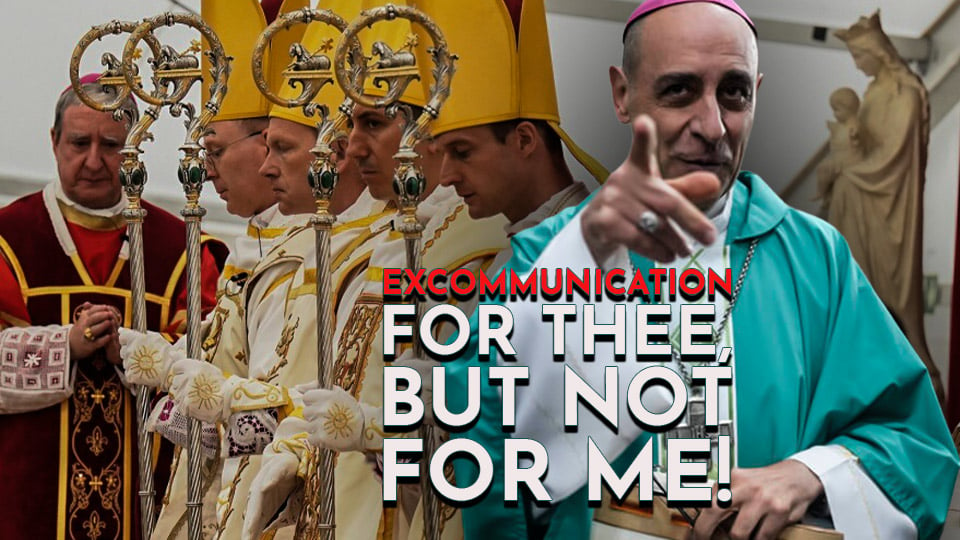

What is Excommunication Actually For?
Excommunication exists to heal souls—not to punish those striving to preserve the Faith.
AN AGE-OLD adage that is commonly applied in military operations and competitive games is that the best defense is often a good offense. As we celebrate the 250th anniversary of the establishment of the United States as a Republic, it seems appropriate to quote General George Washington, in a letter he wrote in the eighteenth century: “Offensive operations, often times, is the surest, if not the only, means of defense.”
Well, we are in a religious war that has been waged for more than sixty years, by Modernists against the Catholic Church. It is a war that is fought by an enemy from within the institutional aspect of the Church, which is why it has been so successful in its attacks upon the Mystical Church and faithful Catholics. So, we should apply the military principle of sustaining a good offense, as a defense against Modernist forces.
That is precisely what the Society of Saint Pius X has done, by announcing in advance their intention to consecrate bishops for their Society and following through with that course of action, regardless of the imperious threats and empty appeals from Rome. In the days leading up to the consecration, SSPX again took the offensive by publishing a phenomenal Profession of Catholic Faith of the Society of Saint Pius X.
Rather than defensively pleading the cause of the SSPX, Catholics should examine whether those imposing these penalties are themselves violating the faith they claim to defend.
Now, facing the sweeping SSPX excommunications, we suggest doubling down on offense; namely, to declare publicly the reality that Modernist Rome lacks not only the grounds for excommunicating SSPX but also the ecclesiastical authority to excommunicate anyone (except themselves), in light of canon 1364: “An apostate from the faith, a heretic or a schismatic incurs a latae sententiae excommunication.”
Indeed, rather than defensively pleading the cause of the SSPX, we should offensively prosecute the case of the apostates, heretics and schismatics who threaten true Catholics with excommunication and penalties.
Excommunication is incurred, latae sententiae, by those who profess and promote ANY of the following:
- The heretical practice of blessing same sex couples and alleging the dignity of sexual perversion
- The heretical claim that capital punishment is inherently wrong and contrary to human dignity
- The heretical claim that all religions are salvific, positively willed by God, or paths to heaven
- The heretical claim that those persisting in mortal sin are suitable to receive Holy Communion
- The apostasy of worshipping or honoring the Amazonian Pachamama demon goddess of fertility
- The apostasy of syncretized prayer and/or worship with false religions associated with spiritism
- The schismatic act of presiding liturgically with or accepting blessings from lady pseudo-clerics
- The schismatic act of granting women authority over clerics, as contrary to Apostolic teaching
- The schismatic act of blasphemy of the Holy Spirit invoked by synods to undermine the Church
- The schismatic selective rejection of doctrines and dogmas prior to the Second Vatican Council
Many will argue, no doubt, that we have no authority to excommunicate anyone. That is true, and beyond dispute. What we assert, however, is that heretics and apostates excommunicate themselves, by the very act of apostasy, heresy or schism. Canon law does not make this excommunication contingent on an ecclesiastical determination or decree for it to take effect– though decrees may be issued in particular cases. While no names are cited in our decree, clearly, canon 1634 applies to powerful prelates in Rome.
Indeed, what we have argued here has been expressed more succinctly and poignantly by an SSPX cleric:
Excommunicated? But by whom? By those who receive the blessing of a schismatic woman, the Archbishop of Canterbury, Sarah Mullally? By those who authorize the blessing of Fiducia supplicans? And who kneel before Pachamama? In the Church, punishments are medicinal. But then, shouldn’t the words of Our Lord in the Gospel rise to the lips of the Catholic of good will: “Medice, cura teipsum” [Physician, heal thyself] (FSSPX News, May 15, 2026)
Beyond canon 1364 which we have just considered and applied to heretics, apostates or schismatics who work in the hierarchy, particularly within the Vatican, there is one more canon we should invoke; namely,
1752: Salus animarum suprema lex esto — the salvation of souls must be the supreme law in the Church.
For fifty-five years, the Society of Saint Pius X has sought to preserve the integrity of the Sacred Liturgy, the Seven Sacraments and the Deposit of the Faith, thereby working for the salvation of souls as broadly as the Society extends and to those all those who entrust themselves into their spiritual and pastoral care. Beyond their own Society, they have done much to preserve and protect the Faith by their very existence. It is likely that without the presence of the Society, the Ecclesia Dei Indult would not have been granted.
The controversy is no longer simply about the SSPX—it is about the purpose of ecclesiastical authority itself.
On a personal note, I remain grateful to the Society for my own reversion into traditional Catholicism and for opening my eyes to heterodoxy in the modern institutional Church. I remember a presentation by one of the original excommunicated SSPX bishops, 25 years ago. His Excellency spoke of negotiations with Rome at the time, which ultimately failed. He used a potent analogy to describe the problem: Rome wants us to drink of the Vatican II soup, even though it has poison in it, assuring us that it’s just a bit of poison.
Well, if there was only a bit of poison in the Vatican Council II soup twenty-five years ago, that soup is now nearly all poison and it is not only bitter to the taste but deadly to the soul. Remnant readers are no doubt more resolved than ever that we will not so much as take a sip of a soup laden with poison. Poison was favored in ancient Rome to kill the body; poison is favored in modernist Rome to kill the soul.
And we are not only grateful to the Society for the past but we also support them for the present and into the future. The consecration of new bishops is not an act of disobedience grounded in schism but an act of self-preservation, necessitated by an incalcitrant Rome and motived by a zeal for the salvation of souls.
The Last Word: in the matter of Rome versus the SSPX, in light of of heretics, apostates and schismatics in the Vatican, it surely seems a case of Excommunicated Excommunicators Excommunicating Catholics.
