
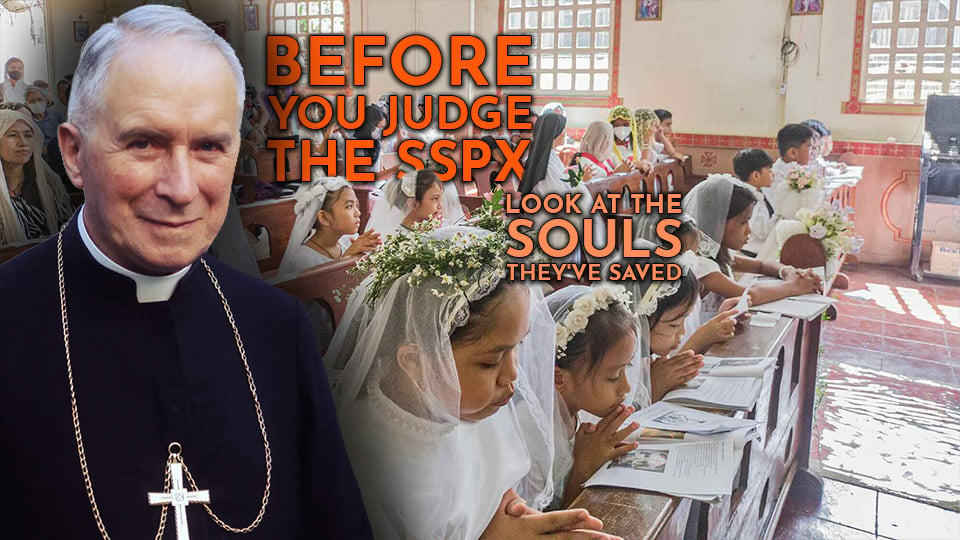

Thirty years may not seem like a long time in the life of the Catholic Church, given that Her entire history spans more than 2000 years.
Yet 30 years or so can be a lifetime in the story of a soul. For many Catholics from Asia, including me, the last three decades or so have been precisely that: a lifetime characterized and shaped by the frequently unseen work of a small band of missionary priests of the Society of Saint Pius X (SSPX).
As someone who grew up amidst an SSPX apostolate in Singapore, the scenes depicted in “A Work of Hope”, the second episode of the newly released documentary series, “Traditio: For the Love of the Church”, regarding the missionary work of the SSPX in Africa, Asia, and the Caribbean, were not merely “mission footage”; but are living and fond memories.
In essence, “A Work of Hope” provides a rare glimpse into the numerous works that SSPX priests have done over the decades in “mission” countries which had a scarcity of priests offering the Traditional Latin Mass (TLM) and teaching traditional Catholic doctrine.
Under the care of Fr. Daniel Couture (who lived in Asia for around 18 years and who was aptly interviewed extensively in this episode), the TLM and traditional Catholic sacraments were not a rare privilege, but the beating and thriving heart of the SSPX Singapore community in the 1990s and 2000s.
In most parts of Asia, there is no luxury of choosing between one Traditional Latin Mass parish or another. Either a missionary priest arrives… or there is simply no Mass.
Day after day, year after year, Fr. Couture labored to transmit Catholic teaching and give the Sacraments to souls all across Asia, for he very knew that for many of them (in Muslim-majority countries like Indonesia and Malaysia, in Buddhist Thailand etc.) the Sacraments were a rarity, and Catholic priests were few and far between.
For the blessed number of us in Singapore (where the SSPX Asia headquarters was and still is based), access to the sacraments like the Holy Eucharist and Confession was not merely a weekend affair, but a daily reality.
Growing up, I was indeed extremely privileged to be able to attend almost daily Mass celebrated by SSPX priests (including Fr. Couture and Don Davide Pagliarani) for years, despite living on a continent where the TLM was almost nowhere to be found (in the 1990s and early 2000s) and where the Catholic religion had been persecuted for years.
Every Holy Sacrifice of the Mass at the altar was not an isolated moment, heard only once a week on Sundays for around an hour, but instead was the axis around which life revolved, undoubtedly thanks to the contributions of priests like Fr. Couture.
I fondly recall how Fr. Couture, in his ardent thirst for the salvation of souls (like how our dying Lord Jesus Christ thirsted for souls while hanging on the Cross on Calvary), occasionally multiplied the number of weekday daily Masses when visiting priests were in town. Sometimes, we had 3 daily Masses (a feat for a country like Singapore with almost no Christian heritage at all) in the early 2000s, one in the early morning, one at midday (for housewives, etc.) and one in the evening! Under Fr. Couture, who was (and still is) extremely devoted to the Blessed Virgin Mary, Singapore had no lack of devotions to the Mother of God, such as the monthly First Friday and First Saturday devotions.
One remarkable incident made it clear to me (then a teenager at that time) that Fr Couture’s love for the Holy Mass was not a matter of routine or performance, but of total self-giving.
Stricken with a grave bout of dengue fever contracted on missionary rounds in the Philippines, emaciated, warded at Singapore’s Mt. Alvernia Hospital, and attached to tubes, Fr. Couture nonetheless was aflame with a single desire: to offer the Holy Sacrifice of the Mass for the feast of Our Lady’s Assumption on August 15 that particular year.
In spite of the fact that he was hovering on the threshold of death, Fr. Couture’s heart was fixed not on himself, but on the altar, on Our Lady, and on the Sacrifice he had offered daily for decades.
He thus asked my father and a few SSPX faithful to help arrange a makeshift altar near his hospital room. At Fr. Couture’s request, my dad brought down the statue of Our Lady of Fatima (ordinarily placed at the altar at my family home) so that the Queen of Heaven would be visibly present near him. In spite of the fact that he was hovering on the threshold of death, Fr. Couture’s heart was fixed not on himself, but on the altar, on Our Lady, and on the Sacrifice he had offered daily for decades.
That very day on August 15, I saw Fr. Couture as I had never seen him before: not in his familiar cassock—for he always travelled intrepidly as a missionary priest, clothed in the dignity of his vocation—but in simple hospital attire, frail and human, but yet more priestly and dignified than ever.
Slowly, Fr. Couture rose from his bed, gathered his strength, and trudged to the makeshift altar.
There, in that improvised chapel, he donned the Mass vestments and chasuble, and with visible effort eventually began the sacred words of the Mass:
“In nomine Patris, et Filii, et Spiritus Sancti… Introibo ad altare Dei.”
Fr. Couture’s voice was weakened, but his intention was unwavering: even at the brink of death, his life’s focus, his raison d’être as a priest, his Love of loves, had not changed. This ailing priest would go unto the altar of God, to God who giveth joy to his youth—because for him, the priesthood and the Mass were not things to be set aside in illness, but treasures worth mustering all his faltering strength to preserve and transmit to others.
“One is a priest 24 hours a day, 7 days a week, like Our Lord, who was always united to His Father,” the same Fr Couture declared in “A Work of Hope” years later.
A few years later, when I was in the Isaan region in Northeast Thailand for a semester abroad (during my college years), I was deprived of the TLM and the traditional sacraments for three entire months, a period of time that felt like an endless eternity of a spiritual drought.
Then came word that Fr. Couture would be in Bangkok (Thailand’s capital) for a weekend mission. Traditional Catholics scattered across Thailand—both expatriates and locals—converged enthusiastically upon hearing that piece of news. That weekend was genuinely a refreshing oasis, with the Holy Mass in the ancient rite, catechism and conferences that edified the mind and heart, and the sacraments that rejuvenated and fortified many weary souls (including me) in Buddhist-majority Thailand.
During my three years of studies in Japan, Fr. Thomas Onoda, the only Japanese priest in the SSPX thus far, displayed the same missionary zeal as Fr. Couture did.
Over time, the SSPX Mass center in Tokyo, Japan, became a small, closely-knit spiritual family. I made friends there, many of whom were converts, attracted by the gravitas of the TLM and the clarity of the one true Faith.
Before there was even a priory in Japan, Fr. Onoda, who was based in Manila, Philippines at that time, was already in full swing, alternating between the Tokyo and Osaka chapels to celebrate the TLM, teach the catechism, and offer pastoral support to many Japanese faithful about once a month.
Over time, the SSPX Mass center in Tokyo, Japan, was not merely a place to “fulfil one’s Sunday obligation”; but became a small, closely-knit spiritual family. After Mass, many Mass attendees stayed for lunch and catechism classes under the instruction of Fr. Onoda. I made many wonderful friends among the Japanese people there, many of whom were converts, attracted not by novelty or trend, but by the gravitas of the TLM and the clarity of the one true Faith.
It was in Japan that my faith was strengthened even further, for I witnessed how a priest like Fr. Onoda did not solely celebrate the TLM, but poured out his life so that the truths of our holy religion may reach those most deprived of them. His monthly travels to his native land of Japan, his willingness to go where others do not go to save souls, and his perseverance over decades in a culture where Catholics are a tiny minority are not the actions of a mere liturgical enthusiast concerned with the “smells and bells”. (He even baptized his previously pagan parents in South Korea!)
What I have seen firsthand from these dedicated SSPX missionary priests is what some Catholics in many Western countries, comfortably settled in diocesan TLM communities or under apostolates like the FSSP or ICKSP, often do not realize.
Unlike many Western countries, in most parts of Asia, there is no luxury of choice between “this TLM parish or that one.” There is one TLM Mass for the week, month, or even year, or simply none at all. Either there is a priest willing to cross borders, navigate the tiresome bureaucracy of visas, and live out of a suitcase, or there is simply… no Mass!
It is far easier to criticize the SSPX from a comfortable pew than to toil on missionary soil.
Hence, the presence of priests like Fr. Couture in Singapore, and Fr. Onoda in Japan, made, for countless souls like my family and me, an enormous difference between sporadic access to the sacraments and a stable spiritual life firmly rooted in the Catholic Faith.
For a Catholic formed in Asia under the aegis of such fervent SSPX missionary priests, it is usually challenging to explain how different the actual lived realities of Catholic Tradition are from the availability of the TLM in places like London, where I lived for a considerable period of time. A weekend can be for an SSPX missionary priest on his missionary round can be very overwhelming for him. For Catholics in the missions, the priest is not merely “the celebrant” of our cherished TLM; he is also the one who has crossed miles and borders to preach to a scattered flock. Arguably, this very awareness deepened our gratitude to the SSPXand honed our perception of the true state of the Church.
In contrast, after the “Agatha Christie” Indult given to England, many could, at least for a time, rely on diocesan clergy (instead of SSPX missionary priests)—often sincere and well‑meaning—to provide the ancient Mass even after Vatican II. For instance, one can easily get a Sunday TLM in a few parts of London (be it at the Rosary Shrine, the London Oratory, St. Mary Magdalene’s in Wandsworth, Our Lady of Willesden Shrine, etc.) without having to go to the SSPX.
Little wonder is it then, that, over time, a certain culture of “traditionalism” has emerged among certain sectors of English Catholics, some of whom arguably have never left their “comfort zones”. Admittedly, in some of these London circles, it is not difficult to find the “armchair theologian” in a G.K. Chesterton‑style suit, pipe in hand, persuaded he has “ticked the boxes” of what it means to be a traditional Catholic simply because he attends a beautiful Sunday liturgy and reads the “right” authors.
Such is the archetype of this kind of “armchair theologian”, who then rushes to the forefront to lambast the SSPX for being “disobedient”, “schismatic”, and “rebellious” for daring to offer the TLM in their chapels, and for even daring to consecrate bishops without papal mandates!
True enough, such “audacity” to consecrate bishops would indeed be a travesty in ordinary times when Church doctrine is preached unambiguously from all pulpits around the world, especially from the Pope himself. I understand these arguments coming from Catholics (many of whom are well meaning) from the ICKSP, and FSSP, diocesan TLM communities that offer the TLM to many in their own areas.
However, as anyone not living under a rock can testify, the actual lived realities on the ground are not merely in black and white.
I would like to gently challenge the “armchair critics” of the SSPX to see how many would actually do what the SSPX missionaries did and still do in Asia: tolerate instability, risk misunderstanding and marginalization, to celebrate the TLM and administer the Sacraments to those who otherwise would have none?
Many Catholics in the United States or Western Europe have the choice between a diocesan TLM, an FSSP parish, or an ICKSP apostolate (even if the said chapel or parish is hours away by car). There can be a huge temptation among many of these Catholics to conclude that the crisis in the Church has receded, that “things are improving” after “Summorum Pontificum”, and that the mission of SSPX priests and bishops defending Catholic Tradition is somehow obsolete after the pontificate of Pope Benedict XVI.
However, such a viewpoint fails to see the Asian Catholic travelling hours for one Sunday Mass a month (which my friends and I did in Japan for years), the family who only rarely has access to confession and the Eucharist, or the convert who finds no doctrinal clarity in local structures infiltrated with ecumenism but experiences such clarity through an SSPX missionary priest attached to Catholic Tradition and the teachings of the pre-Vatican II popes. Moreover, it is noteworthy that in many parts of Asia, other TLM congregations like the Priestly Fraternity of Saint Peter (FSSP) and Institute of Christ the King Sovereign Priest (ICKSP) are practically non-existent.
In face of these “armchair critics” of the SSPX, I would like to gently challenge them to see how many would actually do what the SSPX missionaries featured in “A Work of Hope” did and still do in Asia: travel and live out of a suitcase, tolerate instability, risk misunderstanding and marginalization, and live thousands of miles away from their families and loved ones to celebrate the TLM and administer the Sacraments to those who otherwise would have none? Would they step out, manly and courageously, and sacrifice life, limb and comfort, to save as many souls in the wilderness as possible, or, recoil behind…their keyboards on Reddit forums and anonymously slander this or that SSPX priest?
To clarify, the point of this article is not to sideline the blessings of relatively frequent TLMs that many Western countries like England, the United States, and France have (compared to their Asian counterparts).
Yet in light of the upcoming SSPX bishop consecrations, the case still has to be made (in all charity and out of the love of the Papacy nevertheless), that it is far easier to criticize the SSPX as being “disobedient” to local diocesan bishops and to the Pope when one is living in one’s “comfort zone”in an ivory tower as opposed to actually toiling on missionary soil.
If these “armchair theologians” were to live in places like Asia where Catholic Tradition is not a lifestyle choice but a lifeline, some of them may very well change their minds (save for the die-hard legal positivists who love to harp about the “irregularity” of the canonical status of the SSPX).
It is not easy to imagine the calculations of numerous SSPX priests and their superiors who oversee entire regions with no access to the TLM, to traditional Sacraments, no clear doctrine, and no diocesan shepherds willing to tackle the crisis.
True enough, the sheer love of Christ and the zeal for salvation of souls demand sacrifices from holy priests, sacrifices that no amount of pontificating and fingerpointing from armchairs and pubs can ever fully fathom.
The truth is that the crisis in the Catholic Church has not disappeared or evaporated into thin air, as some would like to think (particularly after “Summorum Pontificum”).
Recent years since the pontificate of Pope Francis have opened the eyes of many Catholics that the crisis in the Catholic Church as predicted by Archbishop Marcel Lefebvre (founder of the SSPX), has unabashedly and fully reared its ugly head without compunction.
Again, as Archbishop Lefebvre rightly pointed out, the liturgical upheaval of the last decades is inextricably intertwined with a grave doctrinal crisis—ambiguity in teaching, abusive pastoral practices, as well as the terrible list of sex-abuse scandals that have caused many to leave the practice of religion altogether!
In such a context, the TLM is not a mere “aesthetically pleasing Mass option” or “spirituality”; au contraire. The TLM is the visible expression of a coherent Catholic Faith, a firm bulwark against the diminishing of belief in the Real Presence, the sacrificial nature of the Mass, and the necessity of conversion (including repenting from sinful homosexual unions) in order to be saved.
Certainly, the words of G.K. Chesterton should resonate strongly with each and every one of us, for “the way to love anything is to realize that it may be lost.” For many Catholics in the West, surrounded by seemingly stable traditional communities, there is an unconscious assumption that the TLM will always be there, that there will always be “some priest” to offer it, that episcopal hostility or indifference is a problem for others (in Asia or in other mission territories) to deal with.
For those of us who have lived (or are currently living) in Asia (and other “mission” countries), we are acutely aware of how quickly the TLM can disappear when a priest is transferred or asked to step down by a bishop hostile to the TLM, or when a fragile TLM mission is left unsupported. Admittedly, for many of us Catholics in Asia, our intense desire for the TLM has been sharpened, moulded, and purified by the very possibility of losing it altogether. .
What, then, should faithful Catholics make of the present moment, with the renewed controversy around the SSPX and the question of upcoming episcopal consecrations on July 1?
For one, faithful Catholics have a duty—to think, to discern, and to carefully consider grave ecclesial decisions, such as episcopal consecrations without papal mandate.
Still, there is also a duty to embrace humility and to refrain from jumping to criticize the SSPX (or “throwing the baby out with the bathwater”) when one does not know the full picture of what is exactly going on in the Vatican or in the Church.
Whatever one’s conclusion may be about canonical questions or prudential decisions, it is simply myopic to gloss over the souls that SSPX priests have rescued from ignorance, indifference, and hell fire, as well as denounce the priests who have given themselves completely for Christ and His Church.
It is very easy to condemn the work of the SSPX from a comfortable pew in a TLM parish in a thriving community in Western Europe or the United States. Yet it is far less easy to imagine the calculations of numerous SSPX priests and their superiors who oversee entire regions with no access to the TLM, to traditional Sacraments, no clear doctrine, and no diocesan shepherds willing to tackle the crisis.
Against this backdrop, the SSPX missionary network in Asia is not a parallel church, but as a much-needed lifeline for countless souls. Just like the documentary stated, the work of the SSPX is truly a “work of hope” precisely because it is a work ordered to the télos (purpose) of Man, that is, his eternal happiness. “Salus animarum suprema lex esto ”, the salvation of souls must be the supreme law in the Church.
Whatever one’s conclusion and discernment may be about canonical questions or prudential decisions, it is simply myopic to neglect, downplay, or worse still, even undermine the good that has been done by the SSPX, gloss over the souls that SSPX priests have rescued from ignorance, indifference, and hell fire, as well as denounce the priests who have given themselves completely for Christ and His Church as “disobedient”.
The episode, “A Work of Hope”, brings to the spotlight a hidden reality that many Catholics (especially these aforesaid “armchair theologians”) will otherwise never see. Yet even this is only the tip of the iceberg when we speak of the numerous concealed sacrifices, the arduous journeys across land and sea to preach the Gospel, the late evenings spent in the confessional reconciling souls to God, the lonely chapels in foreign cities, and the unflinching perseverance of SSPX missionaries like Fr. Couture and Fr. Onoda. Evidently, The lives of priests like Fr. Couture and Fr. Onoda are a reminder that the Catholic Church is larger than any one country, and that the battle for the Faith has been waged intensely in countries where Catholics are few, misunderstood, sidelined, or persecuted.
Perhaps, then, the most charitable and humble response for many Catholics, especially those privileged with stable access to the TLM (for now at least), is not to rush to denounce or anathematize the SSPX in view of the impending episcopal consecrations.
If I may add (albeit in a tongue-in-cheek manner), faithful Catholics should, in accordance with Pope Francis’ desire of the “synodal Church” or the “church of accompaniment”, to listen to the SSPX’s side of the story and realize that what appears secure (their access to the TLM, sacraments, priests, etc.) may not always be so. After all, since time immemorial, the Catholic Church has always needed, and will continue to need missionary priests and bishops who are willing to dedicate their lives for the glory of God and the salvation of souls.