
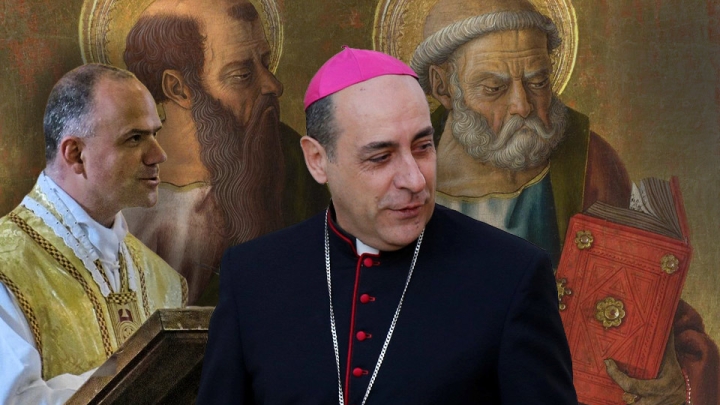

In the letter just published on February 18, the Society of Saint Pius X made clear the position it has adopted in the face of threats of (re)excommunication conveyed by the Prefect of the Dicastery for the Doctrine of the Faith, Cardinal Victor Manuel Fernández, in a warning statement dated February 12.[i]
In a measured and realistic tone, the fraternity’s message points to the only possible path in the context of a situation in which doctrinal agreement seems impossible: that of Christian charity:
“(…) in the shared recognition that we cannot find agreement on doctrine, it seems to me that the only point on which we can agree is that of charity toward souls and toward the Church.”
What is being requested is permission to continue—without further conflicts that would be intensified by a new excommunication—the fruitful pastoral work that the bishops and priests of the Fraternity have carried out for decades. And this does not even imply the establishment of a canonical form—“regularization”—for the functioning of the Fraternity. The message expresses this clearly:
“This same Society asks you only to be allowed to continue to do this same good for the souls to whom it administers the holy Sacraments. It asks nothing else of you—no privileges, nor even canonical regularization, which, in the current state of affairs, is impracticable due to doctrinal divergences. The Society cannot abandon souls. The need for the sacraments is a concrete, short-term need for the survival of Tradition, in service to the Holy Catholic Church.
We can agree on one point: neither of us wishes to reopen wounds. I will not repeat here all that we have already expressed in the letter addressed to Pope Leo XIV, of which you have direct knowledge. I only emphasize that, in the present situation, the only truly viable path is that of charity.”
But perhaps, from the words above, someone might not clearly understand the reason for the conflict. Why would the Vatican wish to excommunicate the bishops of a community whose only desire is to continue offering the Holy Sacraments to their faithful?
Known to many, the answer leads us back to its legendary founder. For the Society of Saint Pius X carries the message of Archbishop Marcel Lefebvre—a message of resistance to those directions inaugurated by the Second Vatican Council that are, in certain respects, real ruptures in relation to the Church’s multi-millennial Traditions. Let me emphasize this point clearly: the divergences are neither liturgical, nor sacramental, nor pastoral in nature. All of these are merely consequences of the real divergences, which concern the very essence of the teaching of the faith.
Paul recounts how he opposed Peter: “But when Cephas was come to Antioch, I withstood him to the face.”
More precisely, they concern doctrinal rectitude—what theology calls “orthodoxy.” What the Society of Saint Pius X seeks to preserve, therefore, is not merely a specific liturgical and sacramental context characteristic of pre–Vatican II Catholicism. Rather, it concerns the so-called “treasure of the faith” (depositum fidei), which in recent pontificates appears—despite official declarations—to be increasingly endangered by actions, attitudes, and teachings that relativize this very depositum fidei. Among these, the most visible and challenging errors are ecumenism and pluralism, which truly endanger the transmission of the Gospel.
Regardless of which priests will be chosen for the consecration on July 1, there is no doubt that they will be faithful to the same evangelical and missionary spirit that opposes conciliar and post-conciliar errors and, in particular, the ecumenical spirit of Assisi and Abu Dhabi. Evidently, the Vatican does not wish to accept new hierarchs with the same strong values of Tradition. The warning issued by His Eminence, Cardinal Victor Manuel Fernández, makes this clear.
Beyond the charity to which the FSSPX’s message appeals, there is only one other virtue—the greatest of all—that could play an extraordinary role: humility. This lies at the heart of the lesson emphasized by one of the most brilliant Saints and Doctors of our Church, Thomas Aquinas, with reference to the famous episode of Saint Paul’s resistance to the duplicitous attitude of the first pope in history, Saint Peter. In his Epistle to the Galatians, the great apostle and evangelizer Paul recounts how he opposed Peter:
“But when Cephas was come to Antioch, I withstood him to the face, because he was to be blamed. For before that some came from James, he did eat with the Gentiles: but when they were come, he withdrew and separated himself, fearing them who were of the circumcision. And to his dissimulation the rest of the Jews consented, so that Barnabas also was led by them into that dissimulation. But when I saw that they walked not uprightly unto the truth of the gospel, I said to Cephas before them all: If thou, being a Jew, livest after the manner of the Gentiles, and not as the Jews do, how dost thou compel the Gentiles to live as do the Jews?” (Galatians 2:11-14).
All Catholic commentators—such as Bishop Richard Challoner—have insisted that “neither was St. Paul’s reprehending him any argument against his supremacy.” Therefore, without ever contesting his pontifical office (just as Archbishop Lefebvre never contested the pontifical office of Paul VI or John Paul II), Paul admonished Peter because of the hypocrisy he had shown.
Saint Thomas Aquinas reasons why God permitted Peter and Paul’s confrontation to be recorded in the sacred text of which He is the Author: “Therefore we have an example: to prelates, an example of humility, that they not disdain corrections from those who are lower and subject to them; to subjects, an example of zeal and freedom, that they fear not to correct their prelates.”
In his commentary, Saint Thomas Aquinas emphasizes the reason why God permitted such a situation to be recorded in the sacred text of which He is the Author. Why did God—who inspired the sacred writers, including Paul, who was His “instrument” in composing the Epistle to the Galatians—wish to preserve the episode at Antioch? Here is the answer of the Angelic Doctor:
“Therefore from the foregoing we have an example: to prelates, indeed, an example of humility, that they not disdain corrections from those who are lower and subject to them; to subjects, an example of zeal and freedom, that they fear not to correct their prelates, particularly if their crime is public and verges upon danger to the multitude.”[ii]
From childhood to the most older ages, no one learns better than through examples. The power of example is irreplaceable. That is why Our Lord Jesus Christ sacrificed Himself on the Cross: to give us the supreme example of the spirit of sacrifice. For the same reason, the episode of Peter’s confrontation—Peter, the first Pope—was recorded by the divine Author through His apostle Saint Paul: so that the hierarchy might receive an example of humility. In other words, so that they may be capable, when necessary, of saying, “I was wrong,” and perhaps even asking publicly for forgiveness. No lesson would be better than this—especially regarding the support of the error of religious indifferentism through ecumenism and religious pluralism.
Just as the popes of the twentieth century erred gravely by failing to obey Heaven’s request to consecrate Russia to the Immaculate Heart of the Blessed Virgin Mary, so too, it is argued, they erred in some of the directions imposed in recent decades. No lesson would be better than the exercise of humility through the acknowledgment of these mistakes. Clearly, something so great depends decisively on the grace of God. That is why I believe we must all pray continuously, as the Superior General, Father Davide Pagliarani, and the other signatories of the official FSSPX response affirmed toward the end:
“Finally, there is another point on which we also agree, and which should encourage us: the time separating us from 1 July is one of prayer. It is a moment when we implore from Heaven a special grace and, from the Holy See, understanding. I pray for you in particular to the Holy Ghost and—do not take this as a provocation—His Most Holy Spouse, the Mediatrix of all Graces.”
If there is a way out of this crisis—apparently without the light at the end of the tunnel being visible—it can only be possible through the grace of God obtained through the intercession of the Blessed Virgin Mary, our Queen and the Queen of all creation. Wouldn’t this be one of the most beautiful gifts of the Blessed Virgin Mary, the Mediatrix of all graces?
