
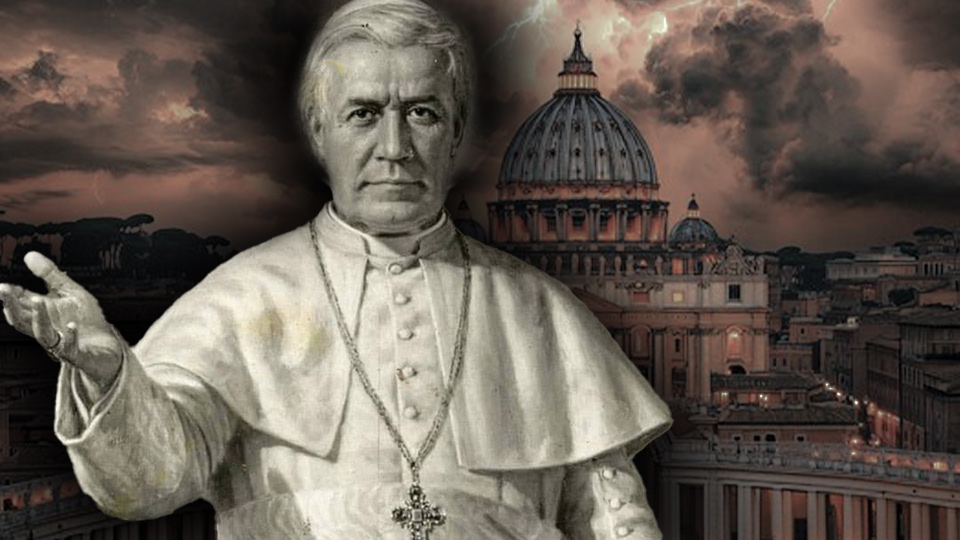

Everything that St. Pius X said about the Modernists of the 1900s could generally be applied to the false shepherds causing so much damage in the Church today because the errors of Modernism remain in “the very veins of the Church,” as the pope wrote. This is why we cannot possibly combat the ongoing crisis by merely targeting the symptoms we saw with Francis and even with Leo XIV today. Rather, those who seriously seek to fight for the Church must combat the same errors that St. Pius X identified.
“Saint Charles is a model for both clergy and people in these days. He was the unwearied advocate and defender of the true Catholic reformation, opposing those innovators whose purpose was not the restoration, but the effacement and destruction of faith and morals.” (St. Pius X, Editae Saepe, On St. Charles Borromeo)
In certain respects, the crisis facing the Catholic Church since Vatican II is unprecedented because for the past sixty years the ostensible hierarchy has not only refused to correct the rampant heresies plaguing the Mystical Body of Christ but has also perpetuated them in various ways. As such, we do not have guidance from the pre-Vatican II popes that precisely answers all of the questions that we may have about the current crisis. However, it seems clear that a significant aspect of God’s perpetual protection of the Church includes the way in which many pre-Vatican II popes clearly provided the guiding principles that we need to address the most important issues we face today.
We now have generations of Catholics who have no experience with pastors who “guard everything pertaining to the integral and inviolate maintenance of the Catholic Faith.”
St. Pius X’s 1910 encyclical on St. Charles Borromeo, Editae Saepe, is less well-known than some of his other forceful condemnations of Modernism, but it provides invaluable instruction and consolation as we face even greater evils today. In fact, Editae Saepe is more relevant and essential in our time, when false ecumenism has effectively negated the work of St. Charles Borromeo, and Modernism continues to cause the damage about which St. Pius X warned.
Heresy is the Greatest Evil
St. Pius X emphasized that heresy is the greatest evil:
“It is obvious that everything quickly lapses back into the ancient barbarism of license whenever God and the Church are hated. It would be more correct to say that everything falls under that most cruel yoke from which only the family of Christ and the education it introduced has freed us. Borromeo expressed the same thought in the following words: ‘It is a certain, well established fact that no other crime so seriously offends God and provokes His greatest wrath as the vice of heresy. Nothing contributes more to the downfall of provinces and kingdoms than this frightful pest.’ Although the enemies of the Church completely disagree among themselves in thought and action (which is a sure indication of error), they are nevertheless united in their obstinate attacks against truth and justice. Since the Church is the guardian and defender of both these virtues, they close their ranks in a unified attack against her. Of course, they loudly proclaim (as is the custom) their impartiality and firmly maintain they are only promoting the cause of peace. In reality, however, their soft words and avowed intentions are only the traps they are laying, thus adding insult to injury, treason to violence. From this it should be evident that a new kind of warfare is now being waged against Christianity. Without a doubt it is far more dangerous than those former conflicts which crowned Borromeo with such glory.”
Prior to Vatican II, the popes realized this and acted accordingly. Conversely, John XXIII opened the Council with a statement that the Church would no longer condemn heresy:
“The Church has always opposed these errors. Frequently she has condemned them with the greatest severity. Nowadays, however, the spouse of Christ prefers to make use of the medicine of mercy rather than that of severity. She considers that she meets the needs of the present day by demonstrating the validity of her teaching rather than by condemnations. Not, certainly, that there is a lack of fallacious teaching, opinions and dangerous concepts to be guarded against and dissipated.”
This radical departure from his predecessors set up a natural experiment: if the pre-Vatican II popes were correct in criticizing heresies, then John XXIII would be provoking God’s wrath and sparking great calamity in the Church and world; if the pre-Vatican II popes were wrong, then we would not expect any ill-effects from John XXIII’s decision. After sixty years, the results are tragically obvious, and anyone pretending that St. Pius X was wrong can be pitied but not followed. More than ever before, we should be thoroughly convinced that heresy is the greatest evil that can afflict the Church and world.
In our age, those who live without persecution are almost certainly failing to stand up to the Church’s enemies as they should.
Wickedness of Today’s Enemies of Catholicism
St. Pius X compared evils of the innovators that St. Charles Borromeo faced (the Protestants) to the wickedness of those opposing the Church in the 1900s:
“All of you know their purpose, subterfuges, and methods. On Our part We have denounced and condemned their scheming. They are proposing a universal apostasy even worse than the one that threatened the age of Charles. It is worse, We say, because it stealthily creeps into the very veins of the Church, hides there, and cunningly pushes erroneous principles to their ultimate conclusions. . . . Although the wild innovators of former times generally preserved some fragments of the treasury of revealed doctrine, these moderns act as if they will not rest until they completely destroy it. When the foundations of religion are overthrown, the restraints of civil society are also necessarily shattered. Behold the sad spectacle of our times! Behold the impending danger of the future!”
Protestants leave the Church, but Modernists remain and spread their heresies from within, undermining the foundations of the Catholic Faith. Everything that St. Pius X said about the Modernists of the 1900s could generally be applied to the false shepherds causing so much damage in the Church today because the errors of Modernism remain in “the very veins of the Church,” as the pope wrote. This is why we cannot possibly combat the ongoing crisis by merely targeting the symptoms we saw with Francis and even with Leo XIV today. Rather, those who seriously seek to fight for the Church must combat the same errors that St. Pius X identified.
Only Sound Doctrine Can Overcome the Heresies
St. Pius X emphasized St. Charles Borromeo’s insistence on sound doctrine to combat heresy:
“Since they attack the very root of faith either by openly denying, hypocritically undermining, or misrepresenting revealed doctrine, we should above all recall the truth Charles often taught. ‘The primary and most important duty of pastors is to guard everything pertaining to the integral and inviolate maintenance of the Catholic Faith, the faith which the Holy Roman Church professes and teaches, without which it is impossible to please God.’ Again: ’In this matter no diligence can be too great to fulfill the certain demands of our office.’ We must therefore use sound doctrine to withstand ‘the leaven of heretical depravity,’ which if not repressed, will corrupt the whole. That is to say, we must oppose these erroneous opinions now deceitfully being scattered abroad, which, when taken all together, are called Modernism.”
This concept has become so foreign that we now have generations of Catholics who have no experience with pastors who “guard everything pertaining to the integral and inviolate maintenance of the Catholic Faith.” Even among so-called conservative Catholics, it is common to find defenders of Vatican II’s documents who say the only problem with them is that they are full of ambiguities — but ambiguity is directly opposed to the “integral and inviolate maintenance of the Catholic Faith.”
St. Pius X also highlighted the need for bishops to protect their flocks from the faintest suspicion of heresy:
“We need not mention the Saint’s other words (echoing the sanctions and penalties decreed by the Roman Pontiffs) against those prelates who are negligent or remiss in purging the evil heresy out of their dioceses. It is fitting, however, to meditate on the conclusions he draws from these papal decrees. ‘Above everything else,’ he says, ‘the Bishop must be eternally on guard and continually vigilant in preventing the contagious disease of heresy from entering among his flock and removing even the faintest suspicion of it from the fold. If it should happen to enter (the Lord forbid!), he must use every means at his command to expel it immediately. Moreover, he must see to it that those infected or suspected be treated according to the pontifical canons and sanctions.’”
Arguably the greatest sign of diabolical disorientation today is the reality that many bishops today only condemn those who try to follow this guidance of St. Charles Borromeo. Satan and his minions hate sound doctrine and they love the ambiguity that has thrived since the Council. Pastors who want to serve God must therefore insist on unadulterated doctrine in opposition to the ambiguity and error that reigns in Rome.
The true glory of God’s protection of the Church shines forth the most when the enemies appear close to victory, when all seems lost humanly speaking.
Need for Faith and Holiness
As St. Pius X wrote, this insistence on sound doctrine must be accompanied by holiness:
“The Church alone possesses together with her magisterium the power of governing and sanctifying human society. Through her ministers and servants (each in his own station and office), she confers on mankind suitable and necessary means of salvation. True reformers understand this very clearly. They do not kill the blossom in saving the root. That is to say, they do not divorce faith from holiness. They rather cultivate both of them, enkindling them with the fire of charity, ‘which is the bond of perfection’ In obedience to the Apostle, they ‘keep the deposit.’ They neither obscure nor dim its light before the nations, but spread far and wide the most saving waters of truth and life welling up from that spring. They combine theory and practice.”
It is illogical to imagine that God would deign to bless the efforts of reformers who insist on sound doctrine but eschew holiness and charity. Surely this is why St. Pius X chose to hold up the virtues of St. Charles Borromeo:
“In this work we have the splendid example of Saint Charles. From his example each one of us can find much for imitation and consolation. Even though his outstanding virtue, his marvelous activity, his never failing charity commanded much respect, he was nonetheless subject to that law which reads, ‘All who want to live piously in Christ Jesus will suffer persecution.’ His austere life, his defense of righteousness and honesty, his protection of law and justice only led to his being hated by rulers and tricked by diplomats and, later, distrusted by the nobility, clergy and people until he was eventually so hated by wicked men that they sought his very life. In spite of his mild and gentle disposition he withstood all these attacks with unflinching courage. He yielded no ground on any matter that would endanger faith and morals. He admitted no claim (even if it was made by a powerful monarch who was always a Catholic) that was either contrary to discipline or burdensome to the faithful.”
Those who earnestly seek to follow this example will be more profitable instruments of God’s Providence and will often face various forms of persecution. In our age, though, those who live without persecution are almost certainly failing to stand up to the Church’s enemies as they should.
The current crisis in the Church is of course important in salvation history, but its greatest significance to those of us living through it is that it provides the context for the ways in which we must cooperate with God’s grace.
God Protects His Church
In addition to this pious exhortation to imitate the virtues of St. Charles Borromeo, St. Pius X also reminded us that we must have great confidence that God always protects His Church:
“When vice runs wild, when persecution hangs heavy, when error is so cunning that it threatens her destruction by snatching many children from her bosom (and plunges them into the whirlpool of sin and impiety) — then, more than ever, the Church is strengthened from above. Whether the wicked will it or not, God makes even error aid in the triumph of Truth whose guardian and defender is the Church. He puts corruption in the service of sanctity, whose mother and nurse is the Church. Out of persecution He brings a more wondrous ‘freedom from our enemies.’ For these reasons, when worldly men think they see the Church buffeted and almost capsized in the raging storm, then she really comes forth fairer, stronger, purer, and brighter with the luster of distinguished virtues. In such a way God’s goodness bears witness to the divinity of the Church. He makes her victorious in that painful battle against the errors and sins that creep into her ranks. Through this victory He verifies the words of Christ: ‘The gates of hell shall not prevail against it.’ In her day-to-day living He fulfills the promise, ‘Behold, I am with you all days, even unto the consummation of the world.’”
The true glory of God’s protection of the Church shines forth the most when the enemies appear close to victory, when all seems lost humanly speaking. And, crucially, those who fight for the unadulterated Faith today have, in a real sense, already demonstrated the prophetic wisdom of St. Pius X’s words: persecution has caused the portion of the Church that adheres to tradition to grow “fairer, stronger, purer, and brighter with the luster of distinguished virtues.”
Still, the battle will continue until God intervenes more directly. As such, St. Pius X reminded us of the need to press on towards the prize of God’s heavenly call in Christ Jesus:
“The true son of the Church and reformer never thinks he has attained his goal. Rather, with the Apostle, he acknowledges that he is only striving for it: ‘Forgetting what is behind, I strain forward to what is before, I press on towards the goal, to the prize of God’s heavenly call in Christ Jesus.’”
Ultimately, all Christians have been called to serve God and save their souls in the particular circumstances in which God puts us during our lives. The current crisis in the Church is of course important in salvation history, but its greatest significance to those of us living through it is that it provides the context for the ways in which we must cooperate with God’s grace. St. Pius X and St. Charles Borromeo yearned to be saints more than they sought to be associated with solving any crisis in the Church. If we do the same, we will be doing as much as we can to serve God, save our souls, and combat the enemies of the Faith. Immaculate Heart of Mary, pray for us!