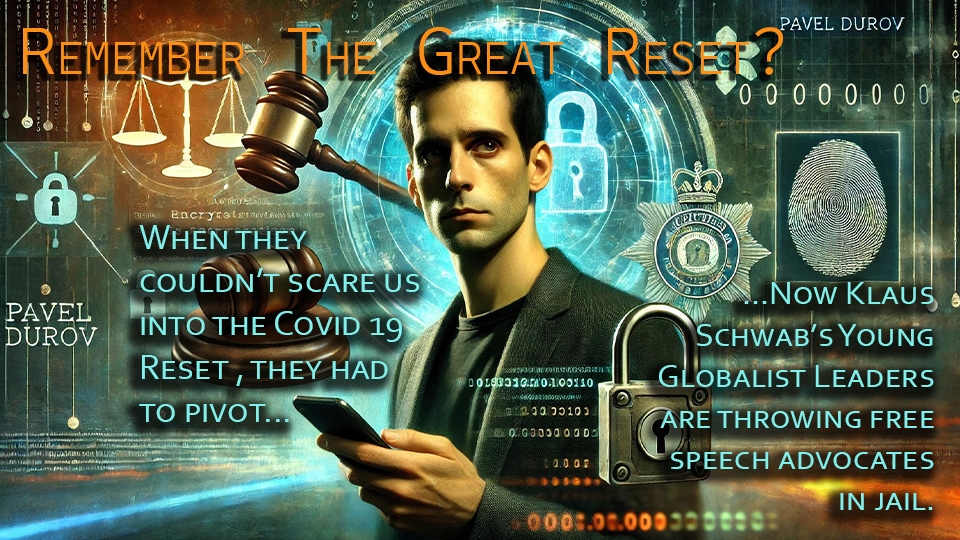

On August 24, Pavel Durov, CEO and co-founder of the Telegram messaging app, was arrested after he disembarked from his private jet at Le Bourget Airport outside of Paris, France.
As per Reuters reports, Durov “was the subject of an arrest warrant in France” due to his alleged failure to moderate “a wide range of crimes” on Telegram.
Notably, the Paris prosecutor’s office claimed that Durov was suspected of involvement in various offenses, including failing to supply information to authorities, and running a messenger that is allegedly used to disseminate child pornography, Sputnik News reported.
After a first round of cross-examinations linked to a current investigation into Telegram that began on July 8, the judge involved in Durov’s case prolonged Durov’s detention to the maximum of 96 hours, subjecting Durov to further interrogation.
French newspaper Canard Enchaine reported that Durov was meant to dine with French President Emmanuel Macron on the day of his arrest. In turn, Macron seemingly sought to distance himself from the matter, unconvincingly claiming that Durov’s arrest was “in no way a political decision”.
Elon Musk slammed Durov’s arrest as an assault on free speech, posting on X: “Check out this ad for the First Amendment. It is very convincing.”
As of the time of reporting, Durov has been released on a €5 million bail, but instructed to report to a police station twice weekly and forbidden from leaving France until his trial ends.
In response to Durov’s arrest, Telegram posted a statement following Durov’s detention, saying that the CEO “has nothing to hide” and that the platform’s moderation abides by international standards as much as it can.
“Telegram abides by EU laws, including the Digital Services Act—its moderation is within industry standards and constantly improving,” the statement read.
Elon Musk, the billionaire owner of X (formerly Twitter) slammed Durov’s arrest as an assault on free speech, posting on X:
“Check out this ad for the First Amendment. It is very convincing.”
Later, Musk scoffed at the French Republic’s motto of claiming to promote “liberté”, or freedom, publishing another post on X stating:
“Liberté Liberté! Liberté?”
Likewise, during an interview with journalist Tucker Carlson that was posted on August 26, Robert F. Kennedy Jr. lamented the deterioration of free speech in Europe, and was cited by Sputnik News as saying:
“We’ve lost Europe. Europe now does not have free speech.”
Similarly, Durov’s lawyer, Dmitry Agranovsky, lambasted Durov’s arrest, telling RIA Novosti and cited by The European Conservative:
“It’s the same as blaming a car manufacturer, some giant auto concern, for the fact that its cars are used for criminal purposes, or blaming them for an accident.”
Notably, during an interview with Carlson in April 2024, Durov disclosed that Western intelligence agencies, including those from the US, have been tireless in attempting to infiltrate Telegram or coerce him into working with them.
Tucker Carlson also remarked on Durov’s arrest, saying: “Pavel Durov sits in a French jail tonight, a living warning to any platform owner who refuses to censor the truth at the behest of governments and intel agencies. Darkness is descending fast on the formerly free world.”
Carlson also remarked on Durov’s arrest, saying:
“Pavel Durov left Russia when the government tried to control his social media company, Telegram. But in the end, it wasn’t Putin who arrested him for allowing the public to exercise free speech. It was a western country, a Biden administration ally and enthusiastic NATO member, that locked him away. Pavel Durov sits in a French jail tonight, a living warning to any platform owner who refuses to censor the truth at the behest of governments and intel agencies. Darkness is descending fast on the formerly free world.”
In the tech sector, Proton VPN founder and entrepreneur Andy Yen cautioned that in wake of Durov’s “insane” arrest and charges against him, he does not see “how tech founders could possibly travel to France, much less hire in France.”
Adding, Yen said:
“This is economic suicide and is rapidly and permanently changing the perception of founders and investors.”
On the same note, economist Philip Pilkington penned in an article on UnHerd that Paris’ decision to detain Durov could prompt investors to leave France and Europe altogether.
“The damage that this could do to France’s image in the eyes of the technology and entrepreneurial communities is profound,” Pilkington warned, suggesting that Durov’s arrest indicates that “the French state’s position on technology is now such that it might bring serious criminal charges against people who develop communication platforms.”
Since its inception in 2013, Telegram has emerged as the world’s top social media app for political activism in countries with restricted freedom of speech, as per a report by The European Conservative.
Upon closer scrutiny, Durov’s arrest is not entirely surprising, given some European Union (EU) countries’ increasingly authoritarian attitudes towards dissenting opinions. Still, Durov’s detention and trial serves as a somber warning of things to come.
Indeed, while “free speech simply for its own sake” is not Catholic teaching, these aforementioned European countries’ attempts to repress such speech is concerning, particularly when these governments support anti-Christian ideologies and agendas.
Across the Channel in Keir Starmer’s Britain, police arrested Wayne O’Rourke from Lincoln as they ruled that what he posted on X during the recent July riots harbored “anti-Muslim and anti-establishment rhetoric”, according to a report by mainstream news outlet BBC (a.k.a “British Brainwashing Corporation”).
By lumping “anti-migrant feeling” with “anti-establishment sentiments”, Starmer’s radical leftist government has taken a significant step towards clamping down on dissent and anyone who dares challenge their narrative.
As per The Times of London, Starmer “directly intervened” to ensure that prosecutors were swift in suppressing critics and dissent. (Previously, I wrote an article elaborating on how the leftist Starmer government is trying to increase state surveillance on British citizens, including the use of intrusive facial recognition technology.)
Welcome to 2024 Britain, an echo of George Orwell’s 1984.
In July this year, Germany’s interior ministry led by radical minister Nancy Faeser banned the government-critical Compact magazine for allegedly “inciting hatred” and “aggressively propagating the toppling of the political order.”
Compact founder and editor-in-chief Jürgen Elsässer criticized the move to ban the magazine without any legal grounds, stating that it was the German government, and not his publication, that was the real threat to democracy. After all, various German lawmakers hailed the move to ban Compact, according to Apollo News.
Various legal specialists also castigated the ministry’s move, with constitutional law professor Volker Boehme-Neßle posting on X, stating:
“There has never been such an extreme violation of press freedom in Germany. If Nancy Faeser remains in office, it says a lot about the government and its respect for the constitution, freedom and democracy.”
Fortunately, a court ruling on August 14 decreed that Compact is now permitted to resume operations, at least for the time being. The magazine has since been rebranded as Näncy, alluding to Faeser herself, as she had called for its closure.
However, Faeser brazenly refused to step down, as demanded by some, claiming that the court’s ruling and her failure to repress Compact was a “completely normal process” in a “state governed by the rule of law”, despite prohibiting Compact at her whims and without legal basis.
Indeed, while “free speech simply for its own sake” is not Catholic teaching, these aforementioned European countries’ attempts to repress such speech is concerning, particularly when these governments support anti-Christian ideologies and agendas.