
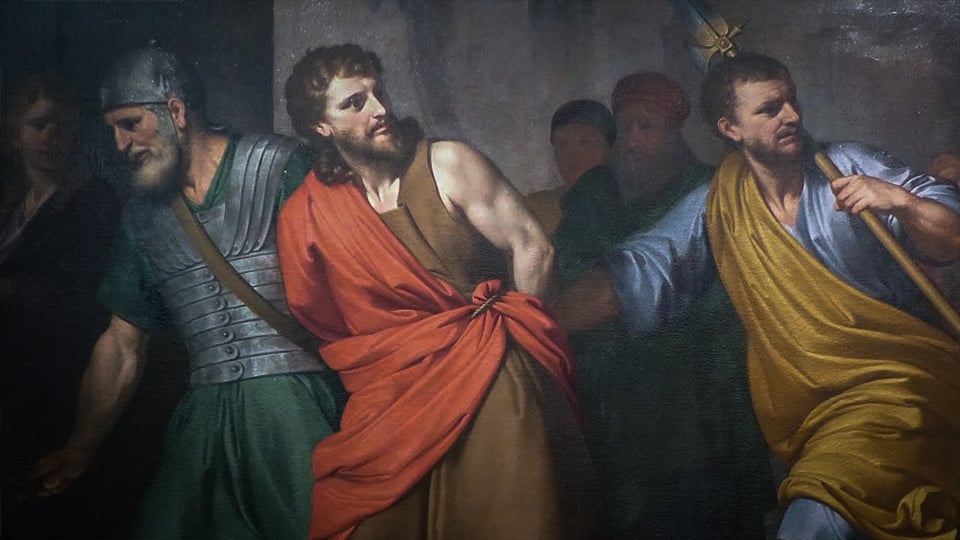

When John the Baptist, from the confinement of Herod’s prison, sent two of his disciples to inquire of Jesus, asking, “Art thou he that art to come, or look we for another?” (Matthew 11:3), the question appears perplexing, even disconcerting. How could John, the Forerunner of the Lord, who recognized Him in the womb and bore witness to His divinity, now seem to express uncertainty?
Jesus’ answer, equally enigmatic, does not offer a direct affirmation, but rather alludes to the fulfillment of the Messianic prophecies, saying, “Go and relate to John what you have heard and seen: The blind see, the lame walk, the lepers are cleansed, the deaf hear, the dead rise again, the poor have the gospel preached to them. And blessed is he whosoever shall not be scandalized in me” (Matthew 11:4-6). The layered significance of both the question and the answer reveals striking truths about John’s mission, the nature of Christ’s Messiahship, and the mysterious wisdom of divine pedagogy.
The Fathers of the Church, along with Thomas Aquinas, resolve the apparent paradox by indicating that John did not ask the question for his own sake, but for the sake of his disciples.
The apparent doubt of John is immediately problematic, for the Gospel reveals that he was filled with the Holy Ghost even from his mother’s womb. The sacred text declares: “And it came to pass, that when Elizabeth heard the salutation of Mary, the infant leaped in her womb. And Elizabeth was filled with the Holy Ghost” (Luke 1:41). The Greek text confirms the specificity of this infilling: καὶ ἐπλήσθη Πνεύματος Ἁγίου. The aorist passive verb ἐπλήσθη (eplēsthē) signifies a completed action, indicating that John was definitively filled with the Spirit from that moment, not merely touched or temporarily graced. Thus, it would seem unthinkable that John, who recognized the presence of the Incarnate Word while still in the womb, could now be uncertain of His identity.
Moreover, John had already given explicit testimony to Christ. When he saw Jesus coming toward him, he proclaimed: “Behold the Lamb of God, behold him who taketh away the sin of the world” (John 1:29). Furthermore, he humbly acknowledged the superiority of Christ’s mission and person, confessing: “I saw the Spirit coming down, as a dove from heaven, and he remained upon him. And I knew him not; but he who sent me to baptize with water, said to me: He upon whom thou shalt see the Spirit descending, and remaining upon him, he it is that baptizeth with the Holy Ghost. And I saw, and I gave testimony, that this is the Son of God” (John 1:32-34). Thus, John, by the divine revelation given at the Jordan, was convinced of Christ’s divine identity and salvific mission. He even declared: “He must increase, but I must decrease” (John 3:30), attesting to his role as the herald who fades into the background as the Bridegroomtakes center stage.
The Fathers of the Church, along with Thomas Aquinas, resolve the apparent paradox by indicating that John did not ask the question for his own sake, but for the sake of his disciples. Saint Ambrose explains: “Therefore, these are not signs of human, but of divine power, to open the darkness of perpetual night to the blind, to heal the wounds of sunken eyes with infused light, to insinuate hearing into the ears of the deaf, to reform loose limbs with joints, to recall the dead to light by restoring the vigor of life. These things were either rare or nonexistent before the Gospel. Tobias received his eyes (Tob. XI, 12), there is one example; and yet that medicine was an angel, not a man’s. Elijah raised the dead: yet he prayed and wept (3 Kings XVII, 20): here he commanded. Elisha caused a leper to be cleansed (4 Kings V, 14); yet the authority of the precept prevailed not there, but the figure of the mystery. He did not fail to give food to the hungry widow, multiplying himself with meal by prophetic precepts (3 Kings XVII, 16); yet that meal, or rather the same type of the sacrament, preserved one widow. But yet these are still small examples of the Lord’s testimony: the fullness of faith is the Lord’s cross, death, and burial.” (Expositio Evangelii secundum Lucam, lib. 5, Chapter 7, verse 22). Ambrose identifies this as the pedagogical charity of John, who, in directing his disciples to question Jesus, was leading them to the true Master.
Thus, John’s question signifies not ignorance, but a holy wonder at the divine plan, wherein the Messiah was manifesting His power through humility and suffering, rather than in a display of royal might.
Perhaps a mystical interpretation may be pertinent, seeing in John’s question a symbol of the mystery of the Incarnation. Thus, John’s question signifies not ignorance, but a holy wonder at the divine plan, wherein the Messiah was manifesting His power through humility and suffering, rather than in a display of royal might.
Thomas Aquinas, in his Catena Aurea, draws from the Fathersand likewise holds that John’s question is not motivated by personal doubt. Citing Chrysostom, he writes: “Yet whilst John was with them, he held them rightly convinced concerning Christ. But when he was going to die, he was more concerned on their behalf. For he feared that he might leave his disciples a prey to some pernicious doctrine, and that they should remain separate from Christ, to whom it had been his care to bring all his followers from the beginning. Had he said to them, depart from me, for He is better than me, he would not have prevailed with them, as they would have supposed that he spoke this in humility, which opinion would have drawn them more closely to him. What then does he? He waits to hear through them that Christ works miracles. Nor did he send all, but two only, (whom perhaps he chose as more ready to believe than the rest), that the reason of his enquiry might be unsuspected, and that from the things themselves which they should see they might understand the difference between him and Jesus.” (Catena Aurea, in Matthaeum 11:3).
Aquinas expounds on the subtlety of Christ’s answer, which, by recounting the works of mercy and miracles, provides a veiled reference to the prophecies of Isaiah: “Then shall the eyes of the blind be opened, and the ears of the deaf shall be unstopped. Then shall the lame man leap as a hart, and the tongue of the dumb shall be free” (Isaiah 35:5-6). The Lord’s reply thus directs John’s disciples to recognize in Him the fulfillment of the Messianic promises without directly declaring Himself as the Messiah. Also in the same Catena Aurea, Saint Thomas quotes Chrysostom again as saying: “So also Christ as knowing the mind of John, said not, I am He; for thus He would have put an obstacle in the way of those that heard Him, who would have at least thought within themselves, if they did not say, what the Jews did say to Christ,” “Thou bearest witness of thyself.” [John 6:13]
Therefore, He would have them learn from His miracles, and so presented His doctrine to them more clear, and without suspicion. For the testimony of deeds is stronger than the testimony of words. Therefore He straightway healed a number of blind, and lame, and many other, for the sake not of John who had knowledge, but of others who doubted; as it follows, “And Jesus answered and said unto them, Go and tell John what ye have heard and seen; The blind see, the lame walk, the lepers are cleansed, the deaf hear, the dead are raised, the poor have the Gospel preached to them.”
John’s question and Christ’s response reveal the divinely orchestrated transition from the Old to the New Covenant. John, the last of the prophets, points his disciples to the Messiah, and Christ, by His works, reveals the fulfillment of the ancient prophecies.
Furthermore, Aquinas, following Augustine, notes that Christ’s indirect answer was itself a demonstration of divine wisdom. The Lord did not wish to state His identity plainly, for this would have deprived His hearers of the merit of faith. As Augustine writes: “Therefore because John’s disciples highly esteemed their master, they heard from John his record concerning Christ, and marveled; and as he was about to die, it was his wish that they should be confirmed by him. For no doubt they were saying among themselves; ‘Such great things does he say of Him, but none such of himself.’ ‘Go then, ask Him; not because I doubt, but that you may be instructed. Go, ask Him, hear from Himself what I am in the habit of telling you; you have heard the herald, be confirmed by the Judge. Go, ask Him, Are You He that should come, or do we look for another?’ They went accordingly and asked; not for John’s sake, but for their own. And for their sakes did Christ say, ‘the blind see, the lame walk, the deaf hear, the lepers are cleansed, the dead are raised, the poor have the Gospel preached to them. You see Me, acknowledge Me then; you see the works, acknowledge the Doer. And blessed is he whosoever shall not be offended in Me. But it is of you I speak, not of John.’ For that we might know that He spoke not this of John, as they departed, He began to speak to the multitudes concerning John; the True, the Truth Himself, proclaimed his true praises.” (Sermon 16 article 4). The miracles themselves were the fulfillment of prophecy, and those with eyes of faith would recognize in them the signs of the Messianic age.
The Greek text of Christ’s answer further reveals its rich significance. When Jesus says: τυφλοὶ ἀναβλέπουσιν καὶ χωλοὶπεριπατοῦσιν, “the blind see and the lame walk” (Matthew 11:5), He uses present indicative verbs, indicating ongoing and definitive actions. The signs of the Messianic age were being actively fulfilled before their eyes. The phrase μακάριός ἐστιν ὃςἐὰν μὴ σκανδαλισθῇ ἐν ἐμοί, “blessed is he who shall not be scandalized in me” (Matthew 11:6), is a clear admonition not to be stumbled by the apparent lowliness of Christ’s mission. The verb σκανδαλισθῇ (skandalisthē) denotes being ensnared or tripped up. Christ is cautioning against being offended by the humility of His coming, which was so different from the expected royal grandeur of the Messiah.
The final remark of Christ regarding John—“Amen I say to you, there hath not risen among them that are born of women a greater than John the Baptist: yet he that is the lesser in the kingdom of heaven is greater than he” (Matthew 11:11)—further demonstrates the divine pedagogy. Here, Christ exalts John’s greatness, yet makes clear that the least in the kingdom of grace surpasses the greatest in the Old Covenant. The Baptist, though a prophet and more than a prophet, still belonged to the time of expectation, while the least disciple of Christ, incorporated into the new covenant by baptism and the indwelling of the Holy Ghost, shares in the mystery of the kingdom in a way even John could not.
Thus, far from manifesting doubt, John’s question and Christ’s response reveal the divinely orchestrated transition from the Old to the New Covenant. John, the last of the prophets, points his disciples to the Messiah, and Christ, by His works, reveals the fulfillment of the ancient prophecies. The question was not a lapse in John’s faith, but an act of perfect humility, whereby the Forerunner directed his disciples away from himself and toward the Lamb of God, whom he had always recognized as the one who would take away the sins of the world.
