

The Gothic cathedral is a powerful metaphor for the Mystical Body of Christ that is the Catholic Church. With the reopening of Notre-Dame de Paris after the 2019 fire, it pays to reflect upon how these cathedrals stand for Mother Church, and what they say about her current state of crisis.
Ask anyone about what a church building might look like. Chances are reasonable that they will think of elements of the Gothic cathedral, which constitutes a widespread notion of what a church is or should resemble. Indeed, the Gothic cathedral is also a powerful metaphor for the Mystical Body of Christ that is the Catholic Church. With the reopening of Notre-Dame de Paris after the 2019 fire, it pays to reflect upon how these cathedrals stand for Mother Church, and what they say about her current state of crisis.
Despite today’s plethora of man-made wonders, the Gothic cathedrals of the Middle Ages remain among the high points of all human architecture and engineering. No wonder, for they represent the heavenly Jerusalem — the very abode of God — on earth. Despite how value systems and aesthetics have moved on since the age of cathedrals, post-Christian Europe would be incomplete without these great churches which continue to mark many a skyline.
The cathedrals are no mere relics. The institution foregrounding their heyday across Western Europe from the twelfth to fifteenth centuries is that which modernity has been wrestling to dismantle since the end of that period. It was the Church that provided the impetus for rebuilding Western civilisation after the fall of Rome, when churchmen assumed leadership abandoned by Roman officials. As the mores, laws and institutions (including the Church herself) that developed to undergird that civilisation come under secular assault, noticeable numbers of the Catholic edifices persist in use, albeit sometimes departing from their original intent after the Reformation. This suggests the die-hard quality of the divine organism that is the Catholic Church. If civilisation in the West (and the rest of the world which increasingly adopts its post-Christian moral trends) is to survive, it must ultimately come anew to terms with the historical yet ageless Catholic faith.
Modern skyscraping temples of commerce and human forays into outer space spring from the Gothic template demarcating the ambition of the Western spirit. No matter what new developmental heights they scale, none match the loftiness of purpose articulated by the cathedrals, which are above all the architectural workings-out of that most exalted concern ever held — the salvation of man’s eternal soul.
Large Vessels for a Loftier Concern
In the high Middle Ages, Gothic cathedrals arose to tower over their surroundings. Examples like Chartres and Salisbury in smaller remaining towns, and even Cologne, at the heart of the major modern city, still convey their awesome scale. The impressiveness of today’s restored Notre-Dame even amid the general elegance of Paris hints at how cathedrals would have seemed within prospering medieval towns, which retained significant disorder or squalor. Many of their poor lived in crammed dwellings; even rich burghers might have dwelt in houses with narrow unglazed windows covered with oil parchment or shutters.
Cathedrals, however, were outstanding iterations of skyward-looking architecture. They represented the Church, which minded the salvation and edification of both the low- and high-born across their life stages (baptism, marriage, illness, death). For the powerful and commoners alike, cathedrals dealt with the mundane but aspired towards the sublime.
Tallest building in the Western hemisphere: upward-pointing triangles on the exterior of New York’s One World Trade Center recall Gothic cathedral spires. (Image modified from photo by Mateus Maia on Unsplash.)
Were they ever tainted by secularity? Yes. Most obviously, the Church being the centre of medieval society made considerable episcopal and princely jockeying behind the great cathedrals unavoidable to a degree. Yet, centuries after temporal obsessions have followed the medievals to the grave, the cathedrals remain. Modern skyscraping temples of commerce and human forays into outer space spring from the Gothic template demarcating the ambition of the Western spirit. No matter what new developmental heights they scale, none match the loftiness of purpose articulated by the cathedrals, which are above all the architectural workings-out of that most exalted concern ever held — the salvation of man’s eternal soul.
Decorated buttresses of Cologne Cathedral. The pinnacles weigh down the buttresses for structural stability. (Photo by User:Mkill on Wikipedia. Licence: CC BY-SA 3.0.)
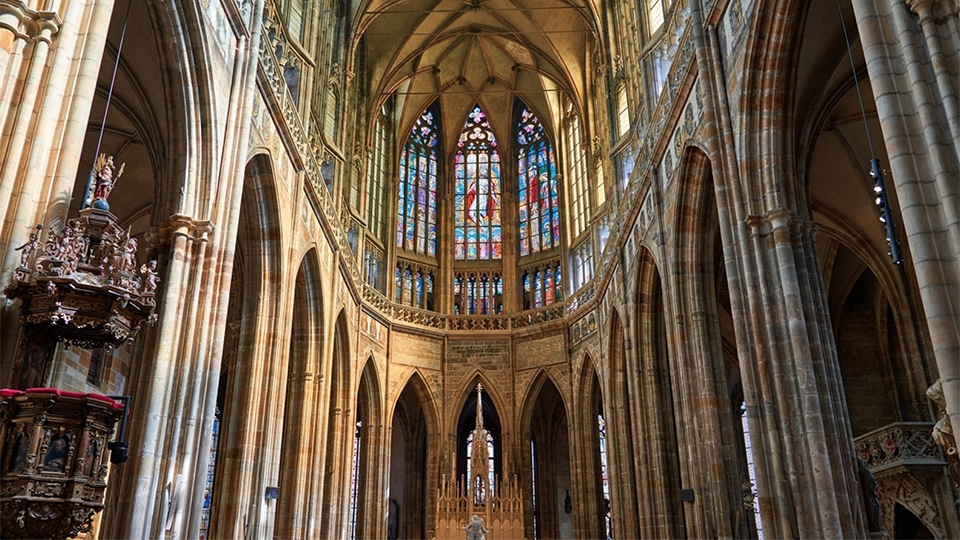
The Gothic cathedrals, with their upward-pointed arches, soaring vaults, celestial shafts of light and flying buttresses, pinnacles and spires, intimate the heights of sanctification to which tiny man must aspire to ultimately ascend to the Divine in his heaven. They are faith writ large in stone — simultaneously rendering and pointing to the eternal infinite abode of God and the saved.
It could not have escaped close observers how working on each aspect of Notre-Dame’s restoration seemed a crowning honour to those involved. In a secularised nation replete with world-class monuments, the Paris cathedral is in an order of its own. There were also pronouncements about Notre-Dame having a soul. Could it be that the X factor in Gothic cathedrals today, when much else clamours for attention, has to do with their being the collective brainchild of the institution par excellence for dealing with the human soul?
Against worldly tendencies to deny the existence of a human soul with otherworldly ramifications for its possessor, the great Gothic churches evoke man’s indispensable if often unacknowledged calling to heed the primary Catholic concern: that of the soul’s eternal destiny.
This immortal soul is the spiritual principle of man, the thing of greatest value in him, the subject of human consciousness and freedom, and that by which he is most especially in God’s image. Together with the body it forms one unique human nature (CCC 363, 365–366). Against worldly tendencies to deny the existence of a human soul with otherworldly ramifications for its possessor, the great Gothic churches evoke man’s indispensable if often unacknowledged calling to heed the primary Catholic concern: that of the soul’s eternal destiny.
The words of the young Calvinist Peter Kreeft to his father, upon being stunned by New York’s Gothic Revival St. Patrick’s Cathedral, “If the Catholics are so dreadfully wrong, how can their churches be so beautiful?”, could equally be uttered by individuals not of any Christian faith. The alliance of truth with beauty is such that those who have experienced a Gothic cathedral might recount their instinctive sensing of the appeal of Catholicism to the human soul made by the church’s beauty.
The Church Is Magisterial
Carvings over a portal of Notre-Dame de Paris before the 2019 fire. (Photo by Stephanie LeBlanc on Unsplash.)
On both their outsides and insides, Gothic cathedrals were designed to instruct. Pictorial carving and stained glass depict biblical and religious images, complementing other architectural features to educate about the journey of souls in relation to their entry into (via baptism) or departure from (via unrepentance) the ark of salvation that is the Church. The entire cathedral itself symbolises this ark, its nave (the main section seating the congregation, from navis, Latin for ship) so called because its ribbed vaulting likens it to an inverted ship’s hull.
Strasbourg Cathedral nave looking east. The brown skeleton of its rib-vaulted ceiling is formed by pointed arches springing from the tops of colonnettes. (Photo by David Iliff on Wikipedia. Licence: CC BY-SA 3.0.)
The predominance of the pointed arch as a load-transmitting member allows walls to extend much higher on thinner masonry, unlike in earlier Romanesque churches of mainly rounded arches set in shorter, thicker walls. This thinning of walls accommodates large glass windows to flood the church with light, symbolising the light of Christ. Forget modern-day Goths — the funereal folk in dark dress and make-up. Gothic cathedral architecture monumentalises the ability of Catholic truth to illuminate the recesses of the human soul. With typically Catholic valuing of the material in making present the spiritual, the medieval Abbot Suger of France’s royal basilica of Saint-Denis (a cradle of Gothic architecture) articulates the architecture’s abilities to illustrate truth:
The dull mind rises to truth through that which is material
And, in seeing this light, is resurrected from its former submersion.
It follows that till now, the Church that invented the Gothic cathedral does not leave individuals fumbling in darkness to figure out what truth is. That would only result in vast differences of opinion among the supposedly well-meaning, which are bogs of error and sin. To speak of just some of today’s most pressing moral issues in an age when grave sin is regularly touted as progress: the Catholic Church means business when she specifically teaches that pre-marital sex, contraception, abortion, in-vitro fertilisation, non-heterosexual lifestyles, sex-change surgery and euthanasia wound the nature of man. Therefore, they wound people. They turn man away from God (his complete happiness and ultimate end) and from genuine love of neighbour through perverse attachment to inferior goods, setting up the human individual as his own god in determining good and evil. If unrepented of, they can lead to the eternal death of hell (CCC 1849–1850, 1855, 1861).
The Church in her widely available traditional catechetical, philosophical and theological literature amply details the strongly reasoned logical arguments for these teachings, which are clearly rooted in scripture and the moral law written in every man’s conscience (CCC 1860). The teachings are not unthinking reactions to change. Those arguments and many others in the Catholic arsenal have a formidable record of making the most convinced Protestants and atheists reexamine their opposition to Catholicism. The Church is after all magisterial, meaning that one of her key faculties is as authoritative teacher of the nations (Matt 28:19–20).
Many Catholics treat the Church like an aesthetic prop for their secular personal morality, which they project as being what she would allow if only she would update herself. They have it backwards.
Do Catholics know the substance of arguments wielded by the Church? The neglect of Catholic pedagogy has led to many mistaking for Christian charity the secular notions of what the Church “should” do to “stay relevant”. This involves what secularists effectively see as “compassion” required to legitimise the beliefs and actions of the alienated in the abovementioned areas of morality. Catchphrases like “safe sex”, “reproductive rights”, “love is love” and “mercy killing” indicate their belief in the reasonableness and necessity of such actions.
However, Jesus’ notion — and thus the Catholic notion — of love entails the Church he founded giving us the grace to live without resort to the destructiveness of sin. Grace is the enablement to live the supernatural life ordained by God. The Church offers seven sacraments — ritual and material outlets of grace, if you will — to combat the temptation to lose faith or act against it, cleanse the repentant of the stain of sin when temptation has overwhelmed them, and truly transform the person throughout. The sacraments reprise the logic of the Incarnation, that God (the eternal spirit) who saves his people became joined to matter to become flesh and dwelt among us (John 1:14).
The secular brand of compassion is the impoverished solution of those who do not properly know what the God of love offers through his Church. Are secularised Catholics too busy protesting against an upstanding, heroic faith they do not even know, and therefore cannot properly practise?
The marketplace invading the Church today has not the moneychangers and animal sellers of the temple in Jesus’ day, but the deadliest traffic of souls in exchange for the world. Many Catholics treat the Church like an aesthetic prop for their secular personal morality, which they project as being what she would allow if only she would update herself. They have it backwards.
The Catholic liturgy, sacraments, supernatural miracles and saintly works, and tremendous canon of theology, philosophy, literature, art, architecture and music are what Scott Hahn identifies as the external splendour radiating from the inner splendour who is Jesus himself, the way, the truth, the life (John 14:6). The Church’s outer splendour is ripped from its context if the truth of her inner splendour is rejected. The Catholic faith subsists not in agreeing with the Church nor expecting her agreement with oneself. Agreement is merely coincidence between one’s views and what the Church teaches, and may be partial and changeable. Faith, instead, is a loving submission of self to Christ present within the Church, which proclaims the fullness of his truth in her teachings.
Flying buttresses comprising ramping half-arches (flyers) and vertical piers, against a wall of Amiens Cathedral. (Image modified from photo by Jacques76250 on Wikipedia. Licence: CC BY-SA 3.0.)
As with Catholicism, Gothic cathedral architecture is fundamentally an integral structural system and not just decorative. Pointed arches spring from columns or thinner colonnettes connected to walls. The highest of these arches — often intersecting one another at their apexes — form the skeletal ribs of ceiling vaults. To prevent vaulting from pushing adjoining walls outward towards collapse, flying buttresses outside the building at right angles to the walls push back on the walls. They also transmit the thrust of the vaulting through flyers into vertical piers, thereby channelling force into the ground. Voids within buttress systems let sunlight stream through the large stained-glass windows occupying erstwhile wall space.
There can be nothing to compare with the Catholic Church in towering over the spiritual and moral landscape of any given age, if only Catholics are up to the task.
During Notre-Dame’s repair, architect-in-chief Philippe Villeneuve revealed to French television series Des Racines et Des Ailes how the bases of two nave columns were scorched by wood from the burning spire smashing through the vault. He had the columns braced, without which they and the entire adjoining wall would have collapsed, followed by the rest of the vaulting and then the flying buttresses into the nave.
Likewise, detrimental changes in any part of the Catholic Church knock on throughout her system, even if she is ultimately indestructible (Matt 16:18) and rises again above any damage she sustains. Central to her faith is God, who in his Trinity is the archetypal family: the love between Father and Son is such that from it proceeds a Spirit of holiness. The Son, begotten of the Father, is the Word (i.e. the logic, according to the original Greek term logos) through whom all things were made (John 1:1–3). The Trinity’s holiness is accordingly the standard for all rightly ordered human relationships. The concomitant human family built on self-giving love and moral self-restraint is the earthly building block of the Church, the divine family of God. Unleashing the destruction of these principles through any human family or individual, by endorsing what the Church teaches to be sinful and therefore unholy will rupture the relationship of similitude to God at the core of faith itself.
Genuine charity means proclaiming, even in the face of opposition, the majesty of Catholic doctrine in this regard. There can be nothing to compare with the Catholic Church in towering over the spiritual and moral landscape of any given age, if only Catholics are up to the task. Any faith claiming to be “Catholic” but compromising with the spirit of its age, is like a Gothic cathedral hoping to be a hovel.
Rachel Lucy Choo is a commentator on Catholic issues, and frequently draws on the Church’s art and architecture to make the case for Catholicism. She grew accustomed to Gothic architecture from early childhood.
