
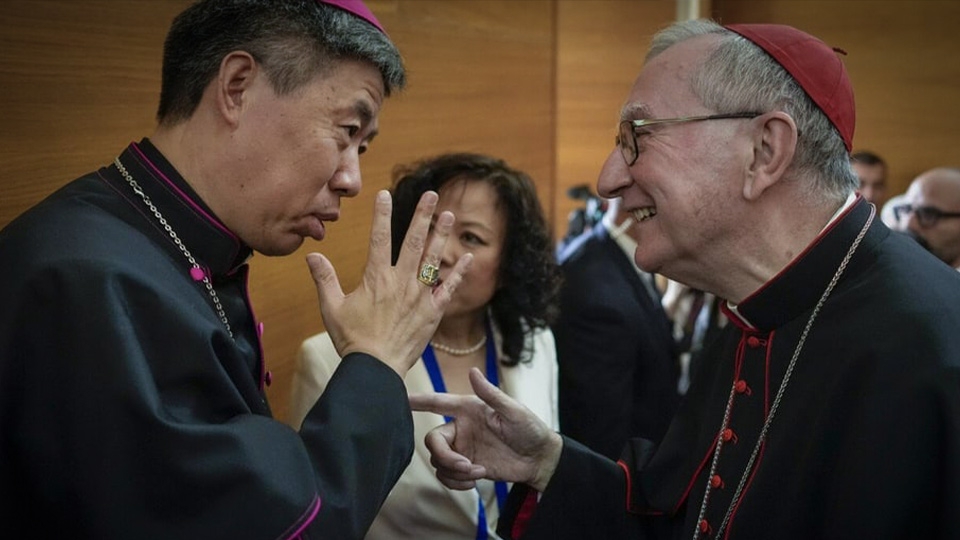

The Chinese Communist Party (CCP)’s delayed and muted response to Pope Francis’s death is telling of the regime’s attitude towards the Catholic Church. In the hours following Pope Francis’ passing, Chinese state media provided nominal coverage (that could be contrasted with the global outpouring of tribute and critiques from those on the Left and on the Right). In fact, it took the CCP regime almost 24 hours to respond to news of the pontiff’s passing, and it did so only when asked during a regular news conference at its foreign ministry.
“In recent years, China and the Vatican have maintained constructive contact and engaged in beneficial exchanges. The Chinese side is willing to work together with the Vatican to promote the continued improvement of China-Vatican relations,” Guo Jiakun, a spokesperson for the ministry, stated, in response to reporters on April 22, without providing further details on whether Beijing would deploy an official representative to attend the late pontiff’s funeral.
Notably, authoritarian Chinese leader Xi Jinping has not made any official remarks following Pope Francis’ death so far (as of the time of writing), despite Pope Francis’ public proclamations of his desire to inch closer to Beijing. Liberal French media outlet Le Monde reported the following incident regarding Pope Francis’ overtures towards the CCP regime:
“Visiting South Korea in October 2014, he was authorized to fly over Chinese airspace, a license that John Paul II had not received in 1999, during the previous visit of a pope to Asia. On this occasion, Francis sent a radio message to Xi Jinping. ‘Upon entering Chinese airspace, I extend my best wishes to your excellency and your fellow citizens, and I invoke divine blessings of peace and wellbeing upon the nation.’”
The same Le Monde article added:
“On ‘two or three occasions,’ according to Benoît Vermander, a Jesuit who teaches philosophy at Fudan University in Shanghai, the pope tried to meet Xi. To no avail. On September 14, 2022, the two men even found themselves in the capital of Kazakhstan at the same time, the former to take part in an interfaith summit, the latter for an official visit. But they didn’t meet.”
Even the Dalai Lama (exiled in India due to the repressive CCP regime) expressed his condolences regarding Pope Francis’ death, despite the latter’s attempts to be friendly towards the very persecutors of Tibetans.
When it comes to achieving their ends (i.e. attaining maximum power and prestige of Party ideology at the expense of our holy Catholic religion), the CCP has expressed no qualms about using all kinds of means, however deceitful they may be.
Unlike his predecessors, Pope Francis attempted to make contact with the communist regime in Beijing to supposedly enhance the Vatican’s ties with the CCP.
Attempts to heal the rift between the Vatican and the CCP regime have long been thwarted by political calculations (especially on the part of the anti-Catholic CCP authorities).
In 1951, merely two years after the fateful establishment of the communist People’s Republic of China (PRC), the CCP under the heavy yoke of murderous dictator Mao Zedong, expelled the Vatican’s official representative, Archbishop Antonio Riberi.
In comments cited by the Australian Broadcasting Corporation (ABC) media outlet, Zhang Tan, a former official with the religious affairs administration in Guizhou province during the 1980s, explained how communist China severed ties with the Vatican in the 1950s:
“At the time, there were around 3 million Catholics in China. The Chinese government expelled the Vatican’s official representative, effectively cutting off diplomatic relations.”
By 1953, the CCP regime embarked on its genocidal campaign targeting Christians, particularly lashing out at those who rejected government control. Communist authorities wasted no time in kicking foreign missionaries out of the country and seizing land and property belonging to Christians in efforts to force ordinary Chinese to submit to governmental control.
Besides, the long-standing and deceptive CCP narrative that the Catholic Church in China was a product of “imperialistic control” still continues to serve as a justification (albeit crumbling) for government persecution of many underground Catholics in this large country to this very day.
Such CCP propaganda contradicts established historical facts, such as when Pope Pius XII published the apostolic constitution “Quotidie Nos” in 1946, formally establishing the Chinese Catholic hierarchy and raising the Chinese Church to an equal status with other dioceses in the world (making the Church in China no longer “mission territory”). Earlier, Pope Pius XI also consecrated China’s first native bishops in 1926.
The CCP has penalized underground Catholics and clergy faithful to Rome with draconian punishments. Communist authorities viewed Catholics’ faithfulness to the Holy See and to the Pope as subversive.
Nonetheless, when it comes to achieving their ends (i.e. attaining maximum power and prestige of Party ideology at the expense of our holy Catholic religion), the CCP has expressed no qualms about using all kinds of means, however deceitful they may be.
Additionally, the CCP has penalized underground Catholics and clergy faithful to Rome with draconian punishments. Communist authorities viewed Catholics’ faithfulness to the Holy See and to the Pope as subversive.
Consequently, faithful Catholics who refused to join the state-sanctioned Chinese Catholic Patriotic Association (CCPA) had to face intense state scrutiny, lengthy jail sentences, as well as brutal torture (that sometimes led to death).
For example, the CCP arrested Archbishop Dominic Tang Yiming in 1958 and imprisoned the cleric for twenty-two long years in prison because of his loyalty to the Papacy.
Likewise, the communist dictators jailed the courageous Cardinal Ignatius Kung Pin-mei for three decades for his unwavering loyalty to Rome and refusal to obey communist dictates. thirty years in prison for similar reasons, suffering long-term incarceration due to his steadfast loyalty to the Vatican and refusal to submit to state religious authorities
Recent years have also seen the CCP stepping up on its persecution of religious minority groups, even publicly celebrating its repression of groups labeled as “xie jiao” ( “evil cults”), such as Christian house churches.
Hence, in light of continued CCP repression of religions like the Catholic Faith in China, it is no wonder why some observers have criticized the Vatican’s attempts to reconcile with a defiant CCP regime in the form of the secretive Sino-Vatican agreement.
Despite the Sino-Vatican pact that is still currently being kept under wraps, critics have slammed Hong Kong’s arrest of Cardinal Joseph Zen Ze-kiun in May 2022, as well as the various high profile unilateral appointments which Pope Francis himself had to retrospectively acknowledge Notwithstanding all the talk about “improving” Sino-Vatican ties, religious suppression and Sinicization programs have only snowballed under Xi.
In view of all these realities, China’s muted response at Pope Francis’ death is consistent with its murderous anti-Catholic policies (domestically) and diplomatic disregard for the Vatican.
Still, no one will ever know (at least in the public domain) whether the late pontiff realized this painful reality before his death: that the Communists can never be trusted to keep their end of the deal.