
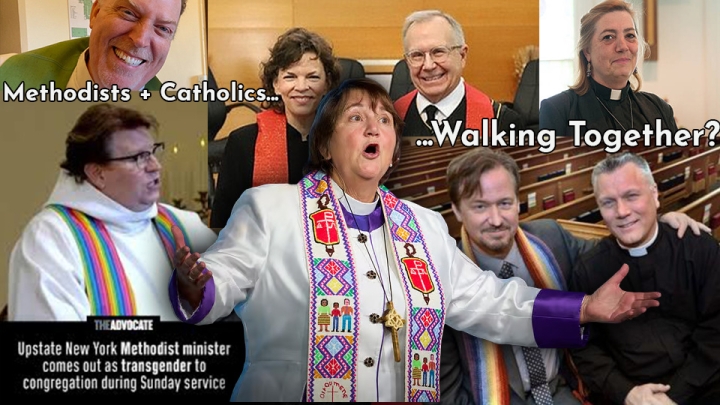

As reported by OSV News, the Vatican publishing house recently released a short book about the progress of ecumenical dialogue between Catholics and Methodists, We Believe in One God: Sixty Years of Methodists and Catholics Walking Together:
“Celebrating almost six decades of Catholic-Methodist theological dialogue, the Vatican publishing house has released a book summarizing the issues dialogue members have agreed on and briefly outlined the issues where work is ongoing. The book, ‘We Believe in One God: 60 Years of Methodists and Catholics Walking Together,’ is based on the results of 11 reports produced by the Methodist-Roman Catholic International Commission since its formal dialogue began back in 1967.”
A few themes from the book are worth exploring in detail because they help us understand the true significance of many of the most disturbing developments in Rome for the past sixty years. In general, though, we can judge this book by its cover, which “features a detail from the Resurrection Window at the United Methodist Church of the Resurrection in Leawood, Kansas, and includes images of St. John XXIII, John Wesley [the founder of the Methodist religion], Teresa of Avila and others.” Like the stained glass window’s depiction of Catholics and Protestants artificially grouped together with no connection to reality, the book reflects sixty years of artificial attempts to harmonize Catholic and Methodist thought with no connection to reality.
It is worth pausing here to reflect on the diabolical cruelty of this message. Who benefits from spreading the message that there may not be eternal punishment for those who die in a state of mortal sin? Only Satan and the enemies of Christianity win by persuading souls that Jesus and the Church were wrong on this all-important matter.
Some Catholics may not be familiar with John Wesley, the founder of the Methodist religion featured alongside John XXIII and St. Teresa of Avila on the book’s cover. The following description from the United Methodist Church website gives us a glimpse of Mr. Wesley, which ties to discussions from the new book:
“Aldersgate Day is celebrated on May 24 (or the Sunday closest) to commemorate the day in 1738 when John Wesley experienced assurance of his salvation. Wesley reluctantly attended a group meeting that evening on Aldersgate Street in London. As he heard a reading from Luther’s Preface to the Epistle to the Romans, he felt his ‘heart strangely warmed.’ Wesley wrote in his journal that at about 8:45 p.m. ‘while he was describing the change which God works in the heart through faith in Christ, I felt my heart strangely warmed. I felt I did trust in Christ, Christ alone for salvation; and an assurance was given me that He had taken away my sins, even mine, and saved me from the law of sin and death.’”
So Mr. Wesley was listening to a reading from the works of Martin Luther in 1738 when his heart felt “strangely warmed,” which he interpreted as an assurance that he was saved. As foreign as this may sound to Catholic belief, the new book informs us that Catholics are edified by Mr. Wesley’s assurance of God’s saving presence:
“There are evident similarities between John Wesley and the mainstream Catholic spirituality. . . . Both Catholics and Methodists have found an edifying example in John Wesley’s deeply personal experience of having his heart ‘strangely warmed’ by the assurance of God’s saving presence.” (Paragraph 48)
Catholics might be excused for failing to realize that they should be edified by Mr. Wesley’s strangely warmed heart. After all, the sentiment generally contradicts what the Council of Trent’s Decree on Justification had to say about whether we ought to feel assurances about our salvation:
“No one moreover, so long as he lives in this mortal state, ought so far to presume concerning the secret mystery of divine predestination, as to decide for certain that he is assuredly in the number of the predestined [can. 15], as if it were true that he who is justified either cannot sin any more [can. 23], or if he shall have sinned, that he ought to promise himself an assured reformation. For except by special revelation, it cannot be known whom God has chosen for Himself [can. 16].” (Denzinger 805)
The problem with relying too much on a “strangely warmed” sensation that we are saved is that such a presumption puts us at greater risk of experiencing an infinitely hotter sensation for eternity, as Jesus warned us:
“If any one abide not in Me, he shall be cast forth as a branch, and shall wither, and they shall gather him up, and cast him into the fire, and he burneth.” (John 15:6)
This danger of eternal damnation does not apply solely to wretched heathens — St. Paul himself made it clear that he could lose his soul if he did not bring his sinful passions into subjection:
“But I chastise my body, and bring it into subjection: lest perhaps, when I have preached to others, I myself should become a castaway.” (1 Corinthians 9:27)
If St. Paul was so deeply concerned that he could suffer eternal damnation, even after having preached the Gospel to others, who among us can hope to avoid eternal damnation if we become presumptuous about our salvation? As it turns out, the new book offers us an unexpected answer:
“While human beings can choose to sever their relationship with God, Catholics and Methodists consider it appropriate to hope that no one will be eternally damned.” (Paragraph 202)
It is worth pausing here to reflect on the diabolical cruelty of this message. Who benefits from spreading the message that there may not be eternal punishment for those who die in a state of mortal sin? Only Satan and the enemies of Christianity win by persuading souls that Jesus and the Church were wrong on this all-important matter.
Pius XII would not have considered Methodists and other Protestants as members of the Mystical Body of Christ because they do not profess the true faith and are separated “from the unity of the Body.” Again, it is truly charitable to insist on this Catholic truth because it tends to encourage Protestants to become Catholic.
The diabolical cruelty is even more clear when we recall that Blessed Pius IX condemned the following statement in his Syllabus of Errors:
“Good hope at least is to be entertained of the eternal salvation of all those who are not at all in the true Church of Christ.”
The Church still condemns this statement, even though the proponents of Vatican II’s ecumenical mission have spent the past sixty years teaching that we should have good hope that Protestants are saved (which is surely why John XXIII is in the Methodist stained glass window from the new book’s cover). It is a matter of true charity for the Church to tell non-Catholics that their heretical and schismatic religions cannot save them — they can potentially be saved in their false religion in circumstances that are likely rare, but not by their false religion. Thus, it is astoundingly wicked for the Vatican to suggest that Protestant religions will save their adherents.
Throughout the new book, though, we find statements suggesting that Catholics and Methodists are both on the path of pleasing God and saving their souls:
- “For both our communions, what is believed is a matter of glad assurance, leading to a path of faith to be followed. What is believed and affirmed in common must be embodied in the life both of the believer and the community of faith.” (Paragraph 29)
- “We joyfully affirm together that the ministries and institutions of our two communions are means of grace by which the Risen Christ in person leads, guides, teaches and sanctifies his church on its pilgrim path.” (Paragraph 144)
- “Methodists and Catholics affirm together the crucial importance of ‘heart religion,’ since we agree that Christianity is a communion of believers, a ‘fellowship with the Father and with his Son Jesus Christ’ (1 John 1:1-3). We form a mystical body whose Head is Christ.” (Paragraph 47)
This latter paragraph from the new book is particularly stunning because it boldly contradicts what Pius XII wrote in his 1943 encyclical on the Mystical Body of Christ, Mystici Corporis Christi. In that encyclical, Pius XII wrote that the Catholic Church is the Mystical Body of Christ, whose members are limited to those who profess the true faith:
“Actually only those are to be included as members of the Church who have been baptized and profess the true faith, and who have not been so unfortunate as to separate themselves from the unity of the Body, or been excluded by legitimate authority for grave faults committed.”
Pius XII would not have considered Methodists and other Protestants as members of the Mystical Body of Christ because they do not profess the true faith and are separated “from the unity of the Body.” Again, it is truly charitable to insist on this Catholic truth because it tends to encourage Protestants to become Catholic.
The Methodists are not to blame for the new book. Rather, the pseudo-Catholics who hijack our religion to make peace with the Church’s enemies are to blame because they should know better.
Abandoning pre-Vatican II teaching about Protestant religions has also led to a violation of what Pius XI wrote in his 1928 encyclical on religious unity, Mortalium Animos:
“This being so, it is clear that the Apostolic See cannot on any terms take part in their assemblies, nor is it anyway lawful for Catholics either to support or to work for such enterprises; for if they do so they will be giving countenance to a false Christianity, quite alien to the one Church of Christ.”
Pius XI made it clear that Catholics cannot take part in the assembles of Protestants. Here, however, is what the new book tells us:
- Methodists and Catholics welcome one another to attend their celebrations of the Eucharist, and we agree that receiving Holy Communion is both a sign of existing unity and a means towards the greater unity of the church, but they are not agreed on the unity in faith required for admission to Communion.” (Paragraph 118)
- “Opportunities to experience each other’s liturgical rites would help dispel misunderstanding about our respective practices and their meaning.” (Paragraph 123)
This is a two-fold scandal: it encourages Catholics to violate Pius XI’s prohibitions on taking part in the assemblies of non-Catholics, and it sends the message that the Catholic Church has changed its teaching on this crucial matter. This latter scandal is perhaps most devastating because if the Church appears to change its teaching on matters like this, then many other teachings can readily fall as well.
The new book even describes the supposed theological justification for how and why settled teachings could eventually change:
“The whole church is endowed with the Spirit of Truth, and it is the whole church, in different ways and through different gifts, that the Spirit leads into all truth. Catholics and Methodists both understand that the whole church must be involved in discernment and teaching under the leadership of the Holy Spirit. Lay people and ordained ministers share this responsibility, but in different ways. Both communions understand that while the gift of discernment belongs to the whole church, ordained ministers in the due exercise of their office play a special role.” (Paragraph 156)
This is essentially what the Synod on Synodality says about the sensus fidei of all Christians:
“Through Baptism, ‘the holy People of God has a share, too, in the prophetic role of Christ, when it renders Him a living witness, especially through a life of faith and charity’ (LG 12). The anointing by the Holy Spirit received at Baptism (cf. 1 Jn 2:20.27) enables all believers to possess an instinct for the truth of the Gospel. We refer to this as the sensus fidei. This consists in a certain connaturality with divine realities based on the fact that, in the Holy Spirit, the Baptised become ‘sharers [participants] in the divine nature’ (DV 2). From this participation comes the aptitude to grasp intuitively what conforms to the truth of Revelation in the communion of the Church. This is the reason why the Church is certain that the holy People of God cannot err in matters of belief. . . . All Christians participate in the sensus fidei through Baptism.” (Final Document of the October 2024 session of the Synod on Synodality)
As nice as this may sound, it is all a blasphemous hoax. It is self-evident that we cannot look to non-Catholics for any reliable indication of Catholic truth. If we need two simple illustrations of this, we can merely consider Methodist views on same-sex marriage and abortion discussed in the new book:
- “For Catholics, marriage is between a man and a woman, while some Methodists allow marriage between people of the same sex.” (Paragraph 125)
- “Our two churches are confronted with complex moral issues relating to abortion, and with wide differences between them in their teaching and interpretation which will require attention in our future dialogue.” (Paragraph 184)
Methodists do not share Catholic views on these two matters, and many others, about which the Bible provides clear guidance. How, then, can we possibly say that the Holy Ghost guides Catholics and Protestants so that they cannot err in matters of belief? Clearly Catholics and Protestants cannot both be right on matters about which they disagree!
Even though the book refrains from calling out the real sins that Methodists accept, it does not hesitate to condemn the imaginary sins against the globalist agenda:
“A further expression of social holiness is care for the earth, God’s gift, our common home. . . . By degrading the biosphere, human beings have committed ‘ecological sins.’ These sins harm the non-human creation and the poor, whose social marginalization leaves them vulnerable to rapid ecological changes.” (Paragraph 191)
So the pseudo-Catholic authors of the new book could not declare that it is a sin to kill babies in the womb but they emphatically denounced sins against “non-human creation.”
If we want help identifying the tree that has produced this diabolical disorientation, we need look no further than the first sentence of the new book’s preface, signed by a Methodist professor and Archbishop Shane Macinlay:
“Following the Second Vatican Council (1962-1965) and a decision made at the World Methodist Council in 1966, the Methodist-Roman Catholic International Commission (MERCIC) — more formally called the Joint International Commission between the World Methodist Council and the Roman Catholic Church — was established in 1967.”
Without Vatican II, there would be no basis whatsoever for Catholics to accept any of the diabolical disorientation in the new book. Today though — after “Sixty Years of Methodists and Catholics Walking Together”—an overwhelming portion of the clergy (apparently including Leo XIV) now finds no reason to complain about false ecumenism, presumably because it was blessed by John XXIII and his Council.
This is why only Traditional Catholics are persecuted by Rome — because those who adhere to what the Church has always taught know that all of this is blasphemous nonsense. Ultimately, we stand in the way of the dumbed-down, lowest common denominator religion that is currently embodied by the Synodal Church and described in the new book. This is why it is so important to insist on the unadulterated Catholic Faith. Even a seemingly minor concession — such as accepting false ecumenism on the basis that it has thrived since Vatican II — cripples Catholic defenses against the Church’s enemies.
The Methodists are not to blame for the new book. Rather, the pseudo-Catholics who hijack our religion to make peace with the Church’s enemies are to blame because they should know better. This recent work of diabolical disorientation ought to be a wake-up call for all serious Catholics to unambiguously denounce the false ecumenical movement that has thrived for sixty years. Those Catholics who refuse to stand with what the Church taught prior to Vatican II are setting themselves up to stand with Martin Luther, John Wesley, and Henry VIII on the Day of Judgment. Immaculate Heart of Mary, pray for us!