
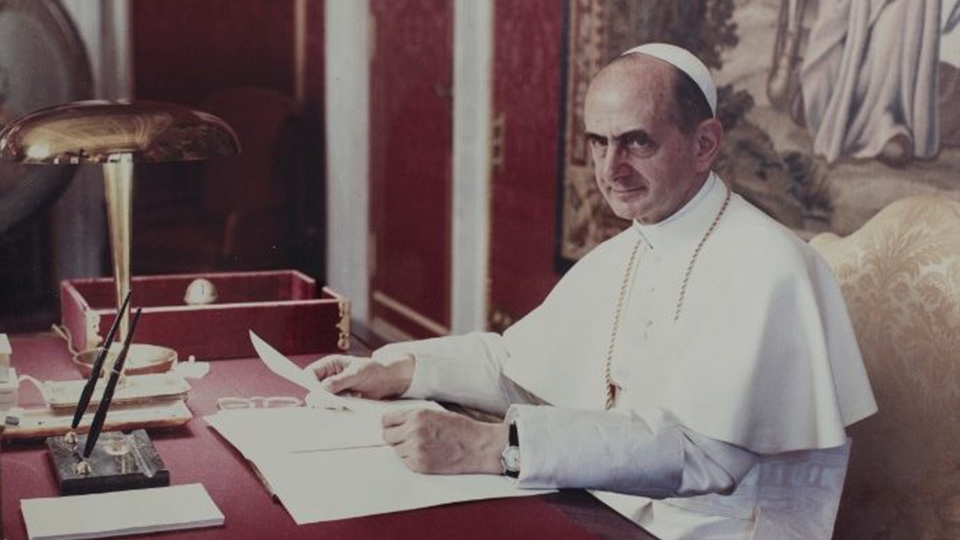

The renunciation of condemning errors in serious matters concerning the Christian faith and morals represents one of the most original features of the Second Vatican Council. However, the one who not only recommended but actually imposed this non-pastoral attitude was—undoubtedly—Pope Paul VI.
A Pastoral Council and a Non-Pastoral Attitude
The revealed Christian teaching has been met, since the time of our Savior Christ, with misunderstanding, resistance, and obstinate opposition. But just as a shepherd guarding his flock must use—for the purpose of correction and punishment—his staff, so too have the hierarchs of the Church, and foremost among them the popes, been compelled countless times to punish those deviations that endangered the salvation of souls. This is why all Councils have been not only pastoral but, first and foremost, dogmatic, professing the true faith and anathematizing heresies.
I had the occasion to witness “live,” while I was in the Apuseni Mountains of western Romania, how shepherds act when the sheep go astray. The head shepherd, upon seeing the deviation, shouted and immediately hurled his knotted staff in the direction of the sheep that were heading toward a dangerous pit. Startled and corrected by the shepherd’s forceful intervention, the sheep turned in the right direction. Without this timely intervention, disaster would have been inevitable.
When it comes to the intervention of Pope Paul VI regarding the transmission of life within Christian marital relations, firm action was lacking. For in the encyclical Humanae Vitae, published on July 25, 1968, the Supreme Pontiff shouted—and that was all. No concrete act of punishment or correction of the heretics was undertaken. This attitude reflected the ideas of a purely pastoral council, that is, one lacking a list of errors and anathemas directed against those who had gone astray. But precisely because of such an attitude, a contraceptive mentality is today so widespread among Catholic faithful. Unfortunately, they have been and continue to be supported by pseudo-theologians of liberal-progressive orientation, and even by some hierarchs who seem no longer to believe strongly in the Church’s traditional teaching. The degradation is now so advanced that it is difficult to foresee a way out of this unprecedented crisis.
It can rightly be said, as many specialists affirm, that the encyclical Humanae Vitae is one of the most controversial papal documents in history.
The Pontifical Commission and the Invisible Schism
In his book The Courage to Be Catholic: Crisis, Reform, and the Future of the Church (Basic Books, 2002), where he analyzes the deep causes of the drift among many Catholics in the modern world, George Weigel describes the specificity of the post-conciliar crisis, referring to the undermining of religious life from within the Christian ecclesia. If, in the past, heresies that attacked the faith ended up being placed outside the Church by way of anathema, today—as can be seen in the case of the encyclical Humanae Vitae—this pastoral way to act seems to belong to the past. What took place in the period preceding the publication of Paul VI’s encyclical is extraordinarily significant. Thus, although in his message the Pontiff proclaimed the intrinsically evil character of contraception, the actions necessary for disseminating this teaching and condemning the heretics were absent.
In his most well-known biography, Witness to Hope: The Biography of Pope John Paul II (HarperCollins, 1999), George Weigel describes, in the section “Humanae Vitae Controversy,” the process of drafting the two reports—the “majority report” and the “minority report.” As we will soon see, the results highlight the existence, even within the Church, of an “invisible schism.”[i] Specifically, this refers to the profound rupture between those who support the licitness of contraception and those who firmly reject it. Let’s look at the details.
The debate took place within the “Pontifical Commission for the Study of Problems of the Family, Population, and Birthrate,” established by Pope John XXIII and expanded by Pope Paul VI. In the end, the commission numbered more than seventy members. What is especially significant is how the hierarchs who were members of this pontifical body voted regarding contraception. There were sixteen of them: nine bishops and seven cardinals. Of these, only three (among them Cardinal Ottaviani and Bishop Colombo, the Pope’s theological advisor) voted for maintaining the Church’s traditional teaching. The rest, numbering thirteen, voted in favor of contraception, committing an error that Pope Paul VI firmly refuted in article 14 of his encyclical.
What exactly was the error present in the “majority report,” which recommended adopting contraception as an acceptable method of regulating births in Catholic morality?
Starting from the premise that conjugal morality should be evaluated in light of the entirety of family life, they considered that any contraceptive method was admissible, as long as the couple did not abandon their fulfilled desire to have children. In other words, if two spouses accept children when they deem it appropriate, they are allowed, at other times, to use condoms or the pill to regulate the frequency of births. This sophism is of extreme gravity, for what is being relativized is the intrinsic value of human actions, regardless of context. As Pope Paul VI made abundantly clear:
“it is never lawful, even for the gravest reasons, to do evil that good may come of it—in other words, to intend directly something which of its very nature contradicts the moral order, and which must therefore be judged unworthy of man, even though the intention is to protect or promote the welfare of an individual, of a family or of society in general. Consequently, it is a serious error to think that a whole married life of otherwise normal relations can justify sexual intercourse which is deliberately contraceptive and so intrinsically wrong.”[ii]
Despite the firmness with which Pope Paul VI—alongside Cardinal Ottaviani, Bishop Colombo, Archbishop Karol Wojtyła, and Jesuit theologian John Ford, S.J.—defended the Church’s orthodox teaching on the morality of conjugal life, the reactions both within and outside the Church were unexpectedly violent. It can rightly be said, as many specialists affirm, that the encyclical Humanae Vitae is one of the most controversial papal documents in history.
We need hierarchs and priests who insist continually not only on the importance of the family but also on the traditional way of life, in which the birth, upbringing, and formation of children’s consciences occupy a central place.
The Crisis of the Modern World and the Crisis of the Church
At that pivotal moment, it seemed that the entire world had united in rejecting the teaching transmitted by the Magisterium of the Church. The advances of science and technology have chained modern people into a secular, materialistic mentality, causing them to forget and reject the transcendent values of supernatural Revelation. Probably Pope Pius XII described the gravity of the situation of today’s world best, when he said in a radio message in 1946:
“Perhaps the greatest sin in the world today is that men have begun to lose the sense of sin.”
If we look around us today, more than half a century after the publication of the encyclical Humanae Vitae, we can see that in the Catholic mainstream environment, the negative reaction seems predominant. The contraceptive mentality—which also leads to the sin of abortion—has become widespread. The demographic collapse of formerly Catholic countries (including the Poland of John Paul II) speaks for itself. By using the mass media in a propagandistic manner—media which, although not intrinsically morally negative, has disastrous effects when misused by immoral or amoral people—all those who struggle to exclude the Church from society have managed to compromise its presence even in the heart of Christian families. Thus, we can encounter Catholics who, despite the Church’s teaching, do not hesitate to declare it outdated and freely use condoms; catechists who make the same choices; and even pastors who are embarrassed to openly and firmly affirm the gravity of the sin of contraception.
In light of these observations, we can return to the controversy surrounding the encyclical Humanae Vitae, now better understanding the context of the debate. If the majority of the members of the Pontifical Commission for the Study of Problems of the Family, Population, and Birthrate accepted contraception, this was undoubtedly due to a secular way of thinking that ignored the only valid context of Christian moral reflection: Holy Tradition. The disproportion between those who voted in favor of contraception (13) and those who voted against it (3) most likely indicates the disproportion between those who still believe in all revealed teachings and those “cafeteria Catholics” who only accept what happens to suit them. Pressured by the assault of forces hostile to the Gospel, many contemporary Catholic faithful think according to the majority’s preferences, in order to avoid open conflict with a radically de-Christianized world. The values of Holy Tradition have been abandoned in favor of highly questionable options. Thus, in matters of morality, the ascetical foundation of Christian teaching is ignored and relegated to memories of a backward past.
More than ever, in such an environment, we need hierarchs and priests who insist continually not only on the importance of the family but also on the traditional way of life, in which the birth, upbringing, and formation of children’s consciences occupy a central place. Moreover, there is great need for Christian mothers. All those women who, under such conditions, take up the heavy cross of motherhood and large families—along with their husbands—deserve our deepest respect. But not only that: they also deserve concrete support through the development of a Catholic business environment that encourages men, husbands with large families. Today, as we celebrate the great protector of the Holy Family and the Church, the carpenter Joseph, let us turn to him with complete trust, asking for his help so that we may have both access to the Mass of the Ages and to the Sacraments celebrated according to Holy Tradition, and also the means without which we cannot sustain authentic Catholic families and communities:
St. Joseph, pray for us!
Noble scion of David, pray for us!
Light of the Patriarchs, pray for us!
Spouse of the Mother of God, pray for us!
Chaste Guardian of the Virgin, pray for us!
Foster-father of the Son of God, pray for us!
Sedulous Defender of Christ, pray for us!
Head of the Holy Family, pray for us!
Joseph most just, pray for us!
Joseph most chaste, pray for us!
Joseph most prudent, pray for us!
Joseph most valiant, pray for us!
Joseph most obedient, pray for us!
Joseph most faithful, pray for us!
Mirror of patience, pray for us!
Lover of poverty, pray for us!
Model of all who labor, pray for us!
Glory of family life, pray for us!
Protector of virgins, pray for us!
Pillar of families, pray for us!
Consolation of the afflicted, pray for us!
Hope of the sick, pray for us!
Patron of the dying, pray for us!
Terror of the demons, pray for us!
Protector of Holy Church, pray for us!
[i] I wrote about this “invisible schism” in an article titled “George Weigel’s ‘Invisible Schism’ Becomes Visible” published in The Remnant: https://www.remnantnewspaper.com/fetzen-fliegen/item/7048-george-weigel-s-invisible-schism-becomes-visible [Accessed: 19 March 2025].
[ii] Humanae Vitae, art. 14: https://www.vatican.va/content/paul-vi/en/encyclicals/documents/hf_p-vi_enc_25071968_humanae-vitae.html [Accessed: 19 March 2025].
