
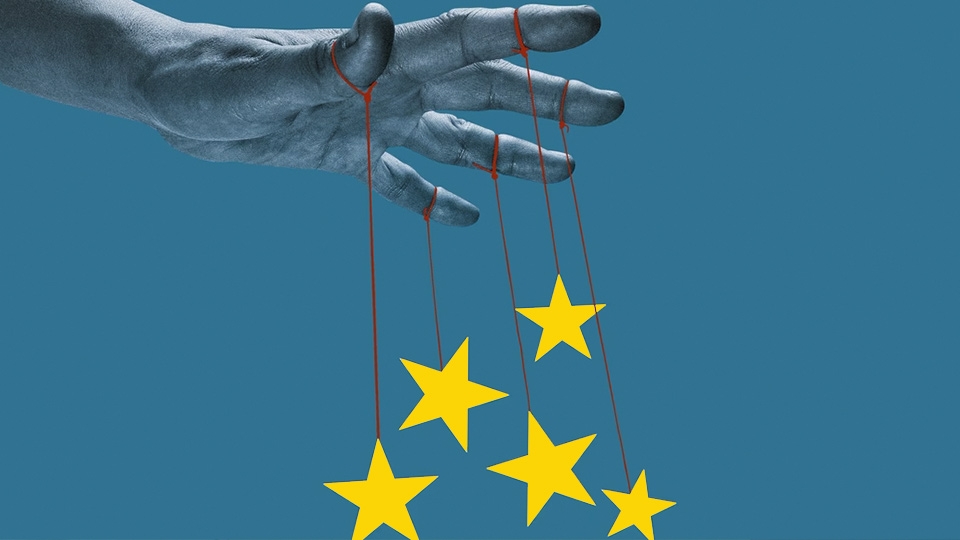

By now, we should have realized that the EU’s version of democracy is to sacrifice the will of its voters at the altar of its left-wing interests. Europeans are to be at the beck and call of the EU elites, including unelected EU queen Ursula von der Leyen, and dissent will not be tolerated in such an atmosphere.
It is already an established reality that the European brahmins in Brussels have been serving their war-mongering interests and globalist plans for a long time, at the expense of ordinary Europeans. Yet recent events have shown how shameless these elites are in flexing their undemocratic muscles to purportedly “save” their version of “democracy” on the continent.
Let’s start with the eastern part of the continent. On March 9, Romania’s Central Electoral Bureau (BEC) annulled the validity of Călin Georgescu’s candidacy for alleged reasons linked to the origin of his campaign finances. Dubious and unproven (as of the time of writing) allegations of Russian meddling in Georgescu’s campaign have been the raison d’etre for the BEC’s aforementioned decision.
Moreover, the European Court of Human Rights (ECHR) dismissed Georgescu’s appeal to overturn the Romanian Constitutional Court (CCR) decision to invalidate the December 2024 election,despite Georgescu emerging victorious in the first round.
According to an article on spiked:
“Ever since Georgescu unexpectedly came top in the first round of Romania’s presidential elections last year, the Romanian political establishment, with the tacit backing of the EU, has set about trying to overturn the result. November’s first-round election was a humiliation for the political mainstream – and not just because of the rapid rise of the ultra-nationalist Georgescu. Hot on his heels in second place was former TV journalist Elena Lasconi, another political outsider. These two anti-establishment figures beat the candidates of Romania’s centrist parties, the Social Democratic Party (PSD) and the center-right National Liberal Party (PNL), which have dominated Romanian politics since the fall of Nicolae Ceaușescu’s Soviet-backed dictatorship in 1989. When the results came in, the Romanian intelligence service immediately sprang into action and, within weeks, published a dossier purporting to show foreign attempts to sway the elections. Then, in December, the Romanian Supreme Court took the unprecedented steps of annulling the first-round results, cancelling the second round and then ordering a rerun of the presidential elections. Now Georgescu cannot even take part in the rerun. He has branded the ban a ‘direct blow to the heart of democracy worldwide’.”
Besides, as Titus Techera stated in The Critic:
“On December 4, in advance of the second round of elections, the Romanian deep state, the secret services, the institution most directly connected to the old Communist tyranny and least reformed in the democratic era, declared that Russian disinformation had potentially determined the presidential elections. Not the legislative elections on December 1, which had been won by the centrist parties (although rightwing parties won a third of seats), which were free from suspicion. Only the presidential elections. Then on December 6, the Romanian Supreme Court canceled the second round of elections and annulled the results of the first.
These unprecedented decisions were countersigned immediately by the US Secretary of State, Blinken, and by Ursula von der Leyen, along with the Polish and Italian Foreign Affairs ministers. Romanians had no idea what was going on, but clearly someone knew, since the reactions came very quickly and often on social media rather than in official communiques, in a guarded language that referred to disinformation and the problems of digital technology, but silently avoided the question of an abuse of power leading directly into a post-constitutional situation.”
By now, we should have realized that the EU’s version of democracy is to sacrifice the will of its voters at the altar of its left-wing interests. Europeans are to be at the beck and call of the EU elites, including unelected EU queen Ursula von der Leyen, and dissent will not be tolerated in such an atmosphere.
In another part of his article, Techera accurately described the situation in Romania and in Europe as a whole:
“The conspiracies against Trump created the “Russia disinformation” rhetoric now employed in Romania — with much less concern about providing any plausible evidence. In Europe, the major political devices that prepared for this are the “cordon sanitaire” and the demissionary government. For example, Emmanuel Macron called for legislative elections last year, promptly lost them, and nevertheless he governs, somehow, by some agreement, in defiance of the will of the people. This is not democracy, but obedience to something that substitutes for religion, the imperative of Progress — the right decision must be made and only elites can be trusted to make it.”
Up north, the EU has largely kept silent (albeit with tacit approval) regarding the audacity of Europhile Donald Tusk’s government in undermining the rule of law in majority-Catholic Poland. The Tusk coalition comprising anti-life liberals and LGBT+ ideologues has seized control of the prosecutor’s office and the public media , permitting those at the top to tap on these institutions to quash political opposition. No prizes for guessing how Brussels would react if members of the nationalist Confederation, such as Catholic Grzegorz Michał Braun, were to be in power instead.
On March 6, the Polish Sejm passed a new law that seeks to outlaw so-called hate speech (i.e. whatever that is considered by the liberal Tusk government to be “hate speech”). As per Ordo Iuris (a Polish Catholic legal organization and think tank), an implementation of this “hate-speech” law “could significantly limit freedom of speech in Poland and grant special privileges to arbitrarily selected social groups—similar to measures in some Western European countries, such as the United Kingdom”.
Notably, the move by the Polish Sejm is notwithstanding the fact that the Parliamentary Assembly of the Council of Europe (PACE) embraced a resolution urging European Union (EU) countries to protect the freedom of speech on social media platforms.
The PACE resolution called on EU governments to “adopt regulations requiring social media platforms to respect freedom of speech, introduce an obligation to justify decisions made by moderators, and create independent bodies to assess the moderation process”.
Evidently, the Tusk regime is choosing to kick the PACE resolution to the curb.
As Visiting Fellow at the Budapest-based Center for Fundamental Rights Sébastien Meuwissen testified:
“Since the arrival of the liberal government led by Donald Tusk, the foundations of what constitutes a properly functioning democracy—i.e., a country that respects the rule of law—have been undermined on several levels. I will focus on three main areas: the takeover of the public media by force, the persecution of political opponents, and finally the de facto destruction of the judiciary in order to place it in the hands of the government. With regard to the public media, an attack was orchestrated with the approval of the Sejm on 19 December 2023. The minister of culture, Colonel Bartłomiej Sienkiewicz, dismissed the chairmen of the boards of management of the public media: television (TVP S.A.), radio (Polskie Radio S.A.) and the Polish News Agency (PAP). He also dismissed the members of the board of management of each of these media in order to appoint new directors, in violation of the law. In April 2024, TVP was formally put into liquidation, although it continued to make programmes, broadcast, and even tried to expand. It seems that this decision was only to achieve political objectives and to rebuild it with ‘loyal’ people. All these changes were made without the approval of the National Media Council, the body that should have authorised them, and with the condemnation of the Constitutional Court, which declared them illegal. In essence, they have turned the public media into a propaganda channel for the Tusk government, and the most appalling thing was that it was done violently, with the use of police and private security.”
What has the response from the EU been in wake of all the actions by the Tusk government?
A deafening silence once again.
Moving West, we explore the situation in the increasingly Islamic country of Germany.
Although Germany is suffering from a faltering economy and reeling from the life-threatening consequences of unbridled migration, the country’s elites’ main focus is the nationalist Alternative für Deutschland (AfD) party.
A recent European Commission operation aimed at “supporting, preventing, and countering illegal hate speech, particularly online”, including “anti-Semitism, xenophobia, Islamophobia, hatred against LGBTIQ persons, and misogyny” (wait, where’s the part about Christophobia or anti-Christian persecution in this report?)
Clearing ignoring German voter sentiments on the ground (the AfD emerged second in the country’s elections in February this year), German liberal politicians, such as the left-wing Greens, are dogged in steamrolling a motion through the Bundestag (German federal parliament) to ban the AfD “as soon as possible”.
Going against German parliamentary rules, German politicians have also denied the AfD party the chance to obtain a deputy speaker’s post in the Bundestag. To add fuel to the fire, the German government under Friedrich Merz has planned to borrow hundreds of billions of euros (at the expense of taxpayers and by circumventing the Bundestag) to supposedly strengthen defence and infrastructure.
What has Brussels got to say in face of the kerfuffle in Germany? Crickets, as usual.
In contrast, Brussels knows when to put its foot down when things don’t go according to plan (i.e. only its plan).
In January this year, Thierry Breton, the European Union’s former internal market commissioner, admitted during an interview that it was the EU that coerced Romania’s CCR to annul the country’s presidential elections last year.
Breton had the nerve to indicate that Brussels’ meddling in Romania was desirable (if the outcome was not what the EU had envisioned).. The former EU’s “digital enforcer” stated at that time (before Germany’s recently concluded federal elections in February) that observers can expect the EU to interfere again if German voters chose the nationalist AfD party instead of the EU-backed mainstream parties.
“We have to prevent interference and make our laws apply. We did it in Romania, and we will obviously have to do it in Germany, if necessary,” Breton said.
Furthermore, a report by Mathias Corvinus Collegium (MCC) Brussels slammed the European Commission (the primary executive arm of the EU) for bankrolling left-leaning non-governmental organisations (NGOs) and think tanks (think billions of euros in funds) to champion its left-wing ideologies. Clearly, the EU has no qualms in using European taxpayers’ money to boost their own ideological agenda that may be at odds with reality (such as LGBT+ ideologies and the like).
“The Commission funds organizations that are economically dependent on its grants and that act as spokespersons for its agenda,” the MCC Brussels report declared.
Based on the executive summary of the MCC Brussels report:
“This ‘propaganda by proxy’ is fundamentally undemocratic. In effect, many EU citizens who are opposed to ‘more Europe’ as the answer to every problem are funding the promotion of greater federalism. More conservative voters and countries, particularly in Central and Eastern Europe, are facing EU- funded promotion of liberal-progressive values they do not share. Elected national governments are coming under attack from groups funded by Brussels. The report concludes that the EU’s use of NGOs as instruments of political advocacy reflects a broader trend of anti-democratic governance.”
Little wonder that Hungary (under the conservative government of Viktor Orbán and a country considered an “enfant terrible” by the leftist EU) has already demanded transparency with regard to all details about EU funding of NGOs in February this year.
However, given a recent European Commission operation aimed at “supporting, preventing, and countering illegal hate speech, particularly online”, including “anti-Semitism, xenophobia, Islamophobia, hatred against LGBTIQ persons, and misogyny” (wait, where’s the part about Christophobia or anti-Christian persecution in this report?), it is highly unlikely that Hungary’s demands for greater accountability by the EU will be met.
By now, we should have realized that the EU’s version of democracy is to sacrifice the will of its voters at the altar of its left-wing interests. Europeans are to be at the beck and call of the EU elites, including unelected EU queen Ursula von der Leyen, and dissent will not be tolerated in such an atmosphere.