
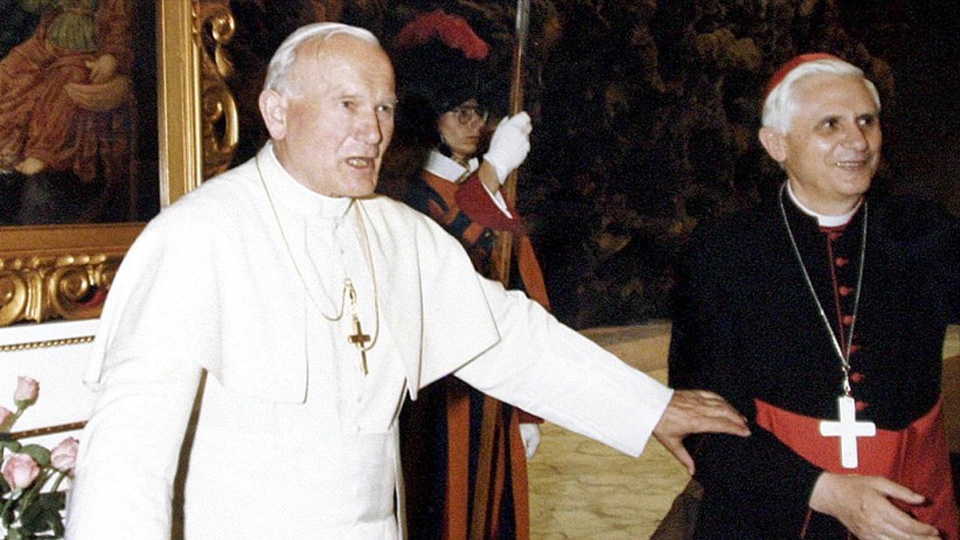

Dominus Iesus (The Lord Jesus) is an August 6, 2000 declaration by the Congregation for the Doctrine of the Faith, signed by Joseph Cardinal Ratzinger and approved by Pope John Paul II. It is known for its elaboration of the Catholic dogma that the Catholic Church is the sole true Church founded by Jesus Christ. From the time of its release Dominus Iesus has been called conservative by some and liberal by others. Here we take a closer look:
Intending to provide as broad a perspective as possible on the reactions to the Dominus Iesus declaration (2000), I had to acknowledge that a complete presentation was impossible. The number of articles published in hundreds, if not thousands, of journals worldwide far exceeds what a single person can comprehensively cover. Realizing the boldness of my endeavor, I sought an appropriate strategy to manage the vast amount of material. Without abandoning my intended goal, I extracted the essential ideas from the texts I reviewed—ideas that, practically speaking, are fairly consistent across most (neo-)Protestant responses. To illustrate these ideas, in this article I will summarize just three such reactions—enough to provide insight into the position of (neo)Protestant denominations.
André Birmelé and the Protestant Tower of Babel
The first article I will refer to is written by André Birmelé, a professor of systematic theology at the Protestant Faculty of Strasbourg. Entitled “Entre la tour de Babel et la Pentecôte,”[1] Birmelé’s text begins with a typically Reformed assertion: the Dominus Iesus declaration is unacceptable, representing a deviation by Ratzinger from the ecumenical doctrine affirmed at the Second Vatican Council. In other words, the one responsible for this declaration is its principal signatory, Joseph Cardinal Ratzinger, who allegedly abused his position as Prefect of the Congregation for the Doctrine of the Faith to the detriment of the much more open ecumenical views upheld by Cardinals Walter Kasper and Edward Idris Cassidy.
In an interview given to Frankfurter Allgemeine Zeitung (September 22, 2000) and translated into French under the title “La pluralité des confessions ne relativise pas l’exigence de la vérité” in L’Osservatore Romano,[2] Cardinal Ratzinger backtracked, attempting to defend himself by pointing out that both Cardinal Cassidy and (then) Monsignor Walter Kasper were members of the Congregation for the Doctrine of the Faith. Consequently, the Dominus Iesus declaration would represent the shared convictions of the three Catholic hierarchs, making any speculation about their supposed divergences unfounded. In fact, today, it is impossible to maintain that there are not exclusive disjunctions between certain theological positions of Joseph Ratzinger and Walter Kasper.
Returning to the content of Birmelé’s reaction, we must immediately note an aspect frequently found in most such interventions: paradoxically, many Protestant and neo-Protestant authors seem to be true supporters of the Second Vatican Council. Considering the Protestantization of Catholic theology and worship that took place in the context of this ecclesiastical event, such an attitude should not surprise us. However, I do not believe we can see anything positive in this, but rather a sign of the increasing alienation of the post-conciliar Catholic Church from its own identity.
Clearly, what bothers this apologist for confessional plurality is precisely the firmness of the Catholic Church, which, in Dominus Iesus, rejects the relativization of the unique Truth that defines Christian Revelation.
What is the fundamental issue with the Dominus Iesus declaration that prompted André Birmelé’s reaction? He correctly identified Joseph Ratzinger’s attempt to counteract progressive-liberal interpretations of the Second Vatican Council through a hermeneutic that seeks to take into account Catholic dogmatic identity and pre-conciliar Tradition. As seen in the famous interview with Vittorio Messori, Entretien sur la foi,[3] the head of the Congregation for the Doctrine of the Faith in 2000 was categorically opposed to any excessive liberal interpretations of the Second Vatican Council.
After an introduction targeting the doctrinal position of Cardinal Ratzinger, Birmelé addresses the stance of Reformed communities, mentioning the ecumenical activity undertaken at the level of these communities:
“On the side of the Churches of the Reformation, the situation seems simpler. Declarations of communion have multiplied in recent years among the Reformed, Lutheran, Anglican, and Methodist families. In Europe and the United States, we mutually recognize one another as full and authentic expressions of the one Church of Christ.”[4]
This “mutual recognition” among post-Reformation communities completely excludes the unity of faith. It does not imply any kind of dogmatic, sacramental, or liturgical agreement—dimensions that are almost entirely absent from these communities. This leads to Birmelé’s ultimate argument, which is absolutely relevant to the Protestant mentality. He asserts:
“The differences that remain between us are legitimate; they are part of our unity. The old divisions have been overcome, and our diverse languages proclaim the same message of salvation.”[5]
This type of declaration represents the core of the (neo-)Protestant position—one that is more postmodern than Christian—which seems to have no limits in its endorsement of dogmatic relativism. Clearly, what bothers this apologist for confessional plurality is precisely the firmness of the Catholic Church, which, in Dominus Iesus, rejects the relativization of the unique Truth that defines Christian Revelation. Equating Catholicism with the Tower of Babel—where theologians fail to reach a consensus due to the existence of dogmas that demand an unreachable doctrinal orthodoxy—Birmelé argues that only the Reformed communities live under the sign of the Pentecost of the Holy Spirit. Does this interpretation (and the reference to the “Springtime of the Holy Spirit”) sound familiar to you?
And yet, what is the explanation for the “resurgence of the Tower of Babel”? Once again, we encounter one of the most characteristic Protestant interpretations:
“Today, the resurgence of the Tower of Babel can no longer be explained solely by traditional theological questions. These are certainly real, but it is too easy to invoke them to conceal other issues, particularly power struggles.”[6]
Simple and effective! According to Lutheran-Calvinist interpretations—which I have even heard from the mouth of an (in)famous peritus at the Second Vatican Council, Gregory Baum (1923–2017)—Rome’s “imperialism” has, since ancient times, generated endless power struggles. But if André Birmelé is convinced that this is the reality of the Catholic Church, the only thing I fail to understand is why he would still be interested in any form of ecumenism.
There is no trace of any ecumenical spirit in his statement. On the contrary, he seems rather delighted to demonstrate his total disregard for the Catholic Church, which he clearly considers—just as Martin Luther did—to be the “Great Whore” of the Apocalypse.
Two Official Declarations
After first presenting the position of a Protestant author, it is now time to analyze two texts from representatives of official Reformed institutions. First, we have the declaration of Alvin L. Barry (1931–2001), the 10th president of the Lutheran Church–Missouri Synod (LCMS).[7]
After expressing his surprise at such a declaration being issued in the current ecumenical climate, Barry nonetheless shows a certain degree of understanding: “Rome is merely restating its historic position.” He then, in a sort of competition with the Catholic Church, assumes the Nicene-Constantinopolitan Creed interpreted similarly to the schismatic autocephalous Eastern Churches, which exclude any reference to papal primacy:
“The Christian Church on earth is one, holy, universal, and apostolic, not because it is the Roman Church or has a pope, but because it is Christ’s church. The church is the assembly of all believers in which the gospel is taught purely and the sacraments are administered rightly. God the Holy Spirit calls, gathers, enlightens, and sanctifies the whole Christian Church on earth and keeps it with Jesus in the one true faith. In this Christian Church, He daily and richly forgives our sins of all believers.”
The final part of the official text issued by the Missouri Synod Lutheran representative, radically anti-Catholic both in its tone and content, leaves no room for ecumenical dialogue or possible nuances:
“The Bishop of Rome is not the head of all Christendom by divine right on the basis of God’s Word. The Church cannot be better ruled and preserved than by living together under one head, Jesus Christ, united in teaching, faith, sacraments, prayers, and works of love.
We Lutherans continue to reject these claims of the Roman Catholic Church and the Bishop of Rome as contrary to Sacred Scripture. With many other Christian churches, we express our deep regret and profound disagreement with this statement by the Vatican.”
What can be appreciated in the text signed by the Missouri Synod Lutheran representative is its honesty: he makes no effort to disguise his deep disagreement with Catholic faith and Tradition. There is no trace of any ecumenical spirit in his statement. On the contrary, he seems rather delighted to demonstrate his total disregard for the Catholic Church, which he clearly considers—just as Martin Luther did—to be the “Great Whore” of the Apocalypse.
The final declaration I will present is that of one of the world’s Protestant leaders, Dr. Setri Nyomi,[8] the General Secretary of the World Alliance of Reformed Churches (based in Geneva). In a letter addressed to Cardinal Edward Idris Cassidy, who was then the head of the Pontifical Council for Promoting Christian Unity, Dr. Nyomi—using a diplomatic tone—expresses his disappointment with Dominus Iesus. What are the reasons for this disappointment?
“(The declaration is) made without ecumenical sensitivity (and) seems to go against the spirit of Vatican II and the progress made in relationships and dialogues since then.”
As with André Birmelé, Nyomi believes that the declaration deviates from the Catholic ecumenical positions expressed in the decree Unitatis Redintegratio, issued at the Second Vatican Council in 1964, reverting to tones characteristic of pre-conciliar declarations. Without adopting a radical tone, Nyomi states that in future bilateral meetings between Reformed and Catholic representatives:
“We will be putting on the table for discussion the question we have regarding how the Roman Catholic Church views the Reformed family, and its implications for our continued dialogue.”
The relative moderation in Dr. Setri Nyomi’s tone indicates that we are in the realm of ecclesiastical diplomacy, where stridencies are avoided. I could continue for dozens of pages summarizing the (neo)Protestant responses to the Dominus Iesus declaration. However, as I stated at the beginning of my article, I have limited myself to presenting only the three texts above, chosen for their representativeness. I will now summarize the common themes found in all such documents, using substantial insights provided by Joseph Cardinal Ratzinger[9] to formulate an appropriate Catholic response to each criticism.
The criticism made by Joseph Cardinal Ratzinger of such a position is certainly valid: “If they are all ‘Church’ in their own way, then this Church is a set of contradictions and is not in a position to offer clear guidance to men.”
The Catholic Answer
All Reformed positions accuse a discontinuity between the Second Vatican Council (the Unitatis Redintegratio declaration) and Dominus Iesus. It is also critically mentioned the attempt to restore continuity with the teachings of the Catholic Church before the Second Vatican Council. This is correct, although many nuances must be added: the famous “hermeneutic of continuity” proposed by Pope Benedict XVI proved to be illusory. For it is impossible to establish continuity between the firm condemnation of religious pluralism and the indifferentism generated by ecumenism, and the post-conciliar ecumenical movement. What continuity can there be between Pius XI’s prohibition regarding the participation of Catholics in any kind of ecumenical actions and associations, and the attitude of the hierarchy after the Second Vatican Council?
In the interview given to Vittorio Messori, Joseph Ratzinger affirms that nothing new was declared at the Second Vatican Council in relation to previous teachings:
“I want to say furthermore that Vatican II certainly did not intend to ‘change’ the faith, but to present it anew in an effective way.”[10]
Unfortunately, especially when it comes to ecumenism, continuity cannot be demonstrated. On the contrary, the Catholic hierarchy’s attitude towards ecumenism has radically changed. “Cosmetic” interpretations cannot conceal the rupture between the two attitudes. It is precisely this discontinuity that is revealed by (neo)Protestant reactions.
On the other hand, the core issue of Protestant criticisms is inextricably linked to the plurality of these communities and the contradictions between them. In order to overcome this problem, thinkers like André Birmelé–whose “master” is one of Ratzinger’s most vehement critics, Eberhard Jüngel (1934–2021), a professor at the University of Tübingen–consider the plurality of post-Reformation Christian confessions to be natural. Despite the significant contradictions that often characterize them, they claim to be in de facto harmony. All these communities would be part–despite the disjunctions and notable differences–of the “one, holy, catholic, and apostolic” Church. This hypothesis is absolutely erroneous. In this sense, the criticism made by Joseph Cardinal Ratzinger of such a position is certainly valid:
“If they are all ‘Church’ in their own way, then this Church is a set of contradictions and is not in a position to offer clear guidance to men.”[11]
Confessional unity, despite the existence of so many different communities full of contradictions, is an illusory appearance. For it is impossible to conceive that the Savior Christ can contradict Himself, legitimizing in one way or another a multitude of communities that, time and again, negate each other using arguments drawn from the same Gospels. This fact represents–as Ratzinger shows–a “coronation of subjectivism:”
“Each person should then create their own Christianity and, in the end, personal taste would be the determining factor.”[12]
At the same time, another liberal-progressive interpretation must be rejected—one that claims ecclesial plurality could be justified through Trinitarian theology: the existence of the Three Subsistent Persons in one Divine Being would, by analogy, be reflected in the existence of multiple ecclesial communities in which a single Church subsists. This idea is theologically inconsistent, as nothing justifies such a transfer of the Trinitarian mystery onto communities guilty of the sins of heresy and schism.
Finally, the point that has sparked the most intense reactions from post-Reformation communities is the one in which the Dominus Iesus declaration strongly emphasizes that full ecclesiality belongs only to the Catholic Church, whereas (neo-)Protestant communities cannot be considered “Churches in the proper sense.” Due to their significance, I will quote the relevant articles:
“Therefore, there exists a single Church of Christ, which subsists in the Catholic Church, governed by the Successor of Peter and by the Bishops in communion with him. The Churches which, while not existing in perfect communion with the Catholic Church, remain united to her by means of the closest bonds, that is, by apostolic succession and a valid Eucharist, are true particular Churches. Therefore, the Church of Christ is present and operative also in these Churches, even though they lack full communion with the Catholic Church, since they do not accept the Catholic doctrine of the Primacy, which, according to the will of God, the Bishop of Rome objectively has and exercises over the entire Church.
On the other hand, the ecclesial communities which have not preserved the valid Episcopate and the genuine and integral substance of the Eucharistic mystery, are not Churches in the proper sense; however, those who are baptized in these communities are, by Baptism, incorporated in Christ and thus are in a certain communion, albeit imperfect, with the Church.”[13]
As can be seen, here we find the famous post-conciliar innovations (i.e., subtleties), such as the highly controversial formula subsistit in. Leaving the discussion of this issue for future articles, I will simply note the generosity with which the Eastern schismatic churches are treated compared to the much stricter way in which the communities that emerged from the Protestant Reformation are presented.
In any case, it is surprising that these communities seek recognition from Rome of their own ecclesial status. Considering that their ecclesiological definitions do not accept the identity between the Church founded by our Lord, Jesus Christ, and the Catholic Church, it seems at least strange that their representatives ask the Catholic Magisterium to recognize their communities as “full” Churches. But how could such a thing be possible when the defining elements of the Church—apostolic succession, papal primacy and infallibility, the apostolic college, the Episcopal hierarchy, the Holy Sacraments, the Orthodox Creed etc.—are rejected by such communities? My question is, of course, rhetorical. And as for the members of the Eastern “Orthodox” Churches, as we will see in the next article, they reacted just as vehemently despite being treated much more positively in the Dominus Iesus declaration.
[1] André Birmelé, “Entre tour de Babel et la Pentecôte,” in Le Messager Évangélique (Strasbourg), N° 4, 21 January 2001, pp. 4-5.
[2] L’Osservatore Romano. Edition hebdomadaire en langue française, N° 43 (2645), 24 October 2000, p. 10.
[3] See the chapter entitled “A Council to be rediscovered” (pp. 27-48), in Joseph, Cardinal Ratzinger and Vittorio Messori, Entretien sur la foi, Paris, Fayard, 1985.
[4] Here is the original text: “Du côté des Églises de la Réforme, les données semblent plus simples. Les déclarations de communion se sont multipliées durant ces dernières années entre les familles réformées, luthériennes, anglicanes et méthodistes. En Europe et aux États-Unis, nous nous reconnaissons mutuellement comme des expressions pleines et authentiques de l’unique Église du Christ.” Cf. André Birmelé, op. cit., p. 5.
[5] “Les différences qui demeurent entre nous (les protestants – ma note) sont légitimes, elles font partie de notre unité. Les anciennes divisions sont dépassées, nos divers langages annoncent le même message du salut.” Cf. André Birmelé, ibidem.
[6] “On ne peut plus aujourd’hui expliquer les résurgences de la tour de Babel par les seules questions théologiques traditionnelles. Celles-ci sont certes réelles, mais il est trop facile de faire appel à elles pour masquer d’autres enjeux et en particulier des conflits de pouvoir.” Cf. André Birmelé, ibidem.
[7] “Barry offers Lutheran response to Declaration Dominus Iesus,” in LCMS News, N° 46, September 18, 2000.
[8] In “Dominus Iesus a ‘Public Relations Disaster’ for Ecumenism Say Critics,” by Edmund Doogue and Stephen Brown, in Christianity Today, September 13, 2000, pp. 3-6: https://www.christianitytoday.com/2000/09/dominus-iesus-public-relations-disaster-for-ecumenism-say-c/ [Accessed: 14 February 2025]. All quotes are taken from here.
[9] The extensive response given by Joseph Cardinal Ratzinger to Christian Geyer of the Frankfurter Allgemeine Zeitung in an interview published on September 22, 2000, titled (in French translation) “La pluralité des confessions ne relativise pas l’exigence de la vérité,” will guide us further. I will quote the French version of the interview, translated in L’Osservatore Romano, Edition hebdomadaire en langue française, N° 42 (2644) from October 17, 2000, p. 10 and no. 44 (2646) from October 31, 2000, p. 7.
[10] Joseph, Cardinal Ratzinger et Vittorio Messori, Entretien sur la foi, ed.cit., p. 38: “Je veux dire en outre que Vatican II n’entendait certes pas ‘changer’ la foi, mais la présenter à nouveau de façon efficace.”
[11] Joseph Ratzinger, “La pluralité des confessions ne relativise pas l’exigence de la vérité,” in L’Osservatore Romano. Edition hebdomadaire en langue française”, N° 42 (2644), 17 octombrie 2000, p.10: “Si elles sont toutes ‘Eglise’ â leur façon, alors cette Église est un ensemble de contradictions et n’est pas en mesure d’offrir aux hommes des orientations claires.”
[12] Joseph Ratzinger, ibidem: “Chacun devrait alors se composer son propre christianisme et, à la fin, le goût personnel résulterait déterminant.”
[13] “Declaration ‘Dominus Iesus’ on the Unicity and Salvific Universality of Jesus Christ and the Church,” 6 August 2000: https://www.vatican.va/roman_curia/congregations/cfaith/documents/rc_con_cfaith_doc_20000806_dominus-iesus_en.html [Accessed: 14 February 2025].
